
Eid Al-Adha Spiced Yogurt Goat Leg Marinade
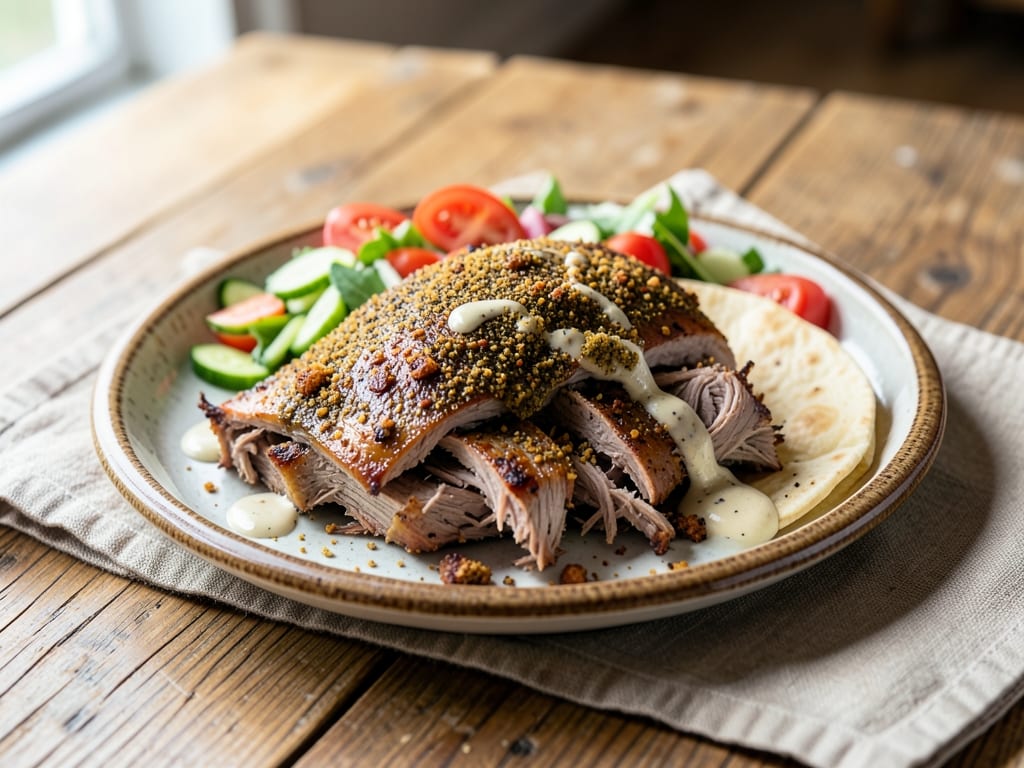
A fragrant, deeply spiced yogurt marinade that honors Eid Al-Adha traditions. Full-fat yogurt combined with warm spices—cumin, coriander, and cardamom—creates a complex base that tenderizes the meat while building layers of flavor. Lemon juice and olive oil round out the marinade, ready to transform a whole goat leg into a magnificent centerpiece for celebration.
- Prep
- 20 min
- Cook
- 2 hr 45 min
- Wait
- 19 hr
- Total
- 22 hr 5 min
- Makes
- Marinade for 1 goat leg (4.5–5.5 lb / 2–2.5 kg)
Steps
Before you start
- Ensure your goat leg is fully thawed if frozen; it should be cold but not rock-hard when you marinate it
- Plan your timeline: this recipe requires 16–24 hours of marinating before roasting, so start the day before you plan to serve
- Have a large roasting pan with at least 2-inch sides and a reliable meat thermometer ready for the roasting phase
- If your oven has hot and cold spots, identify them beforehand so you can position the leg appropriately
Combine yogurt and dry spices
- In a large bowl, whisk together the 2 cups yogurt, 2 tbsp cumin, 2 tbsp coriander, 1 tbsp cardamom, 1 tsp paprika, 1 tsp black pepper, and ½ tsp cinnamon.
- Whisk until the mixture is smooth and the spices are fully incorporated, with no lumps or streaks of yogurt.
- The spices should be evenly distributed throughout, creating a fragrant, pale-tan paste.
+ Show details− Hide details
Ready when: Spices are fully dissolved into the yogurt; no lumps visible
Tip: Use full-fat yogurt only; low-fat or nonfat yogurt is too watery and won't cling to the meat or penetrate as deeply.
Add aromatics, oil, and acid
- Add the 8 minced garlic cloves, 3 tbsp olive oil, 2 tbsp fresh lemon juice, and 1 tbsp salt to the yogurt mixture.
- Stir well with a spoon or whisk until everything is thoroughly combined and no streaks of oil or yogurt remain.
- Taste the marinade directly (raw garlic will taste sharp, which is correct).
- If it seems underseasoned, add ½ tsp more salt.
- The marinade should taste quite assertive and flavorful; some of this intensity will mellow as it sits on the meat.
+ Show details− Hide details
Ready when: Mixture is uniform in color and consistency; oil is emulsified throughout, not pooling on top
Tip: Don't be timid with salt at this stage. The yogurt and meat will absorb considerable seasoning, and some flavor is lost during roasting.
Score the goat leg
- Pat the 5-lb goat leg thoroughly dry with paper towels.
- Using a sharp 8-inch knife, score the skin and surface fat in a crosshatch or diamond pattern, making cuts that are ¼ inch deep and spaced roughly 2 inches apart.
- Work from one end of the leg to the other, making sure to cover all surfaces evenly.
- Do not cut so deep that you break into the muscle.
- Scoring creates channels for the marinade to penetrate into the meat and helps develop a flavorful, rendered crust during roasting.
+ Show details− Hide details
Ready when: Surface is evenly crisscrossed with shallow parallel or diamond-shaped grooves
Tip: A sharp knife is essential. A dull blade will slip and may cut your hand. Work with confident, swift strokes, letting the knife do the work.
Apply marinade and refrigerate
- Place the scored goat leg in a large roasting pan or a sturdy 2-gallon zip-top bag laid flat in a rimmed baking sheet.
- Spoon and rub the entire marinade over the leg, working it into every score and crevice.
- Make sure all surfaces, including the undersides, are thoroughly coated.
- If using a bag, press out excess air, seal, and turn the bag over several times to coat all sides.
- Cover the roasting pan tightly with plastic wrap, or seal the bag.
- Refrigerate for at least 12 hours, but preferably 16–24 hours.
- The longer the marinade sits, the more tender the meat becomes and the deeper the flavors penetrate.
+ Show details− Hide details
Tip: If using a bag, flip it every 4–6 hours during the first day if possible, to ensure even marinating. After 12 hours, the meat will be well-marinated even if not flipped again.
Bring to room temperature
- Remove the marinated goat leg from the refrigerator 45 minutes to 1 hour before you plan to roast it.
- Leave it uncovered on the counter (or in the roasting pan).
- As it warms, the meat will relax, allowing heat to penetrate more evenly during cooking.
- This step is especially important for a thick cut like a whole leg.
+ Show details− Hide details
Ready when: Meat is no longer cold to the touch; the marinade on the surface is no longer chilled
Tip: Don't skip this step. A cold roast will have an overdone exterior before the interior reaches the target temperature.
Sear at high temperatureOven 425°F / 220°C
- Preheat your oven to 425°F (220°C).
- Pat the surface of the goat leg dry with paper towels (this ensures better browning).
- Place it in a large roasting pan, skin-side up if there is skin, and insert a meat thermometer into the thickest part of the thigh, not touching bone.
- Roast at 425°F for the first 15 minutes to develop a flavorful, browned crust.
- The exterior should darken significantly.
+ Show details− Hide details
Ready when: Exterior is deeply browned; fat begins to bubble and render; a savory aroma fills the kitchen
Tip: A meat thermometer should go into the thickest muscle away from bone. This is your guide for doneness, so place it correctly.
Roast until tenderOven 325°F / 165°C
- Reduce the oven temperature to 325°F (163°C).
- Continue roasting the leg for approximately 2.5–3 hours, until the internal temperature reaches 160°F (71°C) for medium or 165°F (74°C) for well-done.
- Plan for roughly 18–20 minutes of roasting time per pound at this lower temperature.
- Every 30 minutes, open the oven and use a spoon to baste the leg with the pan juices that have accumulated.
- If the skin or exterior is browning too quickly, loosely tent it with foil (this is normal for lower-heat roasting).
- The leg is fully cooked when the thermometer reads your target temperature, the meat is fork-tender, the skin is golden and crackling, and juices run clear when pierced.
+ Show details− Hide details
Ready when: Meat thermometer inserted into thickest thigh reads 160–165°F; meat is fork-tender; skin is golden and crackling; juices run clear when pierced
Tip: Basting every 30 minutes is the secret to moist, well-browned meat. Don't skip these intervals, and don't open the oven door more often than necessary, as it drops the temperature and extends cooking time.
Rest before carving
- Remove the roasted leg from the oven and transfer it to a clean cutting board or serving platter.
- Tent it loosely with foil and let it rest for 15 minutes.
- During this time, the residual heat continues to cook the interior slightly, and the meat's muscle fibers relax, reabsorbing the juices.
- This ensures every slice is tender and juicy, not dry.
+ Show details− Hide details
Tip: Resist the urge to cut into the leg immediately after removing it from the oven. The 15-minute rest is non-negotiable for the best texture and juiciness.
Good to know
Tips
- Full-fat yogurt is non-negotiable for this marinade. Low-fat or nonfat yogurt is too thin and won't adhere to the meat or tenderize it effectively. The fat in the yogurt also carries flavor.
- If you can source whole green cardamom pods, crack them slightly with the flat of your knife, discard the pods, and grind the seeds fresh using a spice grinder or mortar and pestle. The aroma and flavor are dramatically superior to pre-ground cardamom.
- The pan drippings make an excellent sauce or gravy. After the leg is rested and removed, skim excess fat from the pan, place it on the stovetop over medium heat, deglaze with ½ cup water or stock, scraping up browned bits, and simmer for 2–3 minutes. Strain and season with salt and pepper to taste.
- This same marinade works beautifully with goat chops, lamb shoulder, or even chicken thighs. Adjust the marinating time (chicken: 4–8 hours maximum) and roasting time accordingly (chicken thighs: 45–60 minutes at 400°F / 200°C until internal temperature reaches 165°F).
Make ahead
The marinade itself can be prepared up to 2 days in advance and stored, covered, in the refrigerator. The goat leg can marinate for up to 24 hours—beyond that, the acids can begin to break down the surface texture, making it mushy. For a celebration, marinate the leg overnight (about 16 hours) for optimal balance between tenderness and texture.
Storage & reheating
Leftover roasted goat leg keeps, refrigerated in an airtight container, for up to 4 days. Store it in its pan drippings or a small amount of additional broth to maintain moisture. Reheat gently in a 325°F (163°C) oven, covered with foil, for 20–30 minutes until warmed through, or slice and reheat gently in a pan over medium-low heat with a splash of broth. The goat leg freezes beautifully for up to 3 months; thaw overnight in the refrigerator and reheat as above. Reheating is best done slowly to avoid drying out the meat.
Substitutions
- plain yogurt, full-fat (such as Greek or whole-milk yogurt) → Greek yogurt, thinned with 2–3 tbsp water to match the consistency of regular yogurt. Greek yogurt is much thicker; thinning it ensures the marinade coats the meat evenly and penetrates as intended.
- coriander, ground → Ground fennel (same amount). Fennel provides a bright, slightly licorice-like note instead of coriander's citrus. The marinade will shift toward a more anise-forward flavor, which is still authentic to some regional Middle Eastern styles.
- cardamom, ground → ½ tbsp ground cloves mixed with ½ tbsp ground allspice. This combination delivers similar warmth and spice complexity, though the result is less delicate and floral. It's a good substitute if cardamom is unavailable.
- goat leg, bone-in → Lamb leg (8–10 lb bone-in); increase all marinade ingredients by 50% and roast 3.5–4 hours at 325°F. Lamb is fattier and significantly larger than goat; adjust quantities accordingly. The flavor is richer, and cooking time is considerably longer, but this marinade is equally delicious with lamb and is traditional for Eid Al-Adha celebrations.
More roasts
See all →

Find more like this
- Meal
- Dinner
- Cuisine
- Middle Eastern
- Method
- Oven
- Quick & Easy
- EasyMake Ahead
- Occasion
- Eid