Black Friday Spicy Gochujang Pork Belly Marinade
A boldly spiced Korean-style marinade loaded with gochujang and gochugaru that seasons and tenderizes pork belly for low-and-slow braising. The combination of spicy fermented paste, fresh ginger, garlic, and sesame oil creates a complex, slightly sweet-spicy glaze that darkens and clings beautifully to the meat as it cooks. The result is fall-apart-tender belly with crispy, crackling skin and a luxurious, concentrated sauce.
- Prep
- 15 min
- Cook
- 3 hr 40 min
- Wait
- 2 hr 10 min
- Total
- 6 hr 5 min
- Makes
- 1 pork belly braise (4 servings)
Steps
Before you start
- Have a 5–6 quart heavy-bottomed Dutch oven with a tight-fitting lid ready
- Preheat your oven to 325°F (163°C) just before searing the pork
- Plan ahead: overnight marinating (8+ hours) yields dramatically better flavor and tenderness than the 2-hour minimum
Combine marinade ingredients
- In a small bowl, whisk together gochujang (4 tbsp / 60g), gochugaru (2 tbsp / 15g), soy sauce (1/4 cup / 60ml), minced ginger (3 tbsp / 30g), minced garlic (8 cloves / 25g), sugar (2 tbsp / 25g), rice vinegar (3 tbsp / 45ml), and toasted sesame oil (2 tbsp / 30ml) until the mixture is smooth and well combined.
- Slowly add pork or beef broth (1 cup / 240ml) while stirring, mixing until thoroughly combined and slightly thickened.
- The finished marinade should be pourable but thick enough to coat a spoon.
+ Show details− Hide details
Ready when: Marinade is smooth, well combined, and slightly thickened
Tip: Mix the paste ingredients thoroughly before adding broth to avoid lumps; if your gochujang is very thick, warm the broth slightly to help it blend smoothly
Prepare pork belly
- Remove pork belly from the refrigerator and pat the skin completely and thoroughly dry with paper towels—this step is crucial for crisping later.
- Using a sharp knife, score the skin in an even crosshatch pattern with cuts about 1/2 inch (1 cm) apart and 1/4 inch (6 mm) deep.
- Cut only through the skin and fat layer without cutting into the meat beneath.
- Generously season all sides with kosher salt (1 tsp / 5g) and freshly ground black pepper (1/2 tsp / 1g).
+ Show details− Hide details
Ready when: Skin is completely dry and evenly scored; meat is seasoned on all sides
Tip: Dry skin is absolutely essential—wet skin will steam rather than crisp. Take your time scoring to create a uniform pattern; even scoring helps the skin render and crisp more evenly
Marinate pork belly
- Place the prepared pork belly in a large bowl, resealable bag, or Dutch oven.
- Pour the prepared marinade over the pork, turning to ensure all sides, especially the meat side, are well coated with the spicy paste.
- Cover the bowl or seal the bag and refrigerate for a minimum of 2 hours.
- However, 8 hours or overnight (up to 24 hours) is strongly recommended for deeper flavor penetration and more tender results.
+ Show details− Hide details
Ready when: Pork is completely submerged and coated in marinade
Tip: Overnight or 8-hour marinating yields vastly better flavor and more tender meat than the 2-hour minimum; plan ahead if possible for the most delicious results
Sear pork belly until crispyOven 325°F / 165°C
- Preheat your oven to 325°F (163°C, gas mark 3).
- Remove the pork belly from the marinade, reserving all the liquid in a separate bowl or measuring cup.
- Heat a 5–6 quart heavy-bottomed Dutch oven (or large braising pot) over medium-high heat for 2 minutes until very hot.
- Carefully place the pork belly skin-side down in the hot pot—no oil is needed as the pork's own fat will render.
- Sear undisturbed for 5–7 minutes until the skin is deep golden brown and crispy at the edges (you should hear a gentle sizzle).
- Flip the pork and sear the meat sides for 3–4 minutes total until browned.
- The pork should sound crispy when you tap it with a spoon.
+ Show details− Hide details
Ready when: Skin is deep golden brown and crispy; meat sides are well browned
Tip: Don't move the pork while searing the skin—let it sit undisturbed so the skin makes good contact with the hot surface for even browning and maximum crispness
Add braising liquidOven 325°F / 165°C
- Pour the reserved marinade and 1 cup (240ml) of fresh water into the pot around (not directly on) the pork.
- The liquid should come about halfway up the sides of the pork—add a bit more water if needed to reach that level.
- Bring to a gentle simmer over medium heat on the stovetop (about 2–3 minutes), then cover the pot with its lid.
- Transfer the covered pot to the preheated 325°F (163°C) oven.
- The braising liquid should shimmer gently, not boil hard; if it starts to boil vigorously once in the oven, reduce the temperature to 300°F (150°C).
+ Show details− Hide details
Ready when: Braising liquid reaches a gentle simmer before the pot enters the oven
Tip: Room-temperature water is easier to manage than hot; gentle braising is key to even, tender results—avoid hard boiling, which toughens meat and causes uneven cooking
Braise pork until very tenderOven 325°F / 165°C
- Braise covered at 325°F (163°C, gas mark 3) for 2.5 to 3 hours.
- At the 1.5-hour mark, remove the pot from the oven, open the lid carefully (watch for steam), rotate the pork so a different side faces down, and return to the oven.
- At 2 hours, check that braising liquid is still visible at the bottom of the pot; if nearly evaporated, add another 1/2 cup (120ml) of water.
- The pork is done when a fork inserted into the meat meets almost no resistance and the meat is very soft, tender, and nearly falling apart.
- The skin may soften and wrinkle, which is normal.
- An internal temperature of 160°F (71°C) is safe, though the meat's tenderness is the better indicator.
+ Show details− Hide details
Ready when: Fork pierces meat with almost no resistance; meat is very soft and tender
Tip: Keep heat constant and gentle—if the braising liquid boils hard, lower the oven to 300°F (150°C); steady, gentle simmering yields the most evenly cooked and tender results
Rest cooked pork belly
- Carefully remove the pot from the oven using oven mitts.
- Transfer the cooked pork belly to a cutting board using tongs or a slotted spoon, being gentle as the meat is very tender and may fall apart easily.
- Let the pork rest, uncovered, for 5 minutes.
- This brief resting period allows juices to redistribute throughout the meat, ensuring each slice is moist and tender.
+ Show details− Hide details
Ready when: Pork has rested and is ready for slicing
Tip: Even a short 5-minute rest makes a noticeable difference in juiciness and texture; resist the urge to slice immediately
Reduce and finish sauce
- While the pork rests, carefully tilt the pot and skim the excess fat from the surface of the braising liquid using a spoon or fat separator.
- Leave about 1–2 tablespoons of fat in the sauce for richness and flavor.
- Return the pot to the stovetop over medium-high heat and bring to a simmer.
- Cook uncovered for 10–15 minutes, stirring occasionally, until the sauce thickens slightly and coats the back of a spoon in a thin glaze.
- The liquid should darken slightly and smell deeply concentrated and fragrant.
- Taste and adjust salt or add extra heat (additional gochugaru or sriracha) if desired.
+ Show details− Hide details
Ready when: Sauce thickens and coats the back of a spoon; flavor is concentrated and rich
Tip: Reducing the sauce is not optional—it concentrates the spicy, savory, slightly sweet flavors into a luxurious glaze that clings beautifully to each bite
Slice and serve
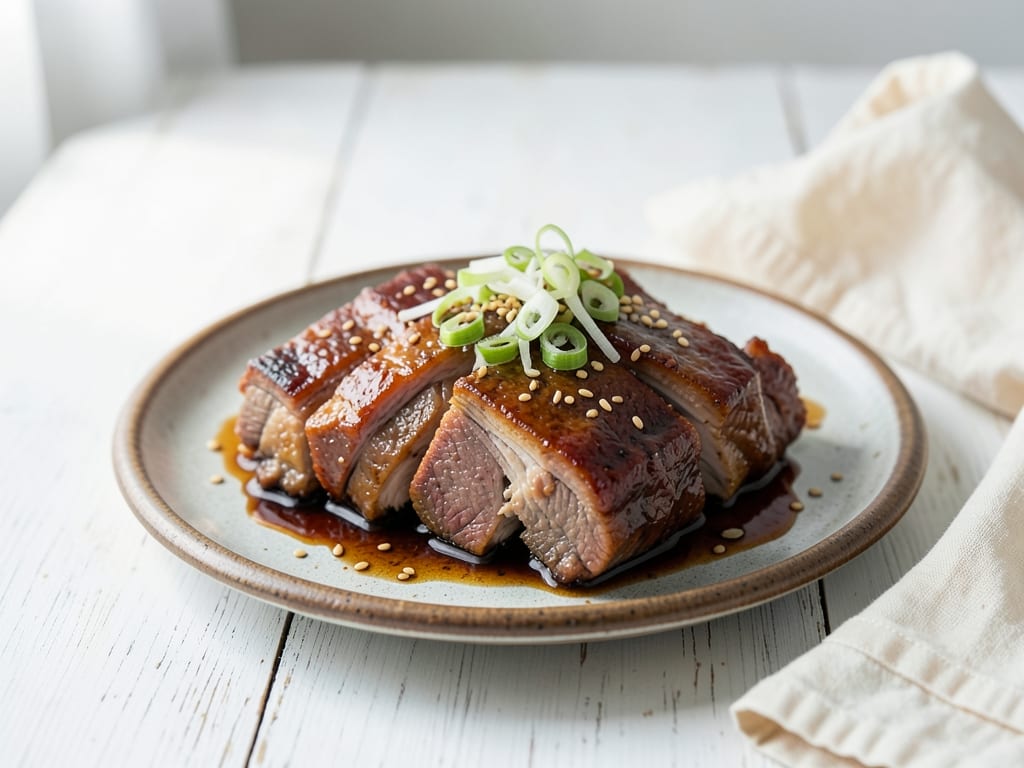
- Slice the rested pork belly into 1/2-inch (1 cm) thick slices, cutting perpendicular to the grain.
- A sharp knife and clean, deliberate cuts yield the neatest slices.
- Arrange the slices on a serving platter, individual plates, or over steamed rice.
- Spoon the reduced sauce generously over and around the slices.
- Garnish with sliced scallions (3–4 stalks / 30–40g) and a sprinkle of sesame seeds (1 tbsp / 10g) if desired.
- Serve immediately with steamed rice, steamed vegetables, or noodles on the side.
+ Show details− Hide details
Ready when: Pork is sliced neatly and plated with sauce and garnish
Tip: A sharp knife is essential for clean slices; cutting perpendicular to the grain maximizes tenderness in each bite
Good to know
Tips
- Scoring the skin properly is crucial for crispy results—make shallow, even cuts without cutting into the meat. This allows fat to render out and creates textural contrast that defines excellent braised pork belly.
- Overnight or 8-hour marinating yields dramatically better flavor and more tender meat than the 2-hour minimum. Plan ahead if possible; this step is not one to rush.
- Don't let the braising liquid boil hard—gentle simmering at 325°F (163°C) yields even, tender results with uniform cooking. If it boils too vigorously, lower the oven to 300°F (150°C).
- Reducing the sauce at the end is essential—it concentrates the spicy, savory, slightly sweet flavors into a luxurious, velvety glaze that clings beautifully to each bite. This step elevates the entire dish.
Make ahead
The marinade can be made up to 3 days in advance and stored covered in the refrigerator. The pork belly can be marinated for up to 24 hours ahead; longer marinating (8+ hours) improves flavor significantly. The fully cooked pork belly and sauce can be made 1 day ahead, cooled, covered, and refrigerated; reheat gently in a 300°F (150°C) oven for 20–30 minutes with a splash of water added to the pan.
Storage & reheating
Refrigerator: Cover and store for up to 3 days. Reheat gently in a 300°F (150°C) oven for 20–30 minutes, covering with foil if the surface browns too much. Add a splash of water if the sauce seems too thick. Freezer: Cool completely, wrap well in foil and freezer bags, and freeze for up to 3 months. Thaw overnight in the refrigerator, then reheat as above.
Substitutions
- gochujang (Korean red chili paste) → 2 tbsp red miso mixed with 2 tbsp spicy chili paste (sambal, sriracha, or Thai chili paste) plus 1 tbsp sugar. This gives a different fermented flavor profile but similar heat and depth. The result will be slightly less sweet and fruity.
- gochugaru (Korean red chili flakes) → 1.5 tbsp cayenne or chili powder mixed with 1 tbsp paprika. Use slightly less since cayenne is hotter; paprika adds color. The result will be less fruity and complex than authentic gochugaru.
- rice vinegar → Apple cider vinegar or mirin. Apple cider vinegar works 1:1; for mirin, use 2 tbsp with an extra 1 tbsp sugar to balance the sweetness and reduce acidity.
- pork belly → Beef chuck or lamb shoulder. Increase braising time by 30 minutes for these leaner cuts. The results will be less tender and have a different texture, but the marinade works well with all three.
More roasts
See all →

Find more like this
- Meal
- Dinner
- Cuisine
- Korean
- Main ingredient
- Pork
- Diet
- Dairy-Free