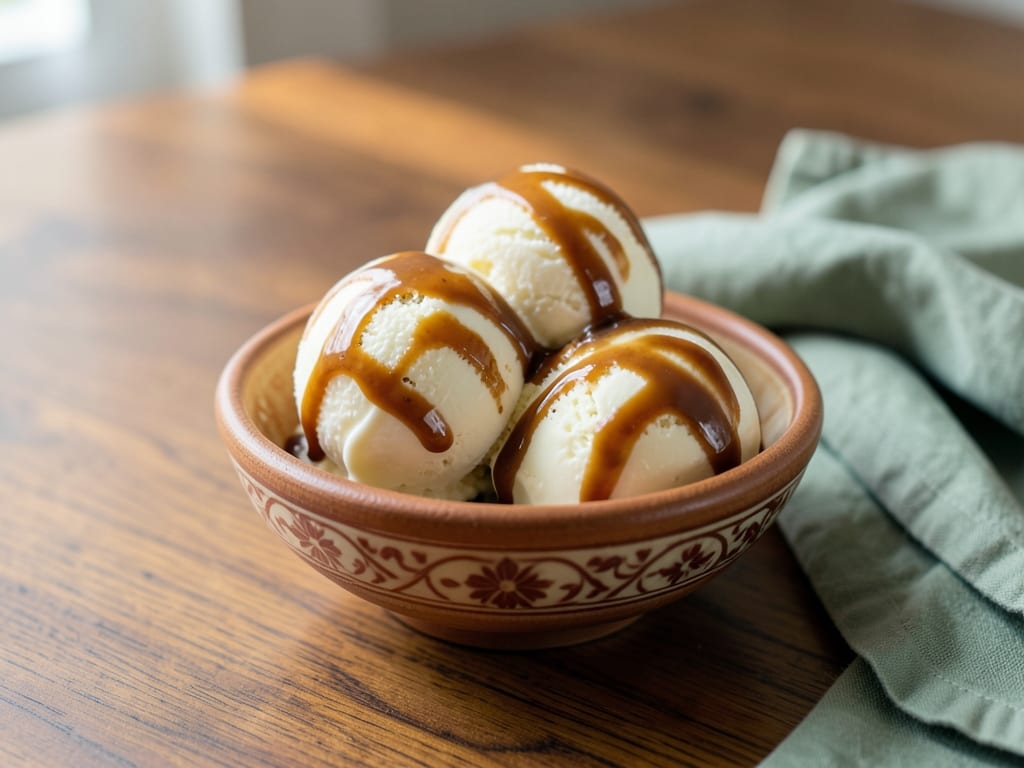
Dulce de Leche Swirl Ice Cream
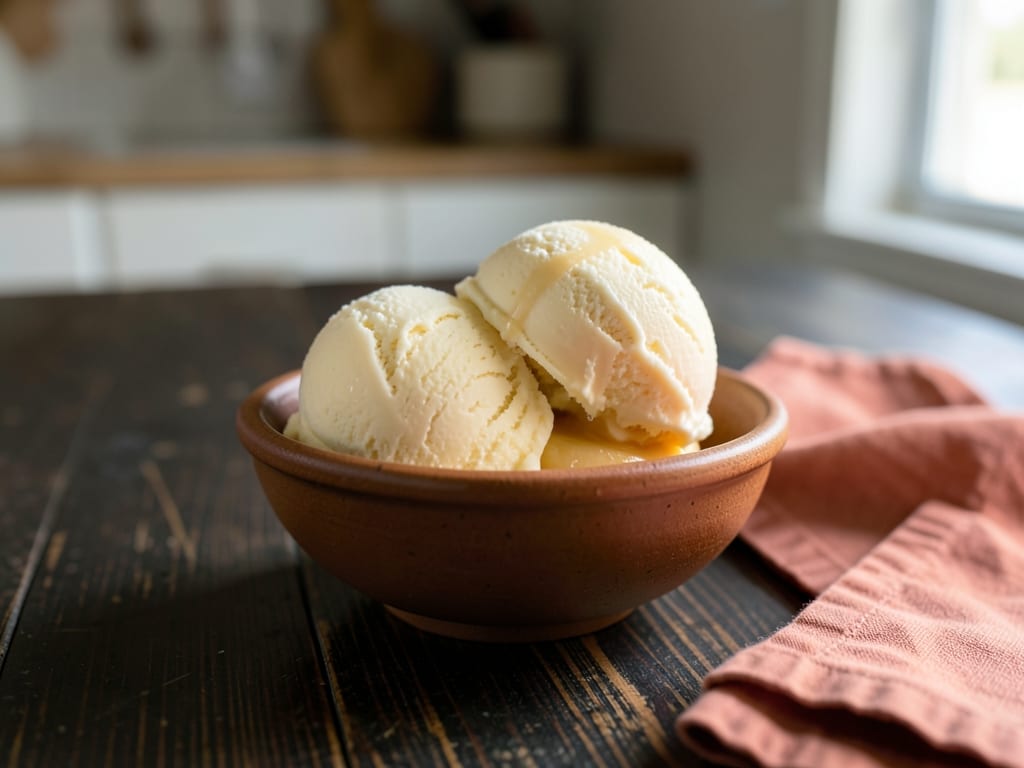
A rich, creamy churned ice cream made with a custard base of cream, milk, and egg yolks, infused with vanilla and swirled with ribbons of dulce de leche. The result is silky, luxurious, and deeply satisfying—perfect for warm days or as a special dessert.
- Prep
- 15 min
- Cook
- 15 min
- Wait
- 8 hr 55 min
- Total
- 9 hr 25 min
- Makes
- 1 quart (serves 4–6, or about 8–12 small scoops)
Steps
Before you start
- Ensure your ice cream maker's freezing bowl has been in the freezer for at least 8 hours or overnight (check manufacturer instructions)
- Read the entire recipe, especially the tempering step, before you begin
- Have your ingredients ready: large eggs at room temperature (or at least not cold), cream and milk chilled, other ingredients measured out
- Have an instant-read thermometer on hand—it's essential for food safety and proper custard texture
Temper the egg yolks
- Combine 5 room-temperature large egg yolks and 2/3 cup (130g) granulated sugar in a medium mixing bowl.
- Whisk vigorously for 2–3 minutes until the mixture becomes pale, thick, and falls from the whisk in a ribbon-like stream.
- This step aerates the eggs and helps them cook evenly without scrambling.
+ Show details− Hide details
Ready when: Mixture is pale, thick, and falls in a ribbon from the whisk
Tip: If eggs are too cold, they won't whisk up properly; let them sit at room temperature for 15 minutes before starting
Heat the cream and milkOven 170°F / 75°C
- Pour 1.5 cups (360 ml) cold heavy cream, 1 cup (240 ml) cold or room-temperature whole milk, and a pinch of fine sea salt into a medium saucepan.
- Heat over medium heat, stirring occasionally with a wooden spoon, until small bubbles form around the edges and steam rises (about 8–10 minutes).
- Use an instant-read thermometer to check for 165–170°F (74–77°C).
- Don't let it boil.
+ Show details− Hide details
Ready when: Small bubbles form around the edges, steam rises, temperature reads 165–170°F (74–77°C)
Tip: Watch for the steaming stage—a full rolling boil will overheat the cream and curdle your custard
Temper the eggs with hot cream
- While whisking the egg mixture constantly, slowly pour in about 1/4 of the hot cream mixture in a very thin stream over about 1 minute.
- Whisk continuously to gradually heat the eggs without scrambling them.
- Once fully incorporated, add the remaining hot cream in a steady, slow stream while whisking.
- Continue whisking for 30 seconds after all cream is combined to ensure everything is smooth.
+ Show details− Hide details
Ready when: All hot cream is fully incorporated and mixture is smooth with no lumps
Tip: Slow is better than fast—rushing scrambles the eggs. If you see tiny lumps form, strain the mixture through a fine-mesh sieve immediately
Cook the custard to safe temperatureOven 170°F / 75°C
- Pour the combined mixture back into the saucepan.
- Cook over medium heat, stirring constantly with a rubber spatula, for about 5–7 minutes until it thickens.
- The custard should reach 160–170°F (71–77°C) on an instant-read thermometer.
- When done, the custard will coat the back of the spatula thickly—dip the spatula in, run your finger across the back, and it should leave a clear trail.
- The mixture will smell rich and eggy.
+ Show details− Hide details
Ready when: Custard reaches 160–170°F (71–77°C), coats the back of a spoon thickly, and leaves a clear trail when you run your finger across it
Tip: Use your instant-read thermometer—temperature is the most reliable indicator of doneness and ensures food safety
Cool and flavor the custard
- Immediately pour the custard through a fine-mesh sieve into a clean, large mixing bowl to catch any cooked egg bits (optional but recommended for silky texture).
- Stir in 2 tsp (10 ml) pure vanilla extract.
- Let the custard cool on the counter, stirring occasionally, for about 30 minutes until it reaches room temperature.
- Then cover and transfer to the refrigerator to chill for at least 2–4 hours (overnight is fine) until it reaches 40°F (4°C) or below.
+ Show details− Hide details
Ready when: Custard is very cold (below 40°F), smooth, creamy, and ready to churn
Tip: Don't skip the chilling step—a very cold custard churns more efficiently and produces creamier, smoother ice cream
Churn the ice cream
- Pour the chilled custard into your prepared ice cream maker (ensure the freezing bowl has been in the freezer overnight).
- Churn according to your machine's instructions, usually 20–25 minutes.
- The ice cream is done when it reaches a soft-serve consistency—it should be thick, creamy, and just barely scoopable from the machine, similar to soft-serve frozen yogurt.
+ Show details− Hide details
Ready when: Ice cream is thick, creamy, and soft-serve consistency; a spoon dragged through it moves slowly
Tip: If you don't have an ice cream maker, freeze the chilled mixture in a shallow 9×13-inch baking pan, then stir vigorously every 30 minutes for 3–4 hours; not quite as smooth, but workable
Swirl in dulce de leche
- As the ice cream finishes churning, drizzle the 1/2 cup (140g) dulce de leche into the machine (or transfer the soft ice cream to a large bowl first).
- Using a rubber spatula, gently fold the dulce de leche into the ice cream, creating ribbons and swirls throughout—avoid over-mixing or the swirl effect will disappear and become uniform.
- Alternatively, layer the ice cream and dulce de leche in a freezer-safe container and use a knife to create swirls by dragging it through.
+ Show details− Hide details
Ready when: Dulce de leche is partially folded in, creating visible ribbons and swirls throughout the ice cream
Tip: If dulce de leche is very thick straight from the fridge, microwave it for 8–10 seconds to warm it slightly, making it easier to fold and swirl
Final freeze and harden
- Transfer the swirled ice cream to a freezer-safe container with a tight-fitting lid or cover.
- Smooth the top and press plastic wrap directly onto the surface to prevent ice crystals from forming.
- Freeze for at least 4–6 hours (or overnight) until it reaches a proper, firm scoopable consistency.
- It should be creamy and firm but not rock-hard.
+ Show details− Hide details
Ready when: Ice cream is firm and scoopable; a scoop holds its shape without collapsing
Tip: To serve, let the ice cream soften at room temperature for 5 minutes for easier scooping and better flavor release
Good to know
Tips
- Tempering is key: Always add the hot liquid slowly to the cold eggs while whisking, never the other way around. This gradual heating prevents scrambled eggs.
- Use an instant-read thermometer to confirm the custard reaches 160–170°F (71–77°C)—this is both for food safety and proper texture. Don't rely on appearance or time alone.
- Straining the cooked custard through a fine-mesh sieve removes any tiny cooked egg bits and produces silky, smooth ice cream with no grainy texture.
- Don't skip the 2–4 hour chilling step. A very cold custard churns more efficiently and produces creamier, smoother ice cream with better body.
Make ahead
The custard base can be made up to 2 days in advance and kept refrigerated in an airtight container. The fully churned and frozen ice cream can be made ahead and stored in the freezer for up to 2 weeks, though it's best consumed within 3–4 days for optimal creaminess and flavor.
Storage & reheating
**Fridge:** Uncooked custard base keeps for up to 2 days in an airtight container. **Freezer:** Ice cream keeps for up to 2 weeks in an airtight freezer container. To serve, let it soften at room temperature for 5 minutes before scooping. If it becomes too hard, let it sit in the fridge for 15–20 minutes to soften. The texture is creamiest within the first 3–4 days before ice crystals form.
Substitutions
- Dulce de leche (store-bought or homemade) → Caramel sauce, salted caramel, or cajeta (goat milk caramel). Use the same amount (1/2 cup / 140g) and fold or swirl in the same way. Caramel will be slightly thinner and brighter in flavor; cajeta is more authentic and tangy.
- Pure vanilla extract → 1 whole vanilla bean pod, split and scraped, or 1/2 tsp vanilla bean paste. This provides a more intense vanilla flavor and visible flecks. Omit the vanilla extract and stir the seeds or paste into the warm custard instead.
- Whole milk → Half-and-half (1 cup), or 1/2 cup crème fraîche plus 1/2 cup whole milk. Half-and-half makes a richer ice cream but may be slightly less scoopable. Crème fraîche adds tang and creaminess.
- Heavy whipping cream → 1.25 cups heavy cream plus 1/4 cup mascarpone cheese (stirred into cooled custard). Mascarpone adds richness, tang, and smoothness, though the ice cream will be slightly denser.
More frozen desserts
See all →
Find more like this
- Meal
- Dessert
- Main ingredient
- Eggs
- Method
- Stovetop
- Quick & Easy
- Make AheadFreezer Friendly
- Season
- Summer