Crispy Vegetable Samosas with Spiced Potato and Pea Filling
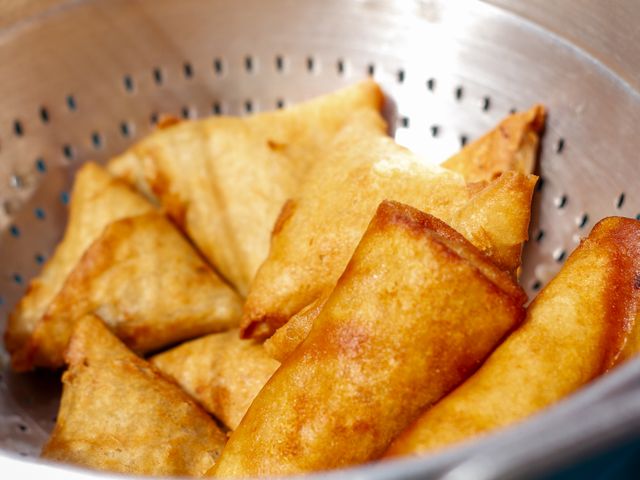
Golden, blistered, flaky pastry cones filled with fragrant spiced potatoes and sweet green peas. The dough is made with oil, so it fries up crisp and bubbly, and the filling is bright with ginger, cumin, and garam masala. Serve hot with mint or tamarind chutney.
- Prep
- 55 min
- Cook
- 1 hr
- Wait
- 20 min
- Total
- 2 hr 15 min
- Makes
- 16 samosas
Steps
Before you start
- Thaw the frozen peas in a bowl on the counter (or run them under cool water) and drain well so no extra moisture goes into the filling.
- Read the timing: the 30-minute dough rest overlaps with boiling the potatoes and making the filling, and the oil heats while you shape the samosas. The filling must cool completely before you fill the pastry, because hot filling tears the dough.
- Use a thermometer for the frying oil. Oil that is too hot browns the crust before the pastry cooks through, and oil that is too cool makes greasy samosas.
- Choose a pot at least 5 inches (12.5 cm) deep. The oil should come only 2 inches (5 cm) up the side, leaving about 3 inches (7.5 cm) of empty space above it.
- Set up a rimmed baking sheet fitted with a wire rack for draining. Preheat the oven to 200°F (93°C) when you start frying so finished samosas stay hot (above 140°F / 60°C) while you finish the batches.
Make and rest dough
- In a large bowl, stir together the flour, dough salt, and ajwain (if using).
- Add the 60 ml (4 tbsp) dough oil and rub it into the flour with your fingertips for about 2 minutes, until the mixture looks like damp sand and holds together when squeezed in your fist.
- Add the water a little at a time, mixing until a stiff dough forms.
- Knead on the counter for 3 to 4 minutes until smooth and firm, adding 1 tablespoon (15 ml) more water only if it will not come together.
- Cover with a damp towel and rest for 30 minutes while you make the filling.
+ Show details− Hide details
Ready when: Dough is smooth, firm, and stiffer than bread dough, and springs back slowly when pressed
Tip: Keep the dough stiff. A soft dough turns puffy and soft after frying instead of crisp and flaky.
Boil potatoes
- Place the potato chunks in a medium pot, cover with cold water by 1 inch (2.5 cm), and add the 18 g (1 tbsp) potato water salt.
- Bring to a boil over medium-high heat, then reduce to medium and simmer for 15 to 20 minutes.
- Drain well and let the potatoes steam dry in the colander for 5 minutes.
+ Show details− Hide details
Ready when: A knife slides into a chunk with no resistance, but the pieces still hold their shape
Tip: Do not let potatoes get mushy or waterlogged. Wet filling makes the samosas soggy and hard to seal.
Toast the spices
- Heat the 30 ml (2 tbsp) filling oil in a 12-inch (30 cm) skillet over medium heat for 1 minute.
- Add the cumin seeds and cook for 20 to 30 seconds until they sizzle and smell toasty.
- Add the ginger and green chilies and stir for 1 minute.
- Stir in the coriander, turmeric, and chili powder and cook for 15 seconds.
+ Show details− Hide details
Ready when: Cumin seeds darken slightly and sizzle, and the ginger smells fragrant, not raw
Tip: Ground spices burn fast. If the pan smokes, lift it off the heat right away.
Mix the filling
- Add the drained potatoes and the thawed peas to the skillet.
- Sprinkle over the garam masala, amchur, and the 6 g (1 tsp) filling salt.
- Roughly crush the potatoes with a spatula or potato masher, leaving some pea-sized chunks for texture, and stir for 2 to 3 minutes over medium-low heat.
- Stir in the cilantro.
- Taste and add a pinch more salt if needed; the dough is only lightly salted, so the filling must carry most of the seasoning.
- Spread the filling on a plate and cool for 15 minutes until it is room temperature to the touch.
+ Show details− Hide details
Ready when: Filling is dry, holds together when pressed, and tastes well seasoned and tangy
Tip: The filling should taste a little stronger than you think it needs. The pastry will mellow it.
Roll the dough
- Knead the rested dough for 30 seconds and divide into 8 equal pieces (about 50 g each), rolling each into a ball.
- Keep the balls covered.
- On a lightly floured counter, roll one ball into a thin round about 7 inches (18 cm) across and 1/16 inch (2 mm) thick.
- Cut the round in half straight through the center with a knife to make 2 half-circles, each with a 7-inch (18 cm) straight edge.
- Repeat with the remaining balls, keeping the cut pieces under a towel.
+ Show details− Hide details
Ready when: Dough is thin enough to see your fingers faintly through it, with no tears
Tip: Dust with flour sparingly. Too much flour on the surface can keep the edges from sealing.
Shape and fill
- Stir the 16 g (2 tbsp) flour and 30 ml (2 tbsp) water together into a thick paste.
- Hold a half-circle with the straight edge facing you and brush the straight edge lightly with paste.
- Fold one corner of the straight edge to the center, then fold the other corner over it, overlapping by about 1/2 inch (1 cm), to make a cone; press the seam firmly.
- Hold the cone in your palm and spoon in a heaping 2 tablespoons (about 40 g) of filling, pressing it in gently with a spoon until the cone is full but not stretched, leaving 1/2 inch (1 cm) empty at the top.
- Brush the open rim with paste, pinch it shut, then press the edge flat with your fingers or a fork.
- Place on a parchment-lined baking sheet and repeat to make 16 samosas.
- Start heating the oil (next step) when you are about halfway through.
+ Show details− Hide details
Ready when: Each samosa is firmly sealed on the seam and rim, with no gaps and no filling on the edges
Tip: Filling on the sealing edges prevents a seal and the samosas will burst in the oil. Wipe any off with your finger.
Heat the oilOven 200°F / 95°C
- Pour the frying oil into a heavy 5½-quart (5.2 L) Dutch oven or kadai about 10 inches (25 cm) wide and at least 5 inches (12.5 cm) deep.
- The oil should be about 2 inches (5 cm) deep, leaving about 3 inches (7.5 cm) of empty space above it.
- Clip a thermometer to the side and heat over medium heat for 10 to 12 minutes until it reaches 340°F (170°C).
- Meanwhile, preheat the oven to 200°F (93°C) for keeping the fried samosas hot.
+ Show details− Hide details
Ready when: Thermometer reads 340°F (170°C), and a pinch of dough sizzles gently and rises to the surface within a few seconds
Tip: Never leave hot oil unattended, and keep a lid nearby in case of a flare-up. Never fill the pot more than halfway.
Fry first batch
- Gently lower 5 to 6 samosas into the oil, slipping them in from the side of the pot so the oil does not splash.
- The oil will drop to about 325°F (165°C); adjust the heat to keep it between 315 and 335°F (157 and 168°C).
- Fry for 8 to 10 minutes, turning every 2 to 3 minutes.
- The samosas will stay pale for the first 3 minutes, then turn golden and blister.
- Lift out with a spider and drain on the wire rack set over a baking sheet.
+ Show details− Hide details
Ready when: Pastry is deep golden brown with small blisters over the surface, and feels hard and crisp when tapped with the spider
Tip: If they brown in under 5 minutes, the oil is too hot and the dough may stay raw inside. Lower the heat. If they are still pale after 6 minutes, raise it.
Fry remaining batchesOven 200°F / 95°C
- Bring the oil back up to 335°F (168°C) between batches over medium heat, which takes 2 to 3 minutes.
- Fry the remaining samosas in 2 more batches of 5 the same way, 8 to 10 minutes each.
- Slide the rack and baking sheet of finished samosas into the 200°F (93°C) oven to keep hot while you fry the rest.
- When the last batch is done, let all samosas rest for 5 minutes before eating so the filling is not scorching.
+ Show details− Hide details
Ready when: Every samosa is evenly golden brown and blistered, and crisp when tapped
Tip: Skim any crumbs of dough from the oil between batches so they do not burn and flavor the oil.
Serve
- Serve the samosas hot or warm, straight from the oven, with mint chutney, tamarind chutney, or ketchup.
- Break one open to check that the dough is crisp and flaky and the filling is steaming hot throughout.
- Do not leave them out for more than 2 hours (1 hour in a hot room).
+ Show details− Hide details
Ready when: Crust shatters when bitten and the filling is hot throughout
Good to know
Tips
- Fry at about 325°F (165°C) for 8 to 10 minutes. This cooks the dough through and makes a blistered, crunchy shell without drying it out.
- Fill each cone fully but do not overfill or force the filling in. Too much filling stretches the dough and causes bursting.
- A thick flour paste seals better than water alone. Brush it on thinly and press firmly.
- Dry the potatoes well after boiling and cool the filling completely. Moisture is the main cause of soggy samosas.
Make ahead
Shape the samosas up to 1 day ahead, arrange in a single layer on a parchment-lined tray, cover loosely, and refrigerate; fry straight from the fridge, adding 1 to 2 minutes. For longer storage, freeze the unfried samosas on a tray until solid (about 2 hours), then bag them for up to 2 months and fry from frozen at 325°F (165°C) for 10 to 12 minutes, in smaller batches so the oil temperature does not crash. The filling can be made and refrigerated up to 2 days ahead.
Storage & reheating
Room temperature: no more than 2 hours (1 hour if the room is above 90°F / 32°C); for parties, hold samosas in a 200°F (93°C) oven until serving, then refrigerate or discard leftovers. Fridge: up to 3 days in an airtight container once fully cooled. Freezer: fried samosas freeze well for up to 2 months. Reheat from the fridge or freezer on a rack on a baking sheet in a 375°F (190°C) oven for 10 to 15 minutes (15 to 20 from frozen) until steaming hot and crisp. Avoid the microwave, which makes the crust soft.
Substitutions
- amchur (dried mango powder) → fresh lemon juice. Use 1 tablespoon, stirred in after the filling comes off the heat, for a similar tang.
- neutral oil or melted ghee → melted ghee or vegan butter. Ghee gives a richer flavor and a slightly more flaky crust.
- frozen green peas → finely diced carrots or cooked chopped spinach. Cook diced carrots with the potatoes, and squeeze spinach very dry so the filling stays dry.
- whole cumin seeds → ground cumin. Use 1/2 teaspoon and add it with the other ground spices, since it burns quickly.