Crispy Pan Omelette with Leftover Vegetables
A golden, lightly crispy French-style omelette loaded with leftover vegetables. The secret is high heat at the start to build a thin browned crust on the bottom while the top stays creamy, then a quick fold and slide onto the plate. Perfect for breakfast, lunch, or a light dinner—ready in under 10 minutes.
Steps
Before you start
- Use eggs straight from the fridge—they're easier to whisk and cook more evenly
- Chop or cut all vegetables to small, bite-sized pieces beforehand so they cook quickly and distribute evenly
- Have a 10-inch non-stick or cast-iron skillet ready—the size matters for the right thickness
Crack and whisk eggs
- Crack 4 eggs into a medium mixing bowl.
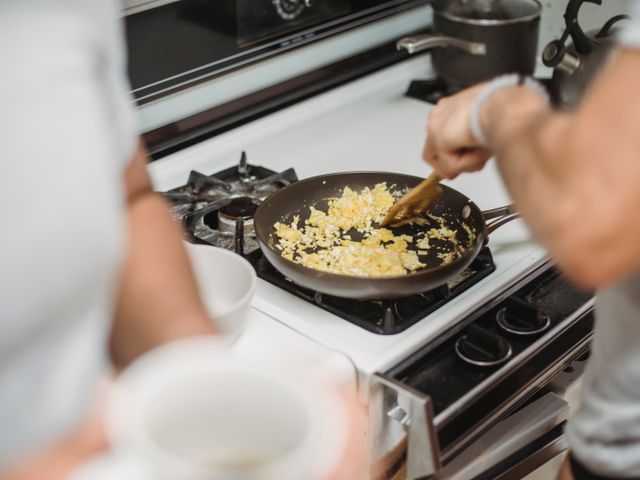
- Whisk vigorously with a fork for 30–45 seconds until the yolks and whites are fully combined and the mixture is light and slightly foamy.
- Season with a generous pinch of kosher salt and a grind of black pepper.
- The eggs should look uniform and bright.
+ Show details− Hide details
Ready when: Eggs are fully blended and foamy
Tip: Don't skip the vigorous whisking—air makes the omelette fluffy rather than dense.
Heat pan and butter
- Place a 10-inch non-stick or cast-iron skillet over medium-high heat.
- Once hot (about 1 minute), add 1 tbsp (14 g) of cold butter.
- Swirl and tilt the pan so the butter melts and coats the entire bottom and sides evenly.
- You want the pan quite hot—the butter should sizzle immediately and turn golden but not brown.
+ Show details− Hide details
Ready when: Butter is melted, golden, and sizzling
Tip: If the butter browns too quickly, the heat is too high—lower it slightly. The pan should be very hot to create that signature light crust.
Pour and spread eggs
- Pour the whisked eggs into the center of the hot buttered pan.
- Immediately use a silicone spatula to gently push the cooked egg at the edges toward the center, tilting the pan so uncooked egg flows to the edges.
- Continue for 20–30 seconds until about half the egg is set but the top is still quite wet.
- The bottom should be beginning to turn light golden.
+ Show details− Hide details
Ready when: Bottom is lightly golden; top is still wet and runny in spots
Tip: Resist over-stirring—you want motion only to bring set egg inward so uncooked flows to edges. Stop when the bottom is still just setting so it doesn't toughen.
Distribute vegetables
- Scatter the prepared vegetables (about 1.5 cups / 210 g) evenly across one half of the omelette (the side closest to the handle).
- If the vegetables are cold from the fridge, they'll absorb some heat from the eggs.
- The top should still be wet in spots.
- Reduce heat to medium to let the residual warmth set the top without burning the bottom.
+ Show details− Hide details
Ready when: Vegetables are distributed; eggs still slightly runny on top
Tip: Use cooked vegetables if you have them so they're warm and fully done. Raw vegetables like tomato or peppers work too but won't warm through as much. Keep to one half so folding is easy.
Cook and set top
- Continue cooking for another 30–45 seconds, shaking the pan gently every few seconds.
- The top should become mostly set but still have a thin sheen of uncooked egg (it will set from residual heat after folding).
- The bottom should be golden and crispy, not dark brown.
- If the eggs are setting faster than the bottom is crisping, you can briefly increase heat to medium-high for 10 seconds.
+ Show details− Hide details
Ready when: Top is 80% set with a slight wet sheen; bottom is golden and crispy
Tip: The omelette will continue cooking from residual heat after you remove it from the pan, so don't overcook it on the stovetop or it'll be rubbery.
Fold and slide to plate
- Remove the pan from heat.
- Using your spatula, carefully slide it under the vegetable-free half of the omelette.
- Fold that half over the vegetables (it should be loose enough to fold without tearing).
- Slide the entire omelette onto a waiting plate, so the fold lands seam-side down.
- Top with the remaining ½ tbsp (7 g) of cold butter (optional but luxurious—it melts over the warm omelette) and a pinch of fresh chopped chives or parsley if using.
+ Show details− Hide details
Ready when: Omelette is folded and on the plate
Tip: If the omelette sticks, gently loosen it with the spatula before folding. The cold butter on top adds richness and looks elegant.
Make the second omelette (if serving two)
- The above recipe yields one large omelette (serving 1–2 people comfortably, or 1 generous portion).
- To serve 2, repeat steps 2–6 immediately with 2 more eggs, 1 tbsp (14 g) butter, and ¾ cup (105 g) vegetables.
- The second cooks just as quickly.
- Have both plates ready so you can serve them at the same time while hot.
+ Show details− Hide details
Ready when: Second omelette is folded and on plate
Tip: Don't try to make two giant omelettes at once—one 10-inch pan handles 2 eggs better than 4. Cooking two smaller ones ensures both stay creamy and crispy.
Good to know
Tips
- Room-temperature vegetables mixed with cold eggs actually cook more evenly—if your veggies are cold from the fridge, they'll chill the eggs slightly and slow cooking. Room-temp vegetables distribute faster and cook more uniformly.
- A non-stick skillet is easier for beginners, but a well-seasoned cast-iron pan makes a superior crispy crust. If using cast iron, ensure it's properly oiled or seasoned to prevent sticking.
- The key to a creamy omelette is not overcooking the eggs. They continue to cook from residual heat after you remove them from the pan, so aim for a thin, shiny layer of raw egg on top when you fold.
- If you don't have fresh herbs, a small squeeze of lemon juice or a pinch of smoked paprika over the finished omelette adds brightness and depth without fussiness.
Storage & reheating
Leftover omelettes are best served immediately, but any uneaten portion can be refrigerated in an airtight container for up to 2 days. Reheat gently in a non-stick skillet over low heat with a dab of butter for 2–3 minutes until warmed through (don't reheat in the microwave, which makes the eggs tough). Best consumed fresh.
Substitutions
- mixed leftover vegetables (cooked or raw) → Any raw or cooked vegetables you have on hand. Zucchini, spinach, tomatoes, mushrooms, bell peppers, onions, peas, corn, broccoli, asparagus, and cheese are all excellent. Use about 1.5 cups (210 g) total. Finely chop raw vegetables for even cooking.
- unsalted butter → Olive oil or ghee. Use 2 tbsp (30 ml) olive oil or 2 tbsp (28 g) ghee for a different flavor. Ghee gives a richer taste; olive oil adds a grassy note.
- fresh chives or parsley, finely chopped → Grated cheese (cheddar, gruyère, or feta), a drizzle of hot sauce, or a sprig of fresh dill. Any of these additions brightens the omelette. Cheese melts into the warm eggs beautifully.
- kosher salt → Sea salt or table salt. Use the same amount if switching salt types, adjusting to taste. Table salt is finer so you may need slightly less.