Creamy Parmesan Polenta
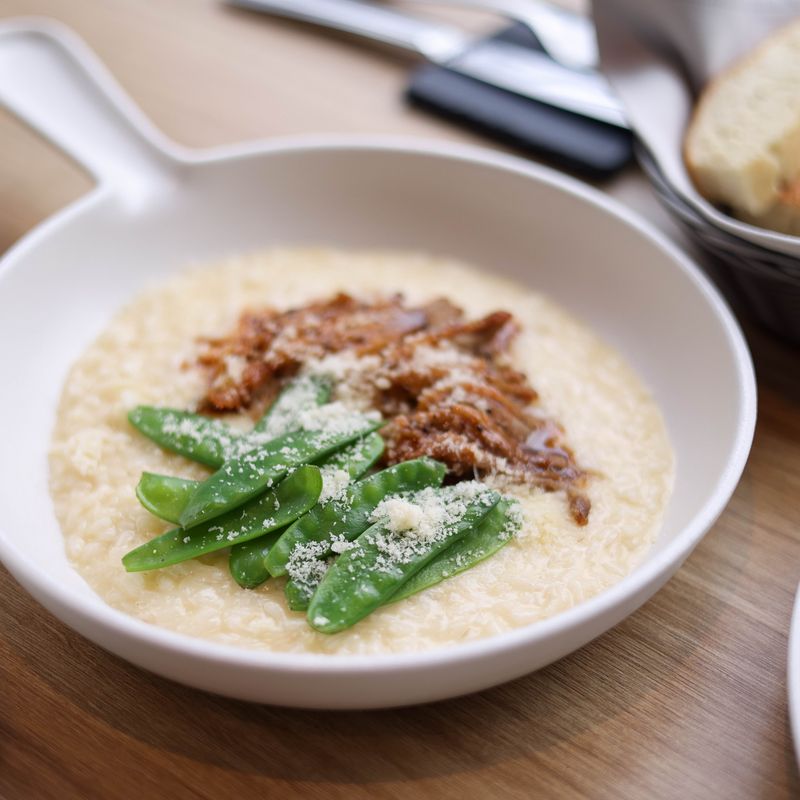
Slow-simmered coarse cornmeal in a mix of water and milk, finished with butter, plenty of Parmesan and black pepper. It's spoonable, rich and savory, and it's a good bed for braises, sausages or roasted vegetables.
- Prep
- 10 min
- Cook
- 45 min
- Wait
- 5 min
- Total
- 1 hr
- Makes
- About 5 cups (6 side-dish servings)
Steps
Before you start
- Check the package: use coarse or medium-grind stone-ground polenta or cornmeal that needs about 40 minutes of cooking. Instant polenta and fine cornmeal need different liquid and timing.
- Grate the Parmesan from a block on the small holes of a box grater or with a rasp-style grater. Pre-grated cheese can turn grainy.
- Use a heavy-bottomed pot. Thin pots scorch the polenta on the bottom.
- Keep a kettle of hot water nearby in case the polenta gets too thick before it's tender.
Measure and grate
- Grate the Parmesan (1 cup/80 g for the polenta, plus 2 tablespoons for serving if using).
- Cut the butter into 4 pieces.
- Measure the cornmeal into a liquid measuring cup or small bowl with a pouring lip so you can add it in a steady stream.
- Grind the pepper.
+ Show details− Hide details
Ready when: Everything is measured and within reach of the stove.
Tip: Once the polenta is cooking you can't walk away to prep, so do this first.
Heat the liquid
- Pour the water and milk into the pot and add the salt.
- Set over medium-high heat and bring to a gentle simmer, about 5 minutes, with small bubbles around the edges and steam rising.
+ Show details− Hide details
Ready when: Small bubbles break around the edge of the pot and the surface steams. It should not be boiling hard.
Tip: Stay nearby. Milk foams up and boils over quickly.
Whisk in cornmeal
- Reduce the heat to medium.
- While whisking constantly with one hand, pour the cornmeal into the liquid in a thin, steady stream.
- Keep whisking for 2 to 3 minutes until the mixture is smooth and starts to thicken and bubble.
+ Show details− Hide details
Ready when: No dry clumps remain and the mixture looks like thin porridge.
Tip: Pouring slowly prevents lumps. If you see clumps, press them against the side of the pot with the whisk.
Simmer low and slow
- Turn the heat to its lowest setting so only an occasional bubble pops.
- Cover the pot.
- Cook for 40 minutes total, uncovering to stir well with a wooden spoon, scraping the bottom and corners, every 5 to 8 minutes for the first 20 minutes, then every 5 minutes after that.
- The polenta will thicken and the grains will swell.
- If it gets stiff and sticks, stir in ¼ cup (60 ml) hot water at a time.
+ Show details− Hide details
Ready when: Smooth and thick like soft mashed potatoes, pulling away from the pot as you stir. A taste has no gritty or raw crunch.
Tip: Bubbles can spit hot polenta, so stir with a long spoon and keep the lid tilted away from you.
Finish with butter and cheese
- Take the pot off the heat.
- Stir in the butter pieces until melted, then stir in the 1 cup (80 g) Parmesan in two additions until smooth and glossy.
- Stir in ½ teaspoon black pepper.
+ Show details− Hide details
Ready when: The butter and cheese are fully melted and the polenta looks creamy and shiny.
Tip: Adding cheese off the heat keeps it from turning stringy or oily.
Rest, then adjust
- Cover the pot and let the polenta rest for 5 minutes.
- It will thicken slightly.
- Taste and add a pinch more salt or pepper if needed.
- If it is thicker than you like, stir in a splash of hot water or milk until it flows slowly off the spoon.
+ Show details− Hide details
Ready when: It slowly spreads when spooned onto a plate, with no watery ring.
Tip: Polenta keeps stiffening as it cools, so loosen it right before serving.
Serve hot
- Spoon the polenta into warm bowls or onto plates.
- Top with the extra grated Parmesan, if using, and a few grinds of black pepper.
- Serve right away.
+ Show details− Hide details
Ready when: Steaming hot and creamy.
Good to know
Tips
- Whisk in the cornmeal slowly and steadily. This is the single best way to avoid lumps.
- Keep the heat low enough that the polenta barely bubbles. A harder simmer scorches the bottom and spits.
- Taste for texture, not just time. Different brands of cornmeal soften at different rates, so keep cooking, adding hot water as needed, until there is no grit.
- Serve it promptly. Polenta firms up quickly, and loosening it with hot water or milk brings back the creamy texture.
Make ahead
"Cook the polenta through step 5, cool slightly, and refrigerate in an airtight container up to 3 days. Reheat with a splash of milk or water as described under storage."
Storage & reheating
"Room temperature: up to 1 hour covered (keep warm in a covered pot over very low heat, stirring in a little hot water as needed). Fridge: up to 3 days in an airtight container; it sets firm. Freezer: not recommended for creamy serving, though it freezes up to 2 months if you plan to fry or grill it. To reheat, warm in a saucepan over low heat with 2 to 4 tablespoons of milk or water per 2 cups, stirring often until smooth and hot, about 8 minutes."
Substitutions
- whole milk → Chicken or vegetable stock. Use 2 cups (480 ml) in place of the milk for a lighter, more savory polenta. Reduce the salt to 1 tsp at first and adjust at the end.
- Parmigiano-Reggiano or Parmesan cheese → Pecorino Romano. Sharper and saltier. Use the same amount and reduce the added salt to about 1 tsp.
- unsalted butter → Extra-virgin olive oil. Use 3 tablespoons (45 ml) for a fruitier flavor.
- coarse stone-ground cornmeal (polenta) → Medium-grind cornmeal. Cooks in about 30 minutes. Start tasting at 25 minutes.