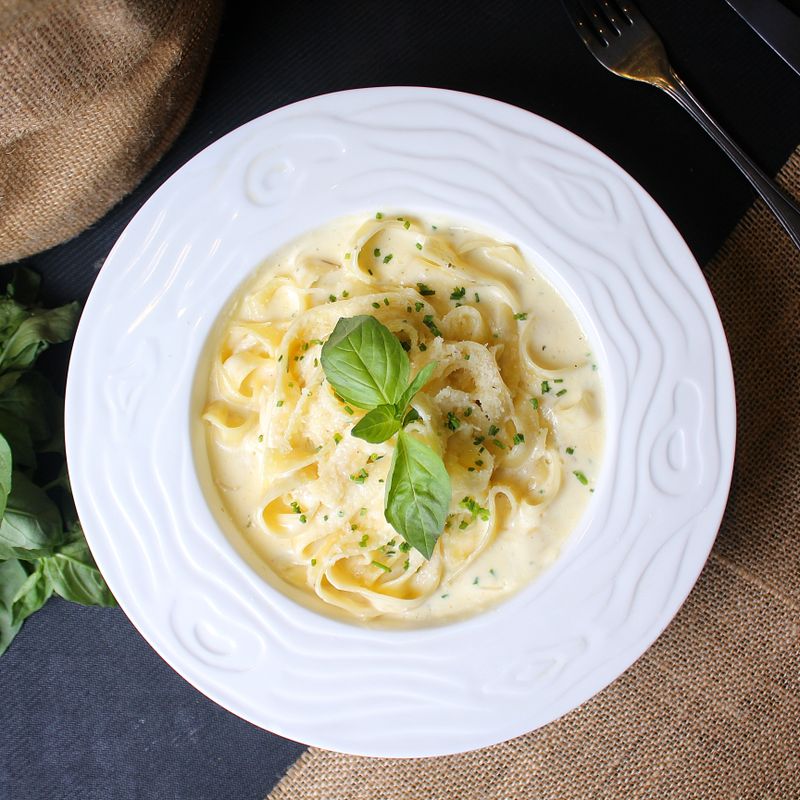
Creamy Fettuccine Alfredo
A silky, rich Alfredo sauce built from butter, heavy cream, garlic and freshly grated Parmesan, tossed with tender fettuccine and loosened with starchy pasta water. It comes together in about 28 minutes.
- Prep
- 10 min
- Cook
- 18 min
- Total
- 28 min
- Makes
- 4 main-course servings (about 6 cups / 1.4 liters of sauced pasta)
Steps
Before you start
- Grate the Parmesan yourself from a block on the finest holes of a box grater or a rasp-style grater. Pre-shredded cheese contains anti-caking starch and tends to turn grainy.
- Have everything measured and ready before you start. The sauce comes together fast, and the pasta should go straight into it.
- Start the sauce about 2 minutes after the pasta goes into the water so both finish together (about 9 minutes later).
- Warm your serving bowls in a 200°F (95°C) oven or under hot tap water. Alfredo thickens quickly as it cools.
Boil salted water
- Pour 4 quarts (3.8 liters) of water into a 6-quart pot, cover, and bring to a full rolling boil over high heat (about 10 minutes).
- While it heats, grate the Parmesan into a bowl and mince the garlic.
- Once the water is boiling, stir in the kosher salt.
+ Show details− Hide details
Ready when: Water is at a vigorous, rolling boil
Tip: Salt the water generously; it is the pasta's main seasoning.
Start the pasta
- Add the fettuccine to the boiling water and stir for the first 30 seconds to prevent sticking.
- Set a timer for 1 minute less than the package directions (usually 8 to 9 minutes), since the pasta finishes cooking in the sauce.
- Start the next step after about 2 minutes.
+ Show details− Hide details
Ready when: Strands are fully submerged and moving freely in the boiling water
Tip: The pasta keeps cooking while you make the sauce in the next steps.
Melt butter, soften garlic
- Set the skillet over medium-low heat and add the butter.
- When it has melted and is foaming gently, add the garlic and stir for 30 to 45 seconds.
+ Show details− Hide details
Ready when: Garlic smells fragrant and looks pale and soft, with no browning
Tip: Do not let the garlic brown; it turns bitter and flavors the whole sauce.
Simmer the cream
- Pour in the cold cream and add the black pepper and the nutmeg, if using.
- Raise the heat to medium and bring to a gentle simmer, with small bubbles around the edges.
- Simmer for 3 minutes, stirring occasionally.
+ Show details− Hide details
Ready when: Cream lightly coats the back of a spoon, and a finger drawn through it leaves a clear line
Tip: Do not boil hard; high heat can make the cream separate and the cheese seize later.
Reserve water, add pasta
- When the pasta has cooked about 8 to 9 minutes, scoop out 1 cup (240 ml) of the starchy pasta water into a heatproof measuring cup.
- Then use tongs to lift the pasta straight into the skillet, letting a little water cling to it.
+ Show details− Hide details
Ready when: Pasta is flexible and tender outside but still slightly firm in the center
Tip: Reserve the water before removing the pasta; its starch helps the sauce cling and emulsify.
Add cheese off heat
- Turn the heat to low (or off).
- Add the Parmesan in three handfuls, tossing the pasta with tongs for about 15 seconds after each addition until the cheese has melted before adding the next.
+ Show details− Hide details
Ready when: Sauce looks smooth and glossy with no visible strands or clumps of cheese
Tip: Adding the cheese gradually over low heat prevents a grainy or clumpy sauce.
Loosen and finish
- Add ¼ cup (60 ml) of the reserved pasta water and toss the pasta continuously for 1 to 2 minutes over low heat.
- Add more water 2 tablespoons at a time if needed.
- Taste and add black pepper or a pinch of salt only if needed (the cheese is already salty).
+ Show details− Hide details
Ready when: Sauce is creamy and flows slowly, coating each strand evenly; pasta is al dente (tender with a slight bite)
Tip: The sauce thickens as it sits, so make it slightly looser than you want it on the plate.
Serve immediately
- Divide the pasta among warmed bowls, twisting it into nests with tongs and spooning any sauce left in the pan over the top.
- Sprinkle with parsley, if using, and a little freshly ground black pepper.
- Serve right away.
+ Show details− Hide details
Ready when: Sauce is glossy and clings to the pasta rather than pooling at the bottom of the bowl
Tip: Alfredo is best within minutes of finishing. If it tightens at the table, stir in a splash of hot water.
Good to know
Tips
- Always grate Parmesan fresh and finely; coarse shreds melt slowly and clump.
- Keep the heat low once the cheese goes in. Overheating makes the cheese tighten and turn oily or grainy.
- If the sauce breaks or looks greasy, remove the pan from the heat and whisk in 2 to 3 tablespoons of hot pasta water to bring it back together.
- For a protein-rich dinner, top with sliced grilled chicken or sautéed shrimp, and serve with steamed broccoli on the side.
Make ahead
The sauce is best made fresh. To save time, grate the Parmesan and mince the garlic up to 1 day ahead and store them separately, covered, in the refrigerator. Bring the cheese to room temperature before using.
Storage & reheating
Room temperature: no more than 2 hours. Refrigerator: store in an airtight container for up to 3 days. Freezer: not recommended, as the cream sauce can separate when thawed. To reheat, place in a skillet over low heat with 2 to 4 tablespoons of milk, cream, or water per portion, and stir gently until warmed through and creamy again (about 3 to 5 minutes). Avoid the microwave on high, which can make the sauce oily.
Substitutions
- Parmigiano-Reggiano cheese → Grana Padano. Slightly milder and a bit less expensive; melts just as smoothly when freshly grated.
- dried fettuccine → Tagliatelle, linguine, or penne. Use the same weight; adjust cooking time to the package directions, minus 1 minute.
- heavy cream → Half-and-half plus 1 tablespoon extra butter. Lighter, but the sauce is thinner and less stable; skip the simmering beyond a gentle warm-through and add the cheese over the lowest heat.
- unsalted butter → Salted butter. Works fine; taste before adding any extra salt at the end.