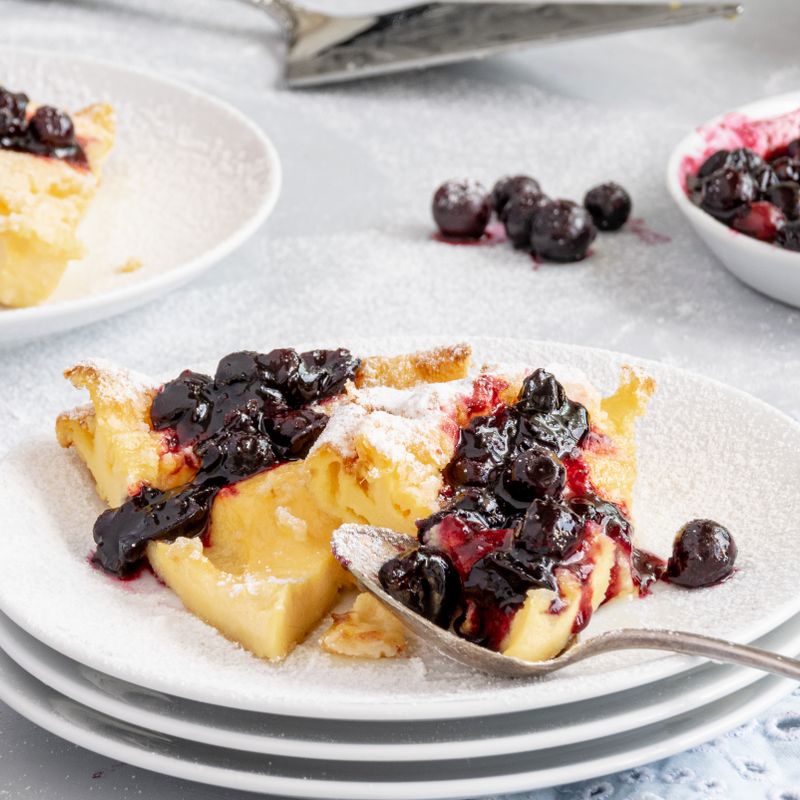
Corn and Blueberry Polenta Breakfast Cake with Honey
A tender, golden breakfast cake built on cornmeal and polenta, studded with fresh blueberries and finished with a glossy honey drizzle. The almond extract adds subtle depth while the polenta creates a moist, slightly grainy crumb that pairs beautifully with morning coffee or tea. This cake is equally at home on a weekend brunch table or wrapped for an afternoon snack.
- Prep
- 15 min
- Cook
- 35 min
- Wait
- 30 min
- Total
- 1 hr 20 min
- Makes
- 1 cake (8 slices)
Steps
Before you start
- Preheat oven to 350°F (175°C) 15 minutes ahead
- Bring all ingredients to room temperature, especially eggs and buttermilk
- Toss fresh blueberries lightly with 1 tablespoon all-purpose flour to prevent sinking
- Use an 8-inch (20 cm) square or 9-inch (23 cm) round cake pan, lined with parchment and lightly buttered
Cream butter and sugar
- In a large mixing bowl, whisk together the softened butter and granulated sugar.
- Beat vigorously with a wooden spoon or electric mixer for 3–4 minutes until the mixture is pale, light, and fluffy.
- This step incorporates air into the batter, creating a tender crumb.
+ Show details− Hide details
Ready when: Mixture is pale, light, and fluffy
Tip: Do not rush this step; proper creaming ensures a light, tender cake structure.
Incorporate eggs and extracts
- Add the eggs one at a time, beating well after each addition until fully combined and no streaks remain.
- Stir in the vanilla and almond extracts.
- The mixture should look smooth and emulsified.
+ Show details− Hide details
Ready when: No visible egg streaks; mixture is smooth and creamy
Tip: If the batter looks curdled or lumpy, add 1 tablespoon of the flour to help emulsify it.
Mix dry ingredients
- In a medium bowl, whisk together the all-purpose flour, polenta, baking powder, and salt.
- Whisk for about 30 seconds to combine and lighten the dry ingredients.
+ Show details− Hide details
Ready when: No lumps visible; mixture is uniform in color and texture
Tip: Whisking the dry ingredients together helps distribute the baking powder evenly and prevents dense pockets in the cake.
Alternate dry and wet ingredients
- Add one-third of the dry mixture to the creamed butter and eggs, stirring gently with a rubber spatula until just combined.
- Pour in half of the buttermilk, stirring until incorporated.
- Repeat with another third of the dry mixture, then the remaining buttermilk.
- Finish with the last of the dry mixture, folding gently until no flour streaks remain.
- Do not overmix; stop as soon as the batter comes together.
+ Show details− Hide details
Ready when: Batter is homogeneous with no visible flour streaks
Tip: Overmixing develops gluten, which toughens the cake. Fold gently and stop as soon as the ingredients are combined.
Fold in blueberries
- Gently fold the flour-dusted blueberries into the batter using a rubber spatula, turning the bowl as you fold.
- Be careful not to crush the berries; just a light hand to distribute them evenly throughout.
- A few broken berries are fine and may bleed color into the cake for visual interest.
+ Show details− Hide details
Ready when: Blueberries are distributed throughout the batter
Tip: Coating the blueberries in flour helps keep them suspended in the batter and prevents them from sinking to the bottom of the cake.
Transfer to pan and smooth
- Pour the batter into the prepared 8-inch square or 9-inch round pan.
- Using an offset spatula or the back of a spoon, gently spread the batter into an even layer.
- The top should be relatively level.
+ Show details− Hide details
Ready when: Batter is evenly distributed in the pan
Tip: Tap the bottom of the pan gently on the counter once or twice to release air bubbles.
Bake the cakeOven 350°F / 175°C
- Place the pan in the preheated 350°F (175°C) oven on the middle rack.
- Bake for 32–38 minutes, depending on your oven and pan shape.
- The cake is done when a toothpick inserted into the center comes out with a few moist crumbs (not wet batter), the top is golden brown, and the edges just begin to pull away from the sides of the pan.
- Do not overbake; the cake will continue to set as it cools.
+ Show details− Hide details
Ready when: Golden brown top, toothpick comes out with a few moist crumbs, edges pull slightly from pan sides
Tip: If the top is browning too quickly, tent with foil for the last 5–10 minutes of baking.
Cool in pan, then turn out
- Let the cake cool in the pan for 10 minutes.
- This allows it to firm up enough to unmold without falling apart.
- Run a thin knife around the edges of the pan to loosen the cake, then carefully invert it onto a cooling rack or plate.
- If using parchment, peel it away.
- Allow the cake to cool to room temperature, about 20 minutes more, before serving.
+ Show details− Hide details
Ready when: Cake is set enough to unmold; it is warm to the touch but no longer hot
Tip: If the cake sticks, dip the bottom of the pan briefly in hot water to help release it.
Drizzle with honey
- Once the cake is completely cooled, gently warm the honey (you can do this by setting the jar in a bowl of hot water for 30 seconds, or microwave for 5–10 seconds).
- Using a fork or whisk, drizzle the honey over the top of the cake in a thin, decorative pattern.
- If desired, you can serve the extra honey on the side for guests to add more.
+ Show details− Hide details
Ready when: Honey is distributed evenly across the top in a light drizzle
Tip: Adding honey after the cake has cooled prevents it from melting into the crumb; it stays visible and adds a beautiful finish.
Good to know
Tips
- Polenta (cornmeal) varies in grind size. For this recipe, use finely ground polenta; coarse cornmeal will result in a grittier crumb. If using very coarse cornmeal, increase the all-purpose flour by 2 tablespoons and reduce the polenta by the same amount.
- The combination of polenta and buttermilk creates a very moist cake that stays tender for several days. The acids in the buttermilk react with the baking powder and interact beautifully with the cornmeal.
- For a more breakfast-like presentation, serve a slice with a dollop of crème fraîche, Greek yogurt, or ricotta whipped with a touch of honey.
- This cake is excellent halved and served with a smear of softened butter. The interplay of warm cake, butter, and honey is irresistible.
Make ahead
The cake keeps well unfrosted for up to 3 days. You can bake it a day ahead, wrap it tightly in plastic wrap at room temperature, and add the honey drizzle just before serving. For longer storage, see Storage section.
Storage & reheating
Room temperature: up to 3 days in an airtight container or wrapped tightly in plastic wrap. Refrigerator: up to 5 days in an airtight container; slice and serve cold or bring to room temperature. Freezer: up to 2 months wrapped in plastic wrap and then foil; thaw at room temperature for 2–3 hours before serving. Do not freeze after adding the honey glaze, as it may separate. The honey can be added fresh after thawing.
Substitutions
- fresh or frozen blueberries → blackberries, raspberries, or a mix of berries. Use the same weight. Larger berries like raspberries may break down slightly more during baking, which is fine. Frozen berries work equally well if thawed and patted dry.
- buttermilk, at room temperature → Greek yogurt thinned with milk (½ cup Greek yogurt + ¼ cup milk) or milk curdled with lemon juice (¾ cup whole milk + 1 tablespoon fresh lemon juice, left to sit for 5 minutes). Both substitutes will yield a slightly denser crumb but remain tender. The tang of buttermilk is important for flavor balance and moisture, so these are the best alternatives.
- almond extract → additional ½ teaspoon vanilla extract or omit entirely. Omitting almond extract still yields a pleasant cake, but you lose the subtle complexity it adds. It pairs particularly well with corn and blueberries.
- honey, for finishing → a simple glaze (½ cup powdered sugar + 2 tablespoons whole milk + ½ teaspoon vanilla) or a dusting of powdered sugar. The honey drizzle is key to the cake's identity, but a light glaze or powdered sugar provides sweetness and polish if you prefer a less sticky finish.
More breakfast bakes
See all →

Find more like this
- Meal
- Breakfast
- Diet
- VegetarianHalal
- Method
- Oven
- Quick & Easy
- Easy