
Coquito Eggnog Brownies
Fudgy chocolate brownies infused with warm spices and dark rum, topped with a luscious condensed milk caramel layer that echoes the flavors of traditional Puerto Rican coquito. The combination of two layers—a rich brownie base and a creamy, spiced topping—creates a decadent, grown-up brownie bar that tastes like creamy eggnog liqueur baked into chocolate.
- Prep
- 16 min
- Cook
- 32 min
- Wait
- 1 hr 35 min
- Total
- 2 hr 23 min
- Makes
- 16 brownies (one 8×8-inch pan cut into 4×4 grid)
Steps
Before you start
- Read the recipe in full—the coquito topping is prepared while the brownies bake, so timing matters.
- Preheat your oven to 350°F (175°C) at least 10 minutes before you plan to add batter.
- Measure and set out all ingredients before you start mixing (mise en place).
- Use room-temperature eggs for the best fudgy texture; remove from the fridge 30 minutes ahead if needed.
Prepare the pan and preheat ovenOven 350°F / 175°C
- Preheat your oven to 350°F (175°C).
- Line an 8×8-inch (20×20 cm) baking pan with parchment paper, leaving a 1-inch (2.5 cm) overhang on two opposite sides—this makes it easier to lift the brownies out for cutting.
+ Show details− Hide details
Ready when: Oven reaches 350°F (175°C)
Tip: Parchment paper with overhang makes removing and slicing brownies much easier and prevents edges from sticking.
Melt chocolate and butter
- Combine the chopped dark chocolate and cold butter in a heatproof bowl.
- Set the bowl over a pot of barely simmering water (the bowl should not touch the water), stirring frequently, until completely melted and smooth, about 4–5 minutes.
- Alternatively, microwave in 30-second bursts, stirring between each burst, until melted and smooth.
- Let the mixture cool for 2–3 minutes at room temperature.
+ Show details− Hide details
Ready when: Completely melted and smooth; cooled to room temperature
Tip: Don't let water touch the bowl or the chocolate may seize. If using a microwave, use short bursts to avoid overheating, which can break the cocoa butter.
Whisk eggs and sugar
- In a large mixing bowl, whisk together the room-temperature eggs and granulated sugar until light, thick, and pale in color, about 2–3 minutes of vigorous whisking.
- The mixture should have the consistency of soft whipped cream and noticeably increase in volume.
+ Show details− Hide details
Ready when: Mixture is light, thick, pale, and has increased noticeably in volume
Tip: This vigorous whisking incorporates air, which is essential for fudgy (not cake-like) brownies. Don't skip this step—use an electric mixer or arm strength and don't rush it.
Add vanilla extract and rum
- Whisk the vanilla extract and dark rum into the egg mixture until well combined and evenly distributed.
+ Show details− Hide details
Ready when: Liquid evenly mixed in, no visible streaks
Fold chocolate into egg mixture
- Gently fold the cooled chocolate-butter mixture into the egg mixture using a rubber spatula.
- Fold carefully, turning the bowl and using down-and-under motions, until no streaks of chocolate remain and the mixture is uniformly smooth and shiny.
- Do not stir vigorously, as this will deflate the air you incorporated in step 3.
+ Show details− Hide details
Ready when: Completely combined, smooth, and shiny; no chocolate streaks visible
Tip: Use folding motions (down, under, and up) rather than stirring. This preserves the airiness you created by whisking the eggs and sugar, which gives brownies their fudgy texture.
Whisk dry ingredients
- In a separate medium mixing bowl, whisk together the all-purpose flour, unsweetened cocoa powder, baking powder, salt, ground cinnamon, ground nutmeg, and ground cloves (if using).
- Whisk for about 30 seconds until all ingredients are evenly distributed and you see no lumps of cocoa powder or flour.
+ Show details− Hide details
Ready when: All ingredients evenly mixed; no visible lumps of cocoa powder or flour
Fold in dry ingredients
- Gently fold the dry ingredient mixture into the chocolate-egg mixture using a rubber spatula.
- Fold carefully until just combined—stop folding as soon as you no longer see streaks of white flour.
- Do not overmix, as this develops gluten and can make the brownies tough and cake-like.
+ Show details− Hide details
Ready when: Dry ingredients just combined; no white flour streaks visible
Tip: Overmixing is the most common mistake in brownie-making. If the dry ingredients are combined, you're done—stop folding.
Bake the brownie baseOven 350°F / 175°C
- Pour the brownie batter into the prepared 8×8-inch (20×20 cm) pan and smooth the top with your spatula.
- Bake in the 350°F (175°C) oven for 18–20 minutes.
- The brownies are done when a toothpick inserted into the center comes out with a few moist crumbs clinging to it—not wet batter, but definitely not completely dry.
- The top should look set and slightly dull, not glossy or wet.
+ Show details− Hide details
Ready when: Toothpick shows a few moist crumbs; top is set but not over-dried
Tip: Brownies continue cooking slightly after you remove them from the oven due to residual heat. Moist crumbs are better than completely dry—overbaked brownies taste cake-like and lose their fudgy texture.
Prepare the coquito topping
- While the brownies bake, combine the sweetened condensed milk, heavy cream, and butter in a small saucepan.
- Heat over medium heat, stirring constantly with a wooden spoon, for 5–7 minutes.
- The mixture will gradually darken and thicken slightly, developing a light caramel color and becoming fragrant.
- Remove from heat when it reaches a light golden-brown color (not dark brown or burnt) and let cool for 2–3 minutes.
+ Show details− Hide details
Ready when: Light caramel color, thickened slightly, fragrant
Tip: Stir constantly to prevent burning. The mixture can scorch quickly toward the end, so watch carefully. If you smell burnt caramel, remove from heat immediately.
Season the topping with rum and spices
- Stir the dark rum, vanilla extract, ground cinnamon, ground nutmeg, and salt into the slightly cooled coquito topping until well combined.
- The mixture should smell fragrant and aromatic, with clear vanilla and warm spice notes reminiscent of traditional coquito.
+ Show details− Hide details
Ready when: All ingredients evenly combined, fragrant
Spread topping on warm brownies
- Remove the brownie layer from the oven (it will be warm and set but still soft).
- Carefully pour or spread the coquito topping evenly over the warm brownies using a spatula or the back of a spoon.
- Work quickly before the topping cools and thickens.
- Try not to disturb the brownie layer beneath, but don't worry if there are minor cracks.
+ Show details− Hide details
Ready when: Topping evenly distributed over brownies
Tip: Work quickly while the topping is still pourable. If it cools too much, it becomes thick and hard to spread evenly.
Bake brownies and topping togetherOven 350°F / 175°C
- Return the pan to the 350°F (175°C) oven and bake for an additional 10–12 minutes.
- The topping should be set but still slightly soft in the center when you gently jiggle the pan.
- It will firm up completely as it cools.
- Don't worry if it looks slightly underbaked—this is better than overbaking.
+ Show details− Hide details
Ready when: Topping is set but slightly soft in center; pan jiggles just slightly when gently shaken
Tip: Slightly underbaked is better than overbaked. The topping will harden and set as it cools, so remove it when it still has a tiny bit of jiggle.
Cool and set the brownies
- Remove the pan from the oven and let it cool in the pan for at least 30 minutes at room temperature.
- For the topping to fully set and develop the best fudgy texture, refrigerate the entire pan for at least 1 hour (or up to overnight) before slicing.
- Use a sharp, thin knife (a serrated knife works well) to slice the brownies into 16 squares (4 rows × 4 columns).
- Wipe the knife clean between cuts for neat edges.
+ Show details− Hide details
Ready when: Cooled to room temperature and thoroughly chilled; cuts cleanly into squares with no crumbling
Tip: A hot pan makes slicing difficult and messy. The chilled brownies will cut cleanly with a sharp knife, and the topping will have a perfect fudgy, creamy texture.
Good to know
Tips
- The two-layer structure is what makes these brownies distinctive—the coquito topping is essential. Don't skip it or substitute it with a simple glaze.
- For an even stronger coquito flavor, add ¼ teaspoon of coconut extract or ¼ teaspoon of rum extract to the topping (optional).
- These brownies are best served slightly chilled or at room temperature, not warm from the oven. The topping sets better and slicing is much cleaner when cold.
- A sharp serrated knife (like a bread knife) works better than a chef's knife for cutting brownies. Wipe the blade with a damp towel between cuts to prevent sticking.
Make ahead
These brownies can be made up to 2 days ahead and stored in an airtight container in the refrigerator. You can also freeze the baked brownie base (without the topping) for up to 3 months; thaw at room temperature and add the topping after thawing, then bake together briefly if desired.
Storage & reheating
Room temperature: up to 2 days in an airtight container (though the topping stays fresher when refrigerated). Refrigerator: up to 7 days in an airtight container. Freezer: up to 3 months for the brownie base without topping. To reheat, warm gently in a 300°F (150°C) oven for 5 minutes, though these are best enjoyed cold or at room temperature so the topping maintains its creamy texture.
Substitutions
- dark rum (such as Myers's or Bacardi) → Brandy, bourbon, or omit entirely for a non-alcoholic version. Omitting reduces the flavor complexity slightly, but the spices will still shine. If substituting with another spirit, use the same amount.
- dark chocolate (70% cocoa) → Semi-sweet chocolate (60% cocoa), or use 2 oz dark chocolate + 2 oz unsweetened chocolate. Semi-sweet will be less intense; the 50/50 mix creates deeper, more complex chocolate flavor.
- sweetened condensed milk → Dulce de leche (caramelized sweetened condensed milk). Use the same amount. The topping will be even richer and caramel-forward.
- heavy cream → Coconut cream (from a can) or whole milk. Coconut cream adds Caribbean flair; whole milk results in a slightly less rich, less creamy topping. Both are delicious.
More brownies & bars
See all →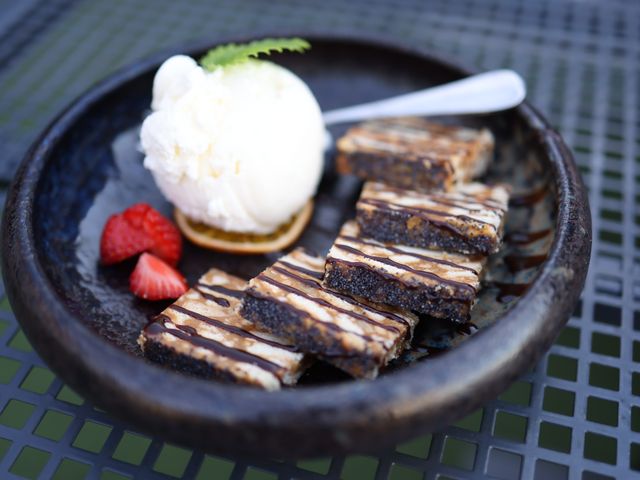



Find more like this
- Meal
- Dessert
- Cuisine
- Caribbean
- Main ingredient
- Eggs
- Diet
- Vegetarian
- Method
- Oven