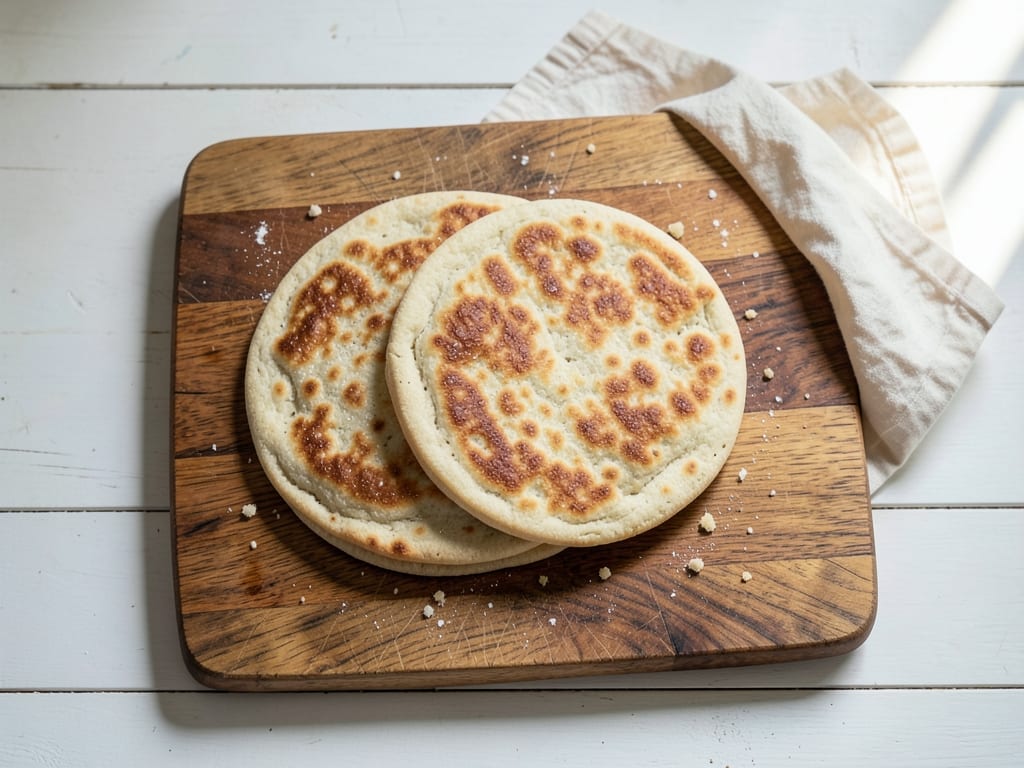
Classic Pan-Fried Bannock
A simple, tender Canadian quick bread made from flour, baking powder, lard and water. The dough comes together in minutes and cooks in a skillet to a golden crust with a soft, fluffy middle. It is wonderful with jam, alongside soup or stew, or split and filled.
- Prep
- 10 min
- Cook
- 20 min
- Wait
- 20 min
- Total
- 50 min
- Makes
- 1 large round bannock cut into 6 wedges (or 6 small rounds)
Steps
Before you start
- Use cold lard straight from the fridge so it stays in small pieces and makes the bannock tender.
- Use a heavy 10-inch (25 cm) skillet, preferably cast iron, so the heat stays steady.
- Check that your baking powder is fresh (it should fizz in hot water); old baking powder gives a flat, dense bannock.
- Keep the heat at medium-low; high heat browns the outside before the center cooks.
Mix dry ingredients
- In a large bowl, whisk together 2½ cups (310 g) flour, 1 tablespoon (12 g) baking powder and ¾ teaspoon (4 g) salt until evenly combined, about 30 seconds.
+ Show details− Hide details
Ready when: No streaks of baking powder or salt remain.
Tip: Whisking spreads the baking powder evenly so the bannock rises uniformly.
Rub in the lard
- Add the 3 tablespoons (40 g) cold lard pieces.
- Cut or rub them into the flour with a pastry cutter or fingertips until the mixture looks like coarse crumbs with some pea-sized bits of fat remaining.
+ Show details− Hide details
Ready when: Mixture looks like coarse crumbs with a few pea-sized pieces of lard.
Tip: Work quickly so the lard stays cold and doesn't melt into the flour.
Add water
- Make a well in the center.
- Pour in ¾ cup (180 ml) cool water and stir with a fork just until a shaggy, sticky dough forms.
- If dry flour remains at the bottom of the bowl, add 1–2 tablespoons more water.
+ Show details− Hide details
Ready when: Dough holds together in a shaggy mass with no dry flour left in the bowl.
Tip: Don't overmix; too much stirring makes tough bannock.
Knead and rest
- Turn the dough onto a lightly floured surface.
- Knead gently 6–8 times, just until it comes together into a smooth-ish ball.
- Cover with the upturned bowl or a clean towel and let rest 15 minutes.
+ Show details− Hide details
Ready when: Dough is soft, slightly tacky and no longer springs back when pressed.
Tip: Dust your hands with flour rather than adding flour to the dough.
Shape the dough
- Pat the dough into a round disc about ¾ inch (2 cm) thick and 8 inches (20 cm) across.
- Score it lightly into 6 wedges with a knife, cutting only about ¼ inch (5 mm) deep.
- Prick the surface a few times with a fork.
+ Show details− Hide details
Ready when: Disc is even in thickness, about ¾ inch (2 cm).
Tip: An even thickness cooks evenly; thin edges will burn before the center is done.
Heat the skillet
- Melt 2 tablespoons (28 g) lard in a 10-inch (25 cm) skillet over medium-low heat until it shimmers and a pinch of flour sizzles gently, about 2 minutes.
+ Show details− Hide details
Ready when: Lard is melted and shimmering, with no smoke.
Tip: If the fat smokes, take the pan off the heat for a minute and lower the burner.
Cook first side
- Carefully lay the dough in the skillet.
- Cover with a lid or baking sheet and cook 8–10 minutes without moving it, until the underside is deep golden brown and the dough has puffed and set around the edges.
+ Show details− Hide details
Ready when: Underside is deep golden brown and the edges look dry and set.
Tip: Lift an edge with a spatula to peek; if it browns too fast, lower the heat.
Flip and finish
- Slide a large spatula underneath and flip the bannock.
- Cook uncovered 7–9 minutes more, until the second side is golden and the center is cooked through.
+ Show details− Hide details
Ready when: Both sides are golden brown, it sounds hollow when tapped, and a toothpick in the center comes out clean (about 200°F/93°C inside).
Tip: If the center still seems doughy, cover and cook 3–4 minutes more on lower heat.
Cool and serve
- Transfer the bannock to a wire rack and let it cool for 5 minutes.
- Cut or tear along the scored lines and serve warm.
+ Show details− Hide details
Ready when: Crumb is soft, fluffy and no longer steaming heavily when torn.
Good to know
Tips
- Handle the dough as little as possible for a tender, fluffy result.
- Keep the heat at medium-low so the center cooks before the outside darkens.
- For small rounds, divide the dough into 6 pieces, pat to ½ inch (1 cm) thick and cook 4–5 minutes per side.
- Cover the skillet for the first side so the top steams and the center cooks through before the bottom darkens.
Make ahead
Mix the dry ingredients and cut in the lard up to 1 day ahead; cover and refrigerate. Add the water, rest and cook when ready.
Storage & reheating
Room temperature in an airtight container or wrapped for up to 2 days. Refrigerate up to 5 days. Freeze wrapped wedges up to 3 months. Reheat by warming wedges in a dry skillet over medium-low heat for 2–3 minutes per side, or toast split wedges until hot.
Substitutions
- lard → cold unsalted butter or vegetable shortening. Butter adds flavor but browns faster; shortening behaves like lard.
- lard → vegetable oil or butter with a little oil. Use the same amount; oil gives a crisper crust.
- all-purpose flour → half whole wheat flour. Replace up to half the flour; add 1–2 extra tablespoons water for a slightly denser, nuttier bannock.
- water → milk. Gives a softer crumb and richer browning; use the same amount.
More quick breads
See all →
Find more like this
- Meal
- Breakfast
- Method
- Stovetop
- Quick & Easy
- 5 Ingredients or LessEasyBudget