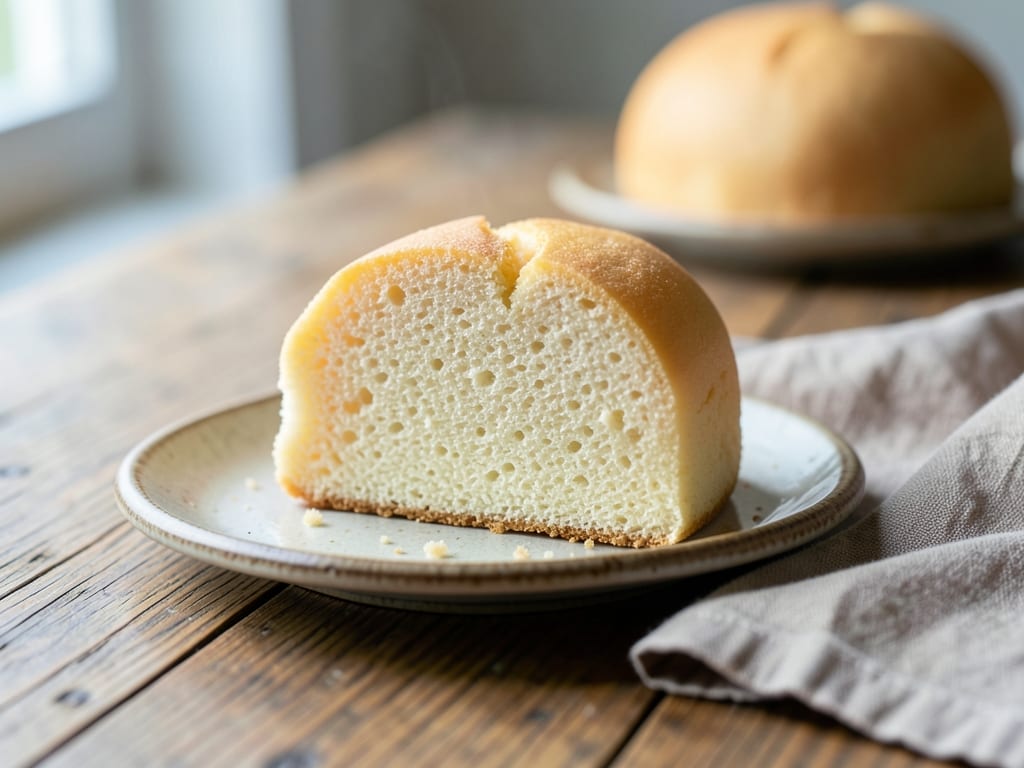
Steamed Chinese Sponge Cake Mantou (Ji Dan Gao Style Quick Bread)
Soft, springy, golden-white steamed sponge buns with a mild milky sweetness. They use baking powder and whipped eggs instead of yeast, so there is no rising time, and they go from bowl to table in under an hour.
- Prep
- 25 min
- Cook
- 18 min
- Wait
- 15 min
- Total
- 58 min
- Makes
- 10 steamed cakes (about 3 inches / 7.5 cm wide)
Steps
Before you start
- Take the eggs and milk out of the fridge 30 minutes ahead so they are at room temperature. Room-temperature eggs whip to a much better volume.
- You need a steamer with a tight lid that holds 10 cups in one or two tiers. If yours holds only 5 cups, steam in two batches (see the tips).
- Check that your baking powder is double-acting and less than 6 months old. Steamed batters depend on it for all of their lift.
- Start heating the steamer water while you mix (step 1). It must be at a full boil when the cups go in.
Start the steamer
- Pour the hot water into the wok or pot so it comes about 1½ inches (4 cm) up the side.
- It must stay below the steamer rack or basket.
- Cover and bring to a full boil over high heat while you mix.
- Line the 10 cups with paper liners, or brush the insides lightly with oil if using silicone or ramekins.
- Set the cups on a tray.
- Wrap a clean kitchen towel around the lid and tie the ends on top, away from the heat.
+ Show details− Hide details
Ready when: Water is at a rolling boil with steam escaping from the edges of the lid.
Tip: The towel-wrapped lid absorbs condensation. Without it, water drips onto the cakes and leaves pockmarked, soggy tops.
Whip eggs and sugar
- Put the eggs and sugar in the large bowl.
- Beat with the electric mixer on medium-high speed for 6 to 7 minutes.
- The mixture should become pale yellow, thick and about tripled in volume.
+ Show details− Hide details
Ready when: When you lift the beaters, the batter falls in a thick ribbon that stays visible on the surface for about 3 seconds before sinking.
Tip: Don't cut this step short. Whipped eggs provide the sponge structure along with the baking powder.
Mix the liquids
- In a measuring cup, stir together the milk, oil and vanilla.
- With the mixer on its lowest speed, pour the liquid into the egg mixture in a slow stream.
- Mix for only 10 to 15 seconds, just until it is incorporated.
+ Show details− Hide details
Ready when: No oil slick on the surface, and the batter is smooth and slightly thinner than before.
Tip: Stop mixing as soon as the liquid is in. Extra mixing knocks out the air you just whipped in.
Sift and fold dry
- Whisk the flour, cornstarch, baking powder and salt together in a separate bowl.
- Sift them over the egg batter in two additions.
- After each, use the rubber spatula to fold gently, scraping down to the bottom of the bowl and sweeping up and over, until no dry flour remains.
+ Show details− Hide details
Ready when: The batter is smooth, thick but pourable, with no flour streaks or lumps.
Tip: Fold with a light hand, about 20 to 25 strokes total. A stirred batter gives tough, dense cakes. Start steaming right away once the baking powder is wet.
Fill the cups
- Spoon or pour about 68 g (a scant ⅓ cup) of batter into each prepared cup, filling it about two-thirds full.
- Tap each cup gently on the counter twice to pop large air bubbles.
- Divide the cups between the two steamer tiers, leaving about 1 inch (2.5 cm) between them so steam circulates and the cakes have room to puff.
+ Show details− Hide details
Ready when: Each cup is two-thirds full and the batter surface is level.
Tip: Don't fill the cups more than two-thirds full. The cakes expand and can overflow.
Steam the cakes
- Reduce the heat to medium-high so the water keeps a steady, strong simmer with plenty of steam.
- Carefully set the steamer tiers over the water and cover with the towel-wrapped lid.
- Steam for 18 minutes without lifting the lid.
+ Show details− Hide details
Ready when: The tops are domed, spring back when lightly pressed, and a toothpick in the center comes out clean. An instant-read thermometer reads about 200°F (93°C).
Tip: Opening the lid early lets the heat drop and the domes collapse. If the pot needs more water, add boiling water only, never cold.
Rest with lid ajar
- Turn off the heat.
- Leave the lid on for 1 minute, then open it a crack, away from you, and let the cakes sit for 4 more minutes.
- This lets the temperature drop gradually.
+ Show details− Hide details
Ready when: Domes stay full and smooth after the lid is cracked open.
Tip: Open the lid away from your face because the steam is scalding.
Cool and serve
- Using silicone-tipped tongs or heatproof gloves, lift the cups out of the steamer onto a wire rack.
- Let them cool for 10 minutes, then lift the cakes out of their cups.
- Serve warm or at room temperature.
+ Show details− Hide details
Ready when: Cakes are warm, not hot, and release cleanly from the cups.
Good to know
Tips
- If your steamer fits only one tier of 5 cups, steam in two batches. Keep the second batch of batter covered at room temperature for no more than 15 minutes, and fill the cups only after the first batch is done.
- To avoid wrinkled, collapsed tops, keep the steam strong and steady and never let the water boil dry or drop to a gentle simmer.
- If the tops crack and look rough, the heat is too high or the batter was over-mixed. Reduce the heat slightly and fold less next time.
- For a more traditional mantou look, serve the cakes plain with sweetened condensed milk for dipping, or split and fill with a little butter.
Make ahead
Steam the cakes up to 1 day ahead, cool completely, and store as described below. Re-steam to refresh them before serving. Don't mix the batter ahead of time, because the baking powder activates as soon as it is wet.
Storage & reheating
Room temperature in an airtight container for up to 1 day. Refrigerator for up to 4 days. Freezer for up to 2 months, wrapped individually, then in a freezer bag. To reheat, steam refrigerated cakes for 4 to 5 minutes, or frozen cakes for 8 to 10 minutes, over boiling water until soft and hot in the center. Or microwave one cake, wrapped in a damp paper towel, for 20 to 30 seconds.
Substitutions
- all-purpose flour → cake flour or low-protein Chinese bun flour (210 g), with the cornstarch omitted and replaced by 30 g more flour. This gives an even softer, more tender crumb.
- whole milk → unsweetened soy milk or oat milk, same amount. The flavor is slightly different, but the texture is nearly identical.
- neutral oil such as canola or grapeseed → melted unsalted butter, cooled, same amount. This adds a richer, buttery flavor, and the cakes firm a little more when cold.
- granulated sugar → light brown sugar, same weight. The cakes will be slightly darker with a caramel note.