Classic Eggs Benedict with Hollandaise
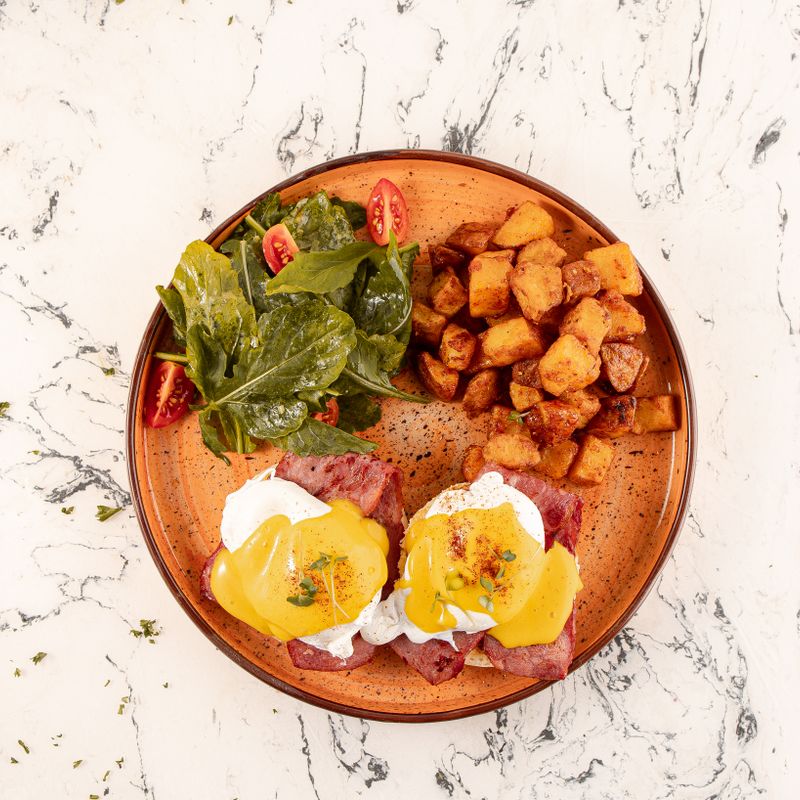
Toasted English muffins topped with seared Canadian bacon, tender poached eggs with runny yolks, and a silky, lemony hollandaise whisked from scratch over gentle heat. It's a true brunch showpiece, and this method keeps each part timed so everything reaches the table warm.
- Prep
- 20 min
- Cook
- 22 min
- Wait
- 8 min
- Total
- 50 min
- Makes
- 4 servings (2 halves each, 8 benedicts total)
Steps
Before you start
- Have everything measured and within reach before you turn on any heat. Hollandaise and poached eggs both need your full attention, and the dish comes together fast.
- Use very fresh eggs for poaching. Fresh whites hold close to the yolk and give a neat shape.
- Make the hollandaise first. It holds warm for about 15 minutes while you finish the bacon, muffins and eggs.
- You need 12 large eggs total: 8 whole eggs for poaching and 4 more for their yolks. Save the 4 whites for scrambled eggs or an omelet.
Set up your stations
- Separate 4 eggs, putting the 4 yolks in a heatproof bowl and saving the whites.
- Crack the 8 eggs for poaching, 2 per ramekin, into the 4 ramekins, taking care not to break the yolks.
- Strain the lemon juice.
- Split the English muffins with a fork.
- Set a plate lined with paper towels near the stove.
- Pour the lemon juice into the yolks along with the water, and have the salt and cayenne ready.
+ Show details− Hide details
Ready when: Yolks, eggs and muffins are all ready within arm's reach
Tip: Sliding the eggs from a ramekin into the water is gentler than cracking straight into the pot, so the whites stay together.
Melt the butter
- Cut the butter into pieces and put it in a small saucepan over medium-low heat.
- Stir occasionally until fully melted and hot but not browned, about 3 minutes (it should reach about 130°F / 55°C).
- Remove from the heat and keep it near the stove.
- Hot butter emulsifies better than lukewarm butter.
+ Show details− Hide details
Ready when: Butter is fully liquid, with no browning and no solid pieces
Tip: Don't let it brown. Brown butter turns the sauce dark and nutty rather than bright and lemony.
Heat the two pans of water
- Pour about 1 inch (2.5 cm) of water into the 2-quart saucepan and bring it to a bare simmer over medium-low heat.
- Pour about 3 inches (8 cm) of water into the deep skillet, add the vinegar, and bring it to a gentle simmer over medium heat, with small bubbles on the bottom and sides of the pan and an occasional bubble rising (about 180°F / 82°C).
- Do not let it reach a rolling boil.
+ Show details− Hide details
Ready when: Water shows small bubbles but isn't rolling
Tip: A rolling boil tears the whites into wispy strands. Lower the heat as soon as you see big bubbles.
Whisk the yolks
- Set the bowl with the yolks, lemon juice and water on top of the saucepan of barely simmering water, making sure the bottom doesn't touch the water.
- Whisk constantly and vigorously, scraping the bottom and sides, for 3 to 4 minutes, until the yolks thicken, turn pale yellow and form ribbons that hold for a second when you lift the whisk, and the mixture reaches 160°F (71°C).
- If the bowl gets too hot or the eggs start to look scrambled at the edges, lift it off the heat for a few seconds while whisking.
+ Show details− Hide details
Ready when: Yolks are pale, thick and ribbon-like, and an instant-read thermometer reads 160°F (71°C)
Tip: Heating the yolks to 160°F (71°C) cooks them to a food-safe temperature.
Emulsify in the butter
- Take the bowl off the saucepan and set it on a folded towel so it doesn't slide.
- Whisking constantly, add the hot melted butter a few drops at a time at first, then in a thin, steady stream once the sauce starts to thicken and look glossy.
- Leave behind the milky white solids at the bottom of the butter pan.
- Stir in the salt and cayenne.
+ Show details− Hide details
Ready when: Sauce is thick, smooth and glossy, and coats the back of a spoon
Tip: If the sauce looks greasy or starts to split, whisk in 1 teaspoon of hot water, then continue adding the butter more slowly.
Taste and hold the sauce
- Taste the hollandaise and adjust with a few more drops of lemon juice, a pinch of salt or a little more cayenne.
- Turn off the heat under the saucepan and set the bowl back over the warm (not simmering) water to hold.
- Cover with a plate or plastic wrap.
- Whisk occasionally.
- Use within 15 minutes.
+ Show details− Hide details
Ready when: Sauce tastes bright, buttery and lightly peppery, and is pourable but thick
Tip: If the sauce thickens too much while it waits, whisk in 1 teaspoon of warm water.
Sear bacon and toast muffins
- Brush a 10-inch (25 cm) nonstick skillet with the oil and heat over medium heat.
- Add the Canadian bacon in a single layer (work in two batches if needed) and cook 1 to 2 minutes per side until browned in spots and hot through, about 140°F (60°C).
- Move to the paper towel-lined plate.
- Meanwhile, toast the muffin halves in a toaster or under the broiler until golden and crisp at the edges.
+ Show details− Hide details
Ready when: Bacon is browned in spots and hot; muffins are golden and crisp
Tip: Cover the bacon and muffins loosely with foil so they stay warm while the eggs poach.
Poach the eggs
- Turn the poaching water down to low to keep a gentle simmer, with the water barely moving.
- Lower the lip of each ramekin to the water's surface and slide in 4 eggs, spacing them apart.
- Poach for 3 minutes for set whites and runny yolks (3½ to 4 minutes for a jammy yolk).
- Lift each egg out with a slotted spoon, rest it on paper towels for a few seconds to drain, and trim any ragged edges.
- Repeat with the remaining 4 eggs.
+ Show details− Hide details
Ready when: Whites are opaque and set, yolks jiggle and feel soft when pressed gently
Tip: Poach 4 at a time at most, or the water temperature drops and they cook unevenly.
Assemble and serve
- Place 2 toasted muffin halves on each of 4 warm plates.
- Top each with a slice of Canadian bacon, then a well-drained poached egg.
- Whisk the hollandaise briefly, spoon generously over each egg, and finish with chives, if using, and freshly ground black pepper.
- Serve right away.
+ Show details− Hide details
Ready when: Sauce is warm and glossy and cloaks each egg
Tip: Blot each egg on a paper towel before it goes on the muffin, so water doesn't thin the sauce.
Good to know
Tips
- Keep the hollandaise warm, not hot. Over 160°F (71°C) the yolks scramble, and below about 100°F (38°C) the butter can firm up.
- Use a bowl that fits snugly over the pan so steam doesn't escape and heat stays gentle.
- To fix a broken hollandaise, whisk 1 tablespoon of hot water in a clean bowl, then slowly whisk the broken sauce into it a little at a time.
- Pre-heat the plates in warm water or a 200°F (95°C) oven so the benedicts stay hot.
Make ahead
"Poached eggs can be made up to 2 days ahead: undercook them by 30 seconds, move them to ice water for 2 minutes, then refrigerate in cold water. Rewarm in hot (not boiling) water for 60 seconds. Hollandaise is best fresh, but holds warm for up to 15 minutes in a bowl over warm water."
Storage & reheating
"Best eaten immediately. Leftover components keep separately: refrigerate poached eggs in water and cooked Canadian bacon up to 2 days. Leftover hollandaise keeps in the fridge up to 2 days in an airtight container; reheat gently in 10-second bursts in the microwave at 50% power, whisking each time, or whisk over warm water, adding a teaspoon of warm water if it thickens. Do not freeze hollandaise or poached eggs. Cooked Canadian bacon can be frozen for up to 2 months."
Substitutions
- Canadian bacon slices → thick-sliced ham, smoked salmon or sautéed spinach. For smoked salmon or spinach, skip searing and just layer them on the muffins.
- fresh lemon juice → white wine vinegar. Use 1 tablespoon, which gives a sharper, more traditional tang.
- English muffins → thick slices of toasted sourdough or biscuits. Cut sourdough to a similar size to the muffin halves so the eggs stay put.
- unsalted butter → ghee (clarified butter). Ghee is already free of milk solids, so it blends smoothly, and the flavor is slightly nuttier.