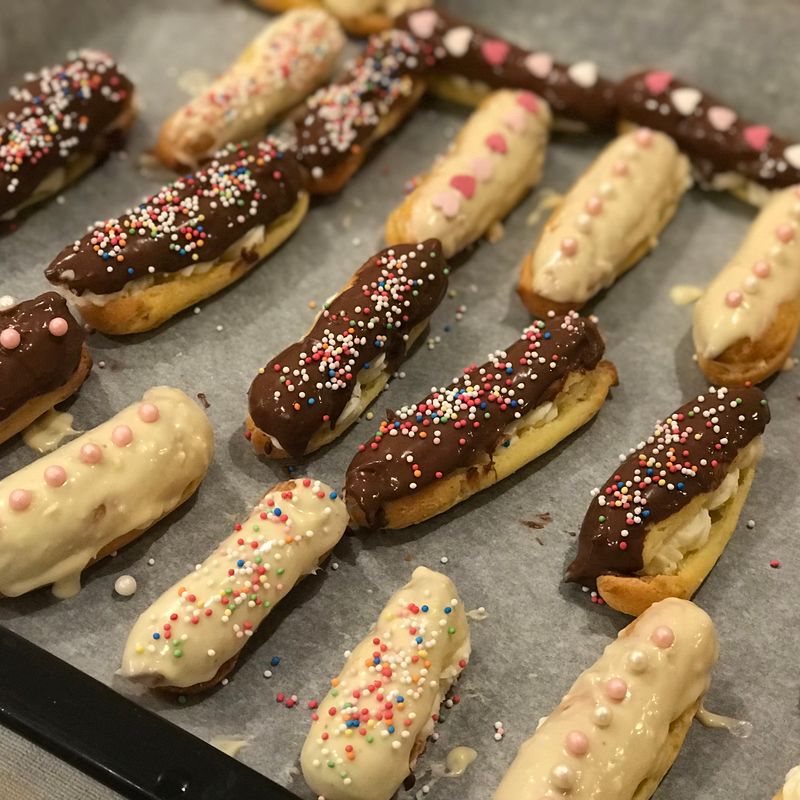
Chocolate Éclairs with Vanilla Pastry Cream
Crisp, hollow choux shells filled with silky vanilla pastry cream and dipped in glossy dark chocolate glaze. This is the classic French bakery pastry, with exact cues so every step is clear.
- Prep
- 1 hr 10 min
- Cook
- 45 min
- Wait
- 53 min
- Total
- 2 hr 48 min
- Makes
- 12 éclairs, each about 5 inches (13 cm) long
Steps
Before you start
- Read the whole recipe first. Make the pastry cream before the choux so it chills while you make and bake the shells. It needs at least 2 hours in the fridge to set, which overlaps with the choux steps, so the clock times listed count that chilling only once.
- Weigh the flour and eggs on a scale. Choux depends on accurate amounts, and eggs vary in size.
- Heat the oven only when you start the choux paste. Position racks in the upper and lower thirds, and use two light-colored baking sheets.
- On each sheet of parchment, draw six 5-inch (13 cm) lines, about 2 inches (5 cm) apart. Flip the parchment over so the ink is underneath.
Whisk the yolk base
- In a medium heatproof bowl, whisk the egg yolks, the pastry cream sugar, cornstarch and the pastry cream salt for 1 minute, until pale yellow and completely smooth with no cornstarch lumps.
- Set the bowl on a damp towel so it stays steady.
+ Show details− Hide details
Ready when: The mixture is thick, pale and smooth.
Tip: Whisk right after combining. Sugar left sitting on yolks forms hard specks.
Heat the milk
- Pour the 2 cups (480 ml) milk into a heavy 3-quart (3 L) saucepan.
- Warm over medium heat for 4 to 5 minutes, stirring occasionally, until tiny bubbles form around the edge and steam rises.
- Do not let it boil.
+ Show details− Hide details
Ready when: Small bubbles around the edge and steam rising, about 180°F (82°C).
Cook the pastry cream
- Slowly pour about half of the hot milk into the yolk mixture while whisking constantly, then pour everything back into the saucepan.
- Cook over medium heat, whisking constantly and reaching into the corners.
- After 2 to 3 minutes the cream will thicken suddenly and begin to bubble.
- Keep whisking and cook 1 more minute so the cornstarch cooks fully.
+ Show details− Hide details
Ready when: Thick like pudding, with large slow bubbles popping on the surface, and 185°F (85°C) or higher on a thermometer.
Tip: Don't stop whisking. Scrambled bits and a scorched bottom happen fast. Cornstarch must bubble for the cream to stay thick later.
Finish and chill
- Remove the pan from the heat.
- Whisk in the vanilla and the butter pieces until melted and smooth.
- Press the cream through a fine-mesh sieve into a clean bowl.
- Press plastic wrap directly onto the surface so no skin forms.
- Refrigerate at least 2 hours, until completely cold and firm.
- This chilling runs in the background while you make, bake and cool the shells in the next steps, so no extra waiting time is counted here.
+ Show details− Hide details
Ready when: Cold throughout and firm enough to hold a spoon-shaped dent (checked at filling time).
Tip: For faster chilling, spread it in a shallow dish before wrapping.
Cook the choux pasteOven 425°F / 220°C
- Preheat the oven to 425°F (220°C) with racks in the upper and lower thirds.
- Line two baking sheets with the marked parchment, marks face down.
- In a 2-quart (2 L) saucepan, combine the water, milk, butter cubes, sugar for the choux and salt.
- Heat over medium-high, stirring, until the butter melts and the liquid reaches a full rolling boil.
- Immediately remove from the heat and dump in all the sifted flour at once.
- Stir hard with a wooden spoon until a smooth ball forms.
- Return to medium heat and stir constantly for 2 minutes, mashing the dough against the pan, until a thin film forms on the pan bottom.
+ Show details− Hide details
Ready when: The dough pulls away from the sides as a smooth ball, a thin film coats the pan bottom, and the dough is about 175°F (80°C).
Tip: Boil the liquid fully before adding flour. If the butter melts slowly, too much water evaporates and the dough turns dry.
Beat in the eggs
- Transfer the dough to a large bowl or stand mixer with the paddle.
- Stir for 1 to 2 minutes to release steam, until warm to the touch but not hot (about 140°F/60°C).
- Add the beaten egg in 5 or 6 additions on medium-low speed, mixing until completely smooth after each.
- You may not need every drop.
- Stop when the paste is thick, glossy and falls from the lifted spoon in a V-shaped ribbon that holds for a few seconds.
+ Show details− Hide details
Ready when: Glossy paste that drops from the spoon in a V-shaped ribbon and leaves a pointed tip when you pull away.
Tip: Add the last egg a little at a time. Too much egg gives flat, soft shells.
Pipe the shells
- Fit a piping bag with a ½-inch (1.5 cm) round tip and fill it with the warm paste.
- Hold the bag at 45 degrees, tip just above the parchment.
- Pipe 5-inch (13 cm) logs along the drawn lines, about 2 inches (5 cm) apart, six per sheet, on both sheets.
- Stop squeezing, then drag the tip away to cut the paste.
- Smooth any peaks with a wet fingertip.
+ Show details− Hide details
Ready when: Logs are even in thickness, about ¾ inch (2 cm) wide, with smooth tops.
Tip: Pipe with steady pressure. Uneven logs bake unevenly.
Bake hot to puffOven 425°F / 220°C
- Put one sheet on the upper rack and one on the lower rack of the 425°F (220°C) oven.
- Bake for 10 minutes.
- Do not open the oven door during this time, so the shells puff and rise.
+ Show details− Hide details
Ready when: Shells have risen and are pale gold.
Tip: Opening the door early lets out steam and the shells can sink.
Bake lower to dryOven 375°F / 190°C
- Without opening the door yet, lower the oven to 375°F (190°C).
- Bake 10 minutes, then quickly swap the sheets' positions and rotate each front to back.
- Bake 12 to 15 more minutes, until the shells are deep golden brown, firm and feel light when lifted.
+ Show details− Hide details
Ready when: Deep golden brown all over, including the sides and cracks, feeling hollow and light.
Tip: Pale shells collapse as they cool. If in doubt, bake 3 more minutes.
Vent the steam
- Turn the oven off.
- Poke a small hole in the end or underside of each shell with a paring knife.
- Return the shells to the oven, with the door propped open about 1 inch (2.5 cm) with a wooden spoon handle, for 10 minutes to dry the inside.
+ Show details− Hide details
Ready when: Insides feel dry, not damp, when you peek into a hole.
Cool the shells
- Move the shells to a wire rack.
- Cool completely, about 25 minutes, until no warmth remains.
- Slice each shell in half horizontally with a serrated knife, or keep whole and fill through the holes.
+ Show details− Hide details
Ready when: Shells are fully cool to the touch.
Tip: Fill warm shells and the cream will melt and weep.
Make the glaze
- Put the chopped chocolate and optional corn syrup in a small heatproof bowl.
- Heat the cream in a small saucepan over medium heat for 2 to 3 minutes until it steams and tiny bubbles appear at the edge.
- Pour over the chocolate, let stand 1 minute, then stir slowly from the center outward until smooth and glossy.
- Cool 5 to 10 minutes, until it thickly coats a spoon and feels barely warm.
+ Show details− Hide details
Ready when: Smooth, glossy and thick enough to coat the back of a spoon.
Tip: Stir slowly to avoid air bubbles, which dull the shine.
Fill and glaze
- Check that the pastry cream is completely cold and firm; if it is still soft, return it to the fridge until it is.
- Whisk the cold pastry cream until smooth and spoon it into a piping bag with a ¼-inch (6 mm) tip or the ½-inch tip.
- Pipe cream into each shell, either along the open bottom half or through the holes until the shell feels heavy and cream just shows at the holes.
- Dip the top of each éclair, or the top half if split, into the glaze.
- Wipe the edges with a finger and set on a rack.
- Let the glaze set for 15 minutes.
- Assemble split shells by setting the glazed tops on the filled bottoms.
+ Show details− Hide details
Ready when: Glaze is matte-shiny and no longer wet when touched lightly.
Tip: Fill within 2 hours of serving so the shells stay crisp.
Good to know
Tips
- Don't skip the second bake and venting. Underbaked or steamy shells collapse and turn soggy.
- Add the eggs gradually. The right paste holds a V-shape on the spoon, and the final egg is often only partially needed.
- Use the 5 leftover egg whites for meringues or an omelet; they are not needed in this recipe.
- If the shells crack unevenly, the oven may be too hot or the dough too stiff; a little extra egg helps next time.
Make ahead
Make the pastry cream up to 2 days ahead and keep it refrigerated with plastic wrap pressed on the surface. Unfilled baked shells keep in an airtight container for 1 day, or freeze for 1 month. Re-crisp frozen shells at 350°F (175°C) for 5 to 8 minutes, then cool completely before filling.
Storage & reheating
Filled éclairs are best the day they are made. Refrigerate in a single layer in an airtight container for up to 2 days; the shells soften slightly. Do not store at room temperature for more than 2 hours. Unfilled shells keep 1 day at room temperature in an airtight container or up to 1 month in the freezer. Filled éclairs do not freeze well. Serve chilled or let stand 10 minutes at room temperature.
Substitutions
- dark chocolate, 60–70% cacao → semisweet chocolate chips. Slightly sweeter and thicker; add 1 tablespoon more cream if the glaze is too stiff.
- pure vanilla extract → 1 vanilla bean, split and scraped. Simmer the pod in the milk, then remove it before tempering; this gives a stronger flavor.
- light corn syrup → honey or omit. Adds shine; the glaze is fine without it.
- all-purpose flour → bread flour. Gives slightly sturdier shells; use the same weight, 140 g.
More pastries
See all →


Find more like this
- Meal
- Dessert
- Cuisine
- French
- Diet
- VegetarianHalal
- Quick & Easy
- Make Ahead