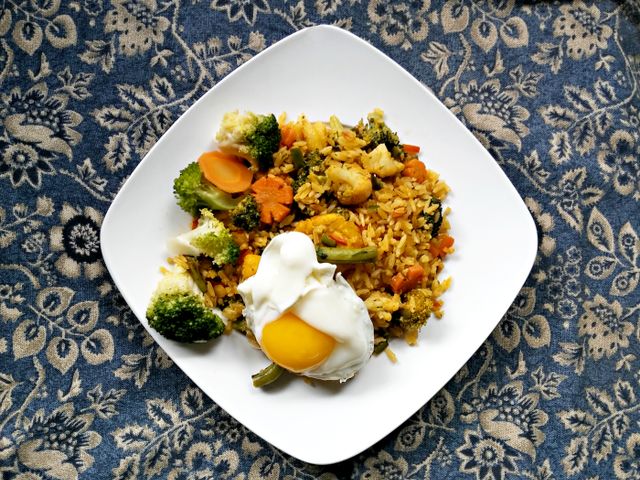
Chinese Soy Vinegar Braised Rice
A deeply savory and tangy braised rice dish infused with soy sauce, black vinegar, and warm spices. The rice grains absorb a glossy coating of umami flavors from the braising liquid, while star anise and rock sugar add complexity and subtle sweetness. This stovetop method creates tender rice with concentrated flavor—a perfect side for stir-fries, roasted meats, or simply on its own.
- Prep
- 10 min
- Cook
- 25 min
- Wait
- 10 min
- Total
- 45 min
- Makes
- About 3 cups braised rice (4 servings)
Steps
Before you start
- Measure all ingredients before starting; the cooking happens quickly once liquid hits the hot pot.
- If using raw rice, rinse it under cold water until the water runs mostly clear to remove excess starch.
- Have a lid ready for your pot—a tight-fitting lid is essential for even cooking.
Heat pot and toast rice
- Set a medium saucepan (3-quart / 2.8L) over medium heat.
- Add 1 tablespoon vegetable oil and swirl to coat the bottom.
- Once hot, add the rinsed rice and stir constantly with a wooden spoon for 2–3 minutes, until the rice is lightly toasted and smells fragrant.
- The grains should look slightly drier and may develop a pale golden tint.
+ Show details− Hide details
Ready when: Rice smells fragrant and grains have a slightly dry appearance
Tip: Toasting the rice prevents it from becoming mushy and deepens its flavor.
Mix braising liquid
- While the rice toasts, whisk together 2 cups stock, 3 tablespoons soy sauce, 1.5 tablespoons black vinegar, and 1 tablespoon rock sugar in a small bowl.
- Stir until the sugar dissolves.
- This ensures even seasoning throughout the braising liquid.
+ Show details− Hide details
Ready when: Sugar completely dissolves in the liquid
Tip: Dissolving the sugar before adding ensures uniform sweetness and prevents grittiness.
Add liquid and spices
- Pour the braising liquid carefully into the toasted rice, stirring gently to combine and prevent lumps.
- Add 2 star anise pods and stir once.
- The liquid should just cover the rice with about ½ inch above.
- Increase heat to medium-high and bring to a boil, watching closely—do not walk away.
+ Show details− Hide details
Ready when: Liquid reaches a rolling boil with visible steam
Tip: Keep the heat at medium-high to reach a boil quickly; this helps the rice cook evenly.
Braise covered
- Once boiling, immediately reduce heat to medium-low.
- Place a tight-fitting lid on the pot and let the rice braise undisturbed for 18–20 minutes.
- Do not lift the lid during cooking; the steam trapped inside cooks the rice evenly.
- The rice should absorb all the braising liquid and become tender and glossy.
+ Show details− Hide details
Ready when: All braising liquid is absorbed; rice is tender and grains are slightly firm but not hard
Tip: Resist the urge to lift the lid—opening it releases steam and disrupts cooking. If you hear sizzling near the end, the heat may be too high; reduce it slightly.
Rest off heat
- Remove the pot from heat and keep the lid in place.
- Let the rice rest undisturbed for 10 minutes.
- This allows carryover cooking to finish and lets the grains firm up slightly, preventing mushiness.
+ Show details− Hide details
Ready when: Rice is fully set and grains are individual but tender
Tip: Resting is crucial—it stops the cooking process and improves texture.
Fluff and serve
- Remove the lid carefully and discard the star anise pods.
- Using a wooden rice paddle or fork, gently fluff the rice by breaking up any clumps with light, scraping motions from bottom to top.
- If using sesame oil, drizzle ½ teaspoon over the rice and gently fold it in.
- Transfer to a serving dish and garnish with the sliced scallion greens if desired.
- Serve hot.
+ Show details− Hide details
Ready when: Rice is fluffy with individual grains; no clumps remain
Tip: Use a light hand when fluffing to avoid breaking the grains. The sesame oil adds a final layer of aromatic flavor.
Good to know
Tips
- Rinsing the rice removes excess starch and prevents clumping, resulting in fluffier grains. Don't skip this step.
- Toasting the rice before braising locks in a slightly nutty flavor and prevents the grains from becoming gluey.
- The ratio of liquid to rice is crucial: use 1⅓ cups liquid per 1 cup rice. Too much liquid yields mushy rice; too little leaves it undercooked.
- For deeper color and richer flavor, substitute some of the stock with Chinese chicken broth made from dried scallops or chicken feet. Add 1 extra tablespoon soy sauce if doing so to maintain balance.
Make ahead
The rice can be cooked up to 4 hours ahead and reheated gently. To reheat, add 2–3 tablespoons water, cover, and warm over medium-low heat for 3–4 minutes, stirring occasionally until heated through. Alternatively, microwave in a covered container with a splash of water for 1–2 minutes.
Storage & reheating
Room temperature (covered): up to 2 hours. Refrigerator (in an airtight container): up to 3 days. Freezer: up to 2 months. Thaw in the refrigerator overnight and reheat as described above.
Substitutions
- Chinese black vinegar (or Worcestershire sauce as alternative) → Worcestershire sauce or regular rice vinegar mixed with a pinch of molasses. Black vinegar adds a deep, complex flavor; Worcestershire provides umami and slight sourness. Use 1.5 tablespoons Worcestershire or 1 tablespoon rice vinegar plus ½ teaspoon molasses.
- rock sugar (or regular granulated sugar) → Granulated white sugar or honey. Rock sugar dissolves slightly slower and adds a delicate sweetness; regular sugar works just as well. Use 1 tablespoon granulated sugar or 1.5 teaspoons honey.
- star anise pods → Whole cloves, cinnamon stick pieces, or Chinese five-spice powder. Star anise is licorice-forward; cloves are peppery-sweet, cinnamon is warm. Use 4–5 whole cloves, 1 cinnamon stick broken into pieces, or ½ teaspoon five-spice powder.
- chicken or vegetable stock → Vegetable or beef stock, or water. Chicken stock adds subtle savory depth. Vegetable stock is lighter; beef stock is richer. Water works but results in less complex flavor.