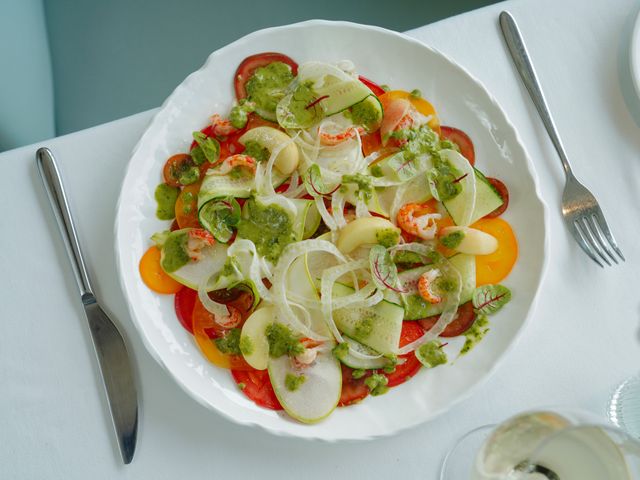
Chimichurri Rojo Dressing
A bright, punchy Argentine-style red chimichurri made with roasted red peppers, fresh parsley, garlic, and red wine vinegar, finished with warm spices and good olive oil. This versatile dressing clings to grilled meats, vegetables, and bread, bringing both heat and herbaceous depth. It's made by hand-chopping fresh herbs with roasted peppers and aromatics, then emulsifying everything with vinegar and olive oil—no blending, so the texture stays chunky and rustic.
- Prep
- 20 min
- Cook
- 15 min
- Wait
- 30 min
- Total
- 1 hr 5 min
- Makes
- About 1½ cups (360 ml)
Steps
Before you start
- Use a good-quality extra-virgin olive oil—it's the backbone of the dressing
- Have fresh flat-leaf parsley at room temperature; don't use dried
- If using jarred roasted red peppers, drain and pat them dry so they don't dilute the dressing with liquid
Char the Red Peppers
- Place whole red peppers directly over a medium-high flame on your stovetop (or under a broiler 4 inches from heat).
- Char them for 12–15 minutes, turning with tongs every 2–3 minutes, until the skin is blackened all over and blistered.
- You want the flesh to soften but still hold its shape.
+ Show details− Hide details
Ready when: Skin is completely blackened and blistered; flesh yields to gentle pressure
Tip: Don't rush this step—a proper char develops the sweet, smoky depth that makes chimichurri sing.
Steam and Peel
- Transfer the charred peppers to a bowl and cover it tightly with plastic wrap.
- Let them sit for 10 minutes so the steam loosens the skin.
- Once cool enough to handle, peel away the blackened skin under cool running water or with your fingers, rubbing gently.
- Remove the stem and seed pod.
- Pat the peppers dry with paper towels.
+ Show details− Hide details
Ready when: Skin peels away easily; peppers are moist but not dripping
Tip: Don't obsess over removing every last bit of char—some adds flavor and complexity.
Chop the Peppers
- Coarsely chop the roasted, peeled red peppers into roughly ¼-inch (6 mm) pieces and place them in a medium bowl.
- This should yield about ¾ cup (180 ml) of chopped peppers.
+ Show details− Hide details
Ready when: Peppers are chopped to roughly ¼-inch pieces
Tip: Use a sharp knife and a rocking motion for even pieces; avoid mashing them or they'll release too much liquid.
Toast the Spices
- In a small skillet over medium heat, combine the red pepper flakes and ground cumin.
- Toast them for about 1 minute, stirring constantly, until fragrant.
- Be careful not to burn them—cumin can turn bitter quickly.
+ Show details− Hide details
Ready when: Spices smell warm and aromatic; no dark spots or browning
Tip: Toasting blooms the oils in dried spices, deepening their flavor—don't skip it, even though it takes one minute.
Combine Herbs and Garlic
- Add the chopped parsley and minced garlic to the bowl with the roasted red peppers.
- Toss gently to distribute the garlic and herbs evenly.
- This is where the chimichurri gets its fresh, grassy character.
+ Show details− Hide details
Ready when: Parsley, garlic, and peppers are evenly mixed
Tip: Don't bruise the parsley by stirring too vigorously; gentle tossing preserves its bright color and flavor.
Add Spices and Seasoning
- Pour the toasted spices into the bowl along with the kosher salt and black pepper.
- Stir everything together with a fork or whisk until well combined.
- The mixture should smell warm, garlicky, and peppery.
+ Show details− Hide details
Ready when: Spices are evenly distributed and no pockets of salt remain
Tip: Taste and adjust salt now if you like, but wait until after the oil to make final seasoning calls.
Add Vinegar
- Pour in the red wine vinegar and stir well with a whisk or fork for about 1 minute.
- The vinegar will deglaze the bowl, bringing up any flavorful bits stuck to the bottom, and begin to soften the peppers slightly.
+ Show details− Hide details
Ready when: Vinegar is fully incorporated; mixture looks glossy
Tip: Whisking the vinegar helps it emulsify and prevents it from pooling at the bottom of the bowl.
Emulsify with Oil
- Slowly drizzle in about three-quarters of the olive oil (roughly ½ cup or 120 ml) while whisking constantly.
- This helps the oil and vinegar start to emulsify, creating a creamy consistency.
- Once half the oil is in, you can add the rest in larger pours.
- Whisk until the dressing is thick, glossy, and holds together without separating immediately.
- Don't over-whisk or you'll force a full emulsion that becomes paste-like; you want a rustic, chunky texture with a bit of oil visible.
+ Show details− Hide details
Ready when: Dressing is creamy and glossy; oil is mostly incorporated but some visible liquid remains
Tip: Whisk steadily but don't overwork it—chimichurri should be chunky and herbaceous, not a smooth paste.
Rest and Meld Flavors
- Transfer the chimichurri to a bowl or glass jar and let it sit at room temperature for 30 minutes.
- This allows the flavors to meld and the peppers to soften slightly.
- The oil will separate a little—that's normal and desirable.
+ Show details− Hide details
Ready when: Aromas are fully developed; dressing looks cohesive with visible herbs and red pepper pieces
Tip: Never refrigerate chimichurri before serving—the flavors come alive at room temperature.
Taste and Adjust
- Stir the chimichurri and taste it.
- Add more salt, vinegar, or red pepper flakes to your preference.
- If it tastes thin or vinegary, add a drizzle more olive oil.
- If it's too mild, add a pinch more red pepper flakes or garlic.
+ Show details− Hide details
Ready when: Dressing tastes balanced—spicy, garlicky, herbaceous, and tangy
Tip: Taste on grilled meat or bread, not just with a spoon—the context changes how the flavors register.
Good to know
Tips
- Chimichurri is best served at room temperature—the flavors flatten when cold and won't cling properly to grilled meat or vegetables.
- Use a good-quality extra-virgin olive oil; this dressing has nowhere to hide. Cheap oil will make it taste thin and greasy.
- If oil separates too much during storage, simply stir it back in. This is natural and doesn't mean anything is wrong—the dressing will separate and recombine every time you let it sit.
- Chimichurri rojo is meant to be eaten fresh and rustic. Don't aim for a perfectly smooth consistency; the chunky texture and visible herb pieces are the whole point.
Make ahead
You can make this chimichurri up to 2 days ahead. Store it in an airtight glass jar in the refrigerator. Before serving, let it come to room temperature and give it a stir (the oil will have separated, which is fine).
Storage & reheating
Room temperature (up to 4 hours before serving): Keep covered in a bowl or jar to prevent oxidation. Refrigerator (up to 3 days): Transfer to a glass jar with a tight lid. The oil will solidify slightly when cold; the flavors mellow. Bring to room temperature and stir before serving. Freezer (up to 3 months): Freeze in ice cube trays, then transfer cubes to a freezer bag. Thaw at room temperature or stir into warm grilled meat straight from the freezer. Reheating: Never reheat chimichurri—serve at room temperature for best flavor and texture.
Substitutions
- red bell peppers, fresh → 2 cups (300 g) roasted red peppers from a jar, drained and patted very dry. This saves 20 minutes of prep if you don't have fresh peppers or time to char them. Quality varies by brand, so taste and adjust spices accordingly.
- fresh flat-leaf parsley → ¾ cup (15 g) mixed fresh cilantro and flat-leaf parsley, or fresh basil. Cilantro adds brightness; basil shifts the flavor toward Italian. Don't use dried herbs—they'll ruin the fresh, rustic character.
- red wine vinegar → ¼ cup (60 ml) sherry vinegar or white wine vinegar. Sherry vinegar adds sweetness; white wine vinegar is sharper. Adjust quantity to taste.
- red pepper flakes (dried) → 1 fresh red chili, minced, or ¼ teaspoon cayenne pepper. Fresh chili adds fruity heat; cayenne is more one-dimensional. Add gradually and taste.