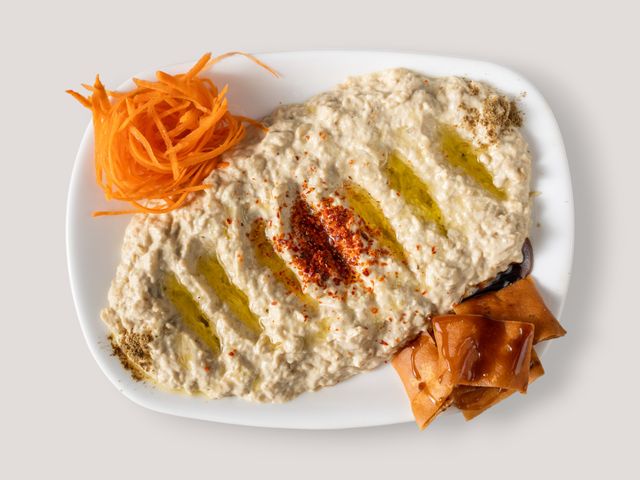
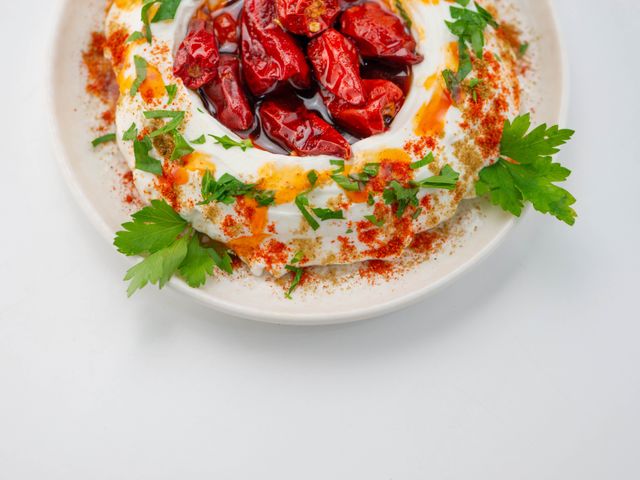
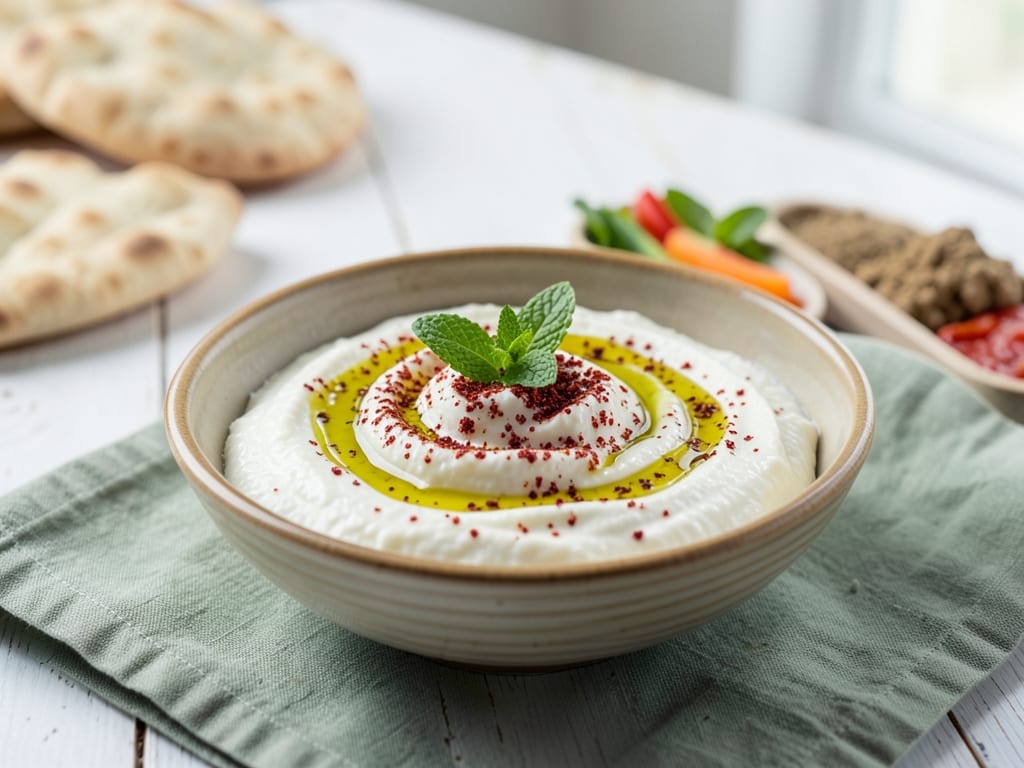
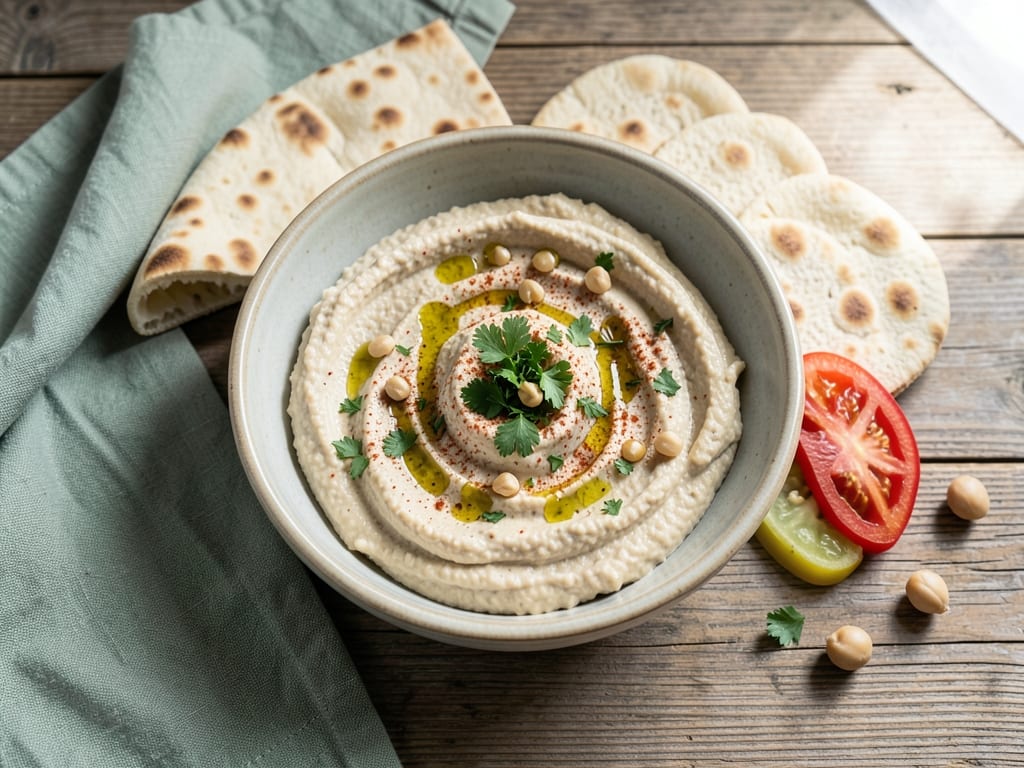
Charred Eggplant and Roasted Garlic Dip with Pomegranate Seeds
A smoky, creamy Lebanese-style dip made with eggplants charred over an open flame until the skin blackens and flesh turns silky. Roasted garlic adds sweetness and depth, while tahini creates richness. Bright lemon juice and pomegranate seeds provide sharp contrast. Serve warm or at room temperature with pita, vegetables, or crackers.
- Prep
- 15 min
- Cook
- 40 min
- Wait
- 10 min
- Total
- 1 hr 5 min
- Makes
- About 2 cups (480 ml) dip; serves 6 as an appetizer
Steps
Before you start
- Preheat your oven to 400°F (200°C) for roasting garlic, or have a gas flame ready for charring eggplant
- Juice the lemon before you begin so it's ready to add
- Have a shallow bowl of ice water nearby for cooling charred eggplants if charring over flame
Roast the garlicOven 400°F / 205°C
- Slice the top quarter off the garlic head to expose the cloves inside.
- Place it cut-side up on a small piece of aluminum foil.
- Drizzle with 1 tablespoon of olive oil and wrap loosely.
- Bake at 400°F (200°C) for 35–40 minutes, until the cloves are soft and golden.
- Remove and let cool for 5 minutes.
+ Show details− Hide details
Ready when: Garlic cloves are soft, golden, and easily squeezed from their skin
Tip: Roast the garlic while you prepare and char the eggplants so everything finishes at roughly the same time
Char the eggplants
- While the garlic roasts, prepare to char the eggplants.
- If you have a gas stovetop, turn one burner to high and carefully hold each eggplant with tongs over the flame, rotating every 30–45 seconds, until the skin is completely blackened all over (about 3–4 minutes per eggplant).
- If using an electric stovetop or broiler, place eggplants on a foil-lined baking sheet under the broiler at high heat for 20–25 minutes total, rotating every 5 minutes, until skin is charred and blistered all over.
- The flesh should feel very soft when pressed gently with tongs.
+ Show details− Hide details
Ready when: Skin is completely blackened and blistered; flesh yields easily when pressed with tongs
Tip: Charring over flame gives the best smoky flavor, but broiling works well too. Don't skip the charring step—it's what creates the distinctive baba ganoush flavor
Cool the charred eggplants
- Transfer the charred eggplants to a cutting board or shallow bowl.
- Let them rest for 5–10 minutes until cool enough to handle.
- This allows the flesh to firm up slightly, making it easier to separate from the skin.
+ Show details− Hide details
Ready when: Eggplants are cool enough to hold without discomfort
Peel the eggplants
- Once cool, cut each charred eggplant in half lengthwise.
- Using a spoon, gently scoop the soft flesh away from the blackened skin into a fine-mesh strainer or colander.
- Discard the skin.
- You should have about 1½ cups (360 ml) of loosely packed eggplant flesh.
- Let the flesh drain in the strainer for 2–3 minutes to remove excess liquid, pressing gently with the back of the spoon.
+ Show details− Hide details
Ready when: Skin is fully separated; drained flesh is no longer dripping
Tip: Don't oversqueeze the eggplant or it will become tough. Let gravity do the work in the strainer
Squeeze roasted garlic from skin
- Once the roasted garlic head has cooled, squeeze the soft cloves out of their skins into a small bowl.
- You should have about 1 tablespoon (12 g) of roasted garlic paste.
- Discard the papery skins.
+ Show details− Hide details
Ready when: All soft cloves are extracted; skins are empty
Blend the dip base
- Transfer the drained eggplant flesh to a food processor.
- Add the roasted garlic, tahini, and lemon juice.
- Blend until very smooth and creamy, about 30–45 seconds, scraping down the sides as needed.
- The mixture should be pale and fluffy, like a mousse.
- Do not overblend or it may become gluey.
+ Show details− Hide details
Ready when: Mixture is smooth, pale, and mousse-like; no lumps remain
Tip: Pulse rather than running continuously to avoid overworking the eggplant, which can make it pasty
Season and taste
- Add the remaining 3 tablespoons (45 ml) of olive oil to the blended mixture.
- Sprinkle with salt and black pepper to taste.
- Stir gently to combine, or pulse briefly in the food processor.
- Taste and adjust seasoning, adding more lemon juice, salt, or pepper as needed.
- If using cumin, add ¼ teaspoon now and stir to distribute evenly.
+ Show details− Hide details
Ready when: Seasoning is evenly distributed; flavors are balanced
Tip: Taste before serving—the dip should taste bright and garlicky with a hint of smoke from the char
Transfer and garnish
- Spoon the dip into a serving bowl.
- Create a shallow well in the center with the back of a spoon.
- Drizzle a little extra olive oil into the well.
- Scatter pomegranate seeds generously over the top and around the edges.
- If desired, sprinkle with chopped fresh parsley for color.
- Serve warm or at room temperature with warm pita bread, vegetable sticks (cucumber, bell pepper, radish), or crackers.
+ Show details− Hide details
Ready when: Dip is plated and garnished, ready to serve
Tip: The pomegranate seeds add both visual appeal and bursts of tartness. Add them just before serving so they stay plump and don't bleed into the dip
Good to know
Tips
- For the deepest, smokiest flavor, char the eggplants over a gas flame rather than under a broiler. The direct heat creates better char and more pronounced smoke flavor.
- Don't peel the eggplant skin under running water—it will wash away the smoky char flavor. Use a dry spoon to scoop the flesh away from the skin instead.
- If your food processor is small, work in batches: blend half the eggplant with half the garlic, tahini, and lemon juice first, transfer to a bowl, then blend the rest and combine.
- Serve the dip at room temperature or warm—never straight from the fridge, as the cold temperature will mute the flavors and make the tahini seem overly thick.
Make ahead
The dip can be made up to 2 days ahead. Blend everything except the pomegranate seeds and parsley, transfer to an airtight container, and refrigerate. Before serving, bring to room temperature or gently warm in a microwave in 30-second bursts, stirring between each, until just warm. Add fresh pomegranate seeds and parsley just before serving for best presentation.
Storage & reheating
Refrigerate in an airtight container for up to 3 days. The dip will thicken slightly when cold; stir in a splash of lemon juice or water and let sit at room temperature for 15 minutes before serving. Do not freeze, as the texture will become grainy. Pomegranate seeds will keep separate in the fridge for 2 days if not mixed in.
Substitutions
- pomegranate seeds (arils) → Aleppo pepper or sumac sprinkled on top instead of pomegranate seeds. Loses the juicy burst and tartness, but adds a different spice dimension; use about ½ teaspoon
- tahini (sesame paste) → Greek yogurt or labneh (strained yogurt). Use 2 tablespoons yogurt in place of tahini for a tangier, slightly less rich dip; texture will be slightly thinner
- fresh lemon juice → Red wine vinegar or pomegranate molasses. Use ¼ cup vinegar for tartness, or 2 tablespoons pomegranate molasses for deep fruit sweetness; adjust to taste
- fresh flat-leaf parsley → Fresh mint or cilantro. Mint adds coolness and is traditionally used in some versions; cilantro adds herbaceous brightness. Use the same amount