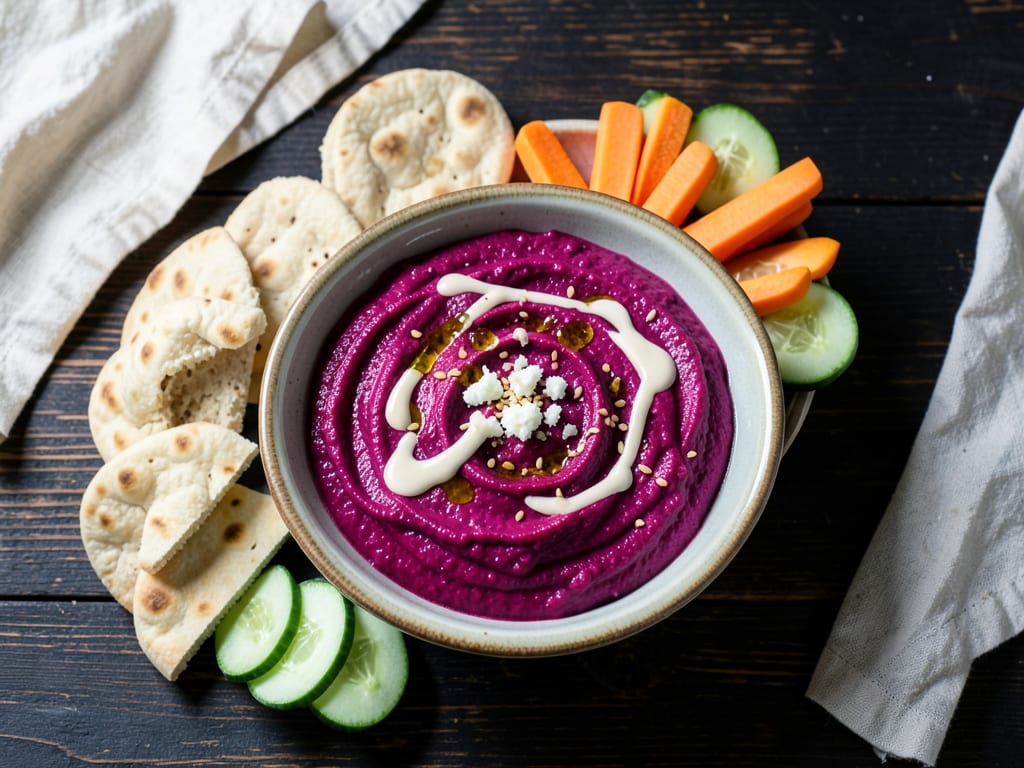
Beet Hummus
This jewel-toned hummus is a stunning departure from traditional chickpea versions. Roasted beets bring natural sweetness and a beautiful ruby color, while tahini and garlic create the signature creamy base with warm, earthy undertones. Bright lemon juice balances the earthiness perfectly. It's elegant enough for entertaining yet simple enough for weeknight snacking.
- Prep
- 35 min
- Cook
- 50 min
- Wait
- 5 min
- Total
- 1 hr 30 min
- Makes
- About 3 cups (720 ml)
Steps
Before you start
- Preheat your oven to 375°F (190°C) before trimming the beets
- Have your food processor ready with the steel blade attachment in place
- Wear disposable gloves to prevent beet stains on your hands and clothes
Roast the beetsOven 375°F / 190°C
- Preheat your oven to 375°F (190°C).
- Trim the stem and roots from the beets, leaving about 1 inch of stem.
- Rinse under cold water and pat dry.
- Wrap each beet loosely in aluminum foil.
- Place them on a baking sheet and roast for 50 to 60 minutes until very tender when pierced with a fork—the exact time depends on beet size.
+ Show details− Hide details
Ready when: Beets are very tender when pierced with a fork and the foil feels soft
Tip: Don't skip the foil—it traps steam and makes peeling much easier, plus it prevents the oven from getting stained
Cool and peel the beets
- Remove the baking sheet from the oven and let the beets cool for about 5 minutes until you can handle them comfortably.
- Once cool enough to touch, unwrap the foil carefully and gently rub away the papery skin with your fingers or the back of a spoon.
- The skin should come off easily; if it resists, let them cool a few minutes longer.
- Cut the peeled beets into 1-inch (2.5 cm) pieces and set aside.
+ Show details− Hide details
Ready when: Beet skin rubs away easily; beets are cut into uniform pieces
Tip: Wear disposable gloves to protect your hands from beet staining—the color is surprisingly persistent
Combine and process until creamy
- Add the roasted beets, drained and rinsed chickpeas, tahini, minced garlic, lemon juice, olive oil, salt, and cumin (if using) to your food processor fitted with the steel blade.
- Cover and pulse several times to break up the larger pieces, then run continuously for 2 to 3 minutes until the mixture begins to come together.
- Pause and scrape down the sides and bottom of the bowl with a spatula, pushing any larger pieces toward the blade.
- Continue processing for another 2 to 3 minutes until completely smooth and creamy.
- If the hummus is thicker than you'd like, pulse in water 1 tablespoon at a time until you reach your desired spreadable consistency.
+ Show details− Hide details
Ready when: Completely smooth and creamy with no visible chunks; consistency is thick but spreadable
Tip: For a chunky, rustic texture you can eat with a spoon, pulse 6 to 8 times instead of processing continuously
Taste, adjust, and serve
- Transfer the hummus to a serving bowl.
- Taste a spoonful and adjust the seasoning as needed—add more salt for saltiness, more lemon juice for brightness, or more cumin for warmth.
- Drizzle the top with a little extra olive oil and a light dusting of paprika for color if desired.
- Serve at room temperature with pita bread, pita chips, fresh vegetables such as carrots, celery, cucumbers, or bell peppers, or your favorite crackers.
+ Show details− Hide details
Ready when: Flavors are well-balanced to your personal preference
Good to know
Tips
- Roast beets with the oven door closed to ensure even cooking. The foil wrapping is absolutely key—it traps steam, prevents drying, and makes peeling nearly effortless.
- For an even silkier, more luxurious texture, whisk your tahini with 1-2 tablespoons of water until smooth before adding it to the processor. This also helps it blend more evenly.
- If your hummus breaks or seems grainy during processing, add 1-2 tablespoons of water and continue processing—this fixes the texture almost immediately.
- Serve chilled or at room temperature. Fresh beet hummus is naturally vibrant and beautiful on its own, but a drizzle of olive oil and dusting of paprika, sumac, or pomegranate seeds elevates it for entertaining.
Make ahead
Beet hummus can be made up to 3 days in advance. Cover with plastic wrap or transfer to an airtight container and refrigerate. You can also roast the beets up to 2 days ahead and store them covered in the refrigerator before peeling and processing. Let chilled hummus sit at room temperature for 10 minutes before serving for fuller flavor.
Storage & reheating
Room temperature: up to 2 hours. Refrigerator: cover with plastic wrap or transfer to an airtight container and store for up to 4 days. Freezer: transfer to a freezer-safe container and freeze for up to 3 months. To serve after freezing, thaw in the refrigerator overnight, then pulse in a food processor with 1-2 tablespoons of water to restore creaminess.
Substitutions
- fresh beets → Canned roasted beets (two 15-oz / 425-g cans, drained). For convenience, use canned roasted beets. This saves about 50 minutes of cooking time. No need to roast or peel; just cut into 1-inch pieces before processing.
- tahini → Natural peanut butter. If you don't have tahini, use 3 tablespoons of unsweetened peanut butter for a richer, nuttier hummus. The texture will be thicker, so add an extra 1-2 tablespoons of water when processing.
- fresh lemon juice → Bottled lemon juice or white vinegar. Use 2 tablespoons bottled lemon juice if you don't have fresh lemons. Alternatively, use 2-3 tablespoons of white vinegar for a tangier, more assertive flavor.
- ground cumin → Ground coriander or omit entirely. Omit the cumin for a milder, purely beet-forward flavor, or replace with 1/4 teaspoon of ground coriander for a different warm spice profile.