Charred Cassava and Coconut Dip
Roasted cassava develops deep caramelized edges in this creamy Caribbean-inspired dip. Coconut milk provides richness, while fresh lime juice and cilantro brighten the earthy cassava base. A hint of turmeric adds warmth and subtle color. Serve warm or at room temperature with cassava chips, plantain chips, or fresh vegetables.
- Prep
- 15 min
- Cook
- 35 min
- Wait
- 10 min
- Total
- 1 hr
- Makes
- About 2 cups (480 ml)
Steps
Before you start
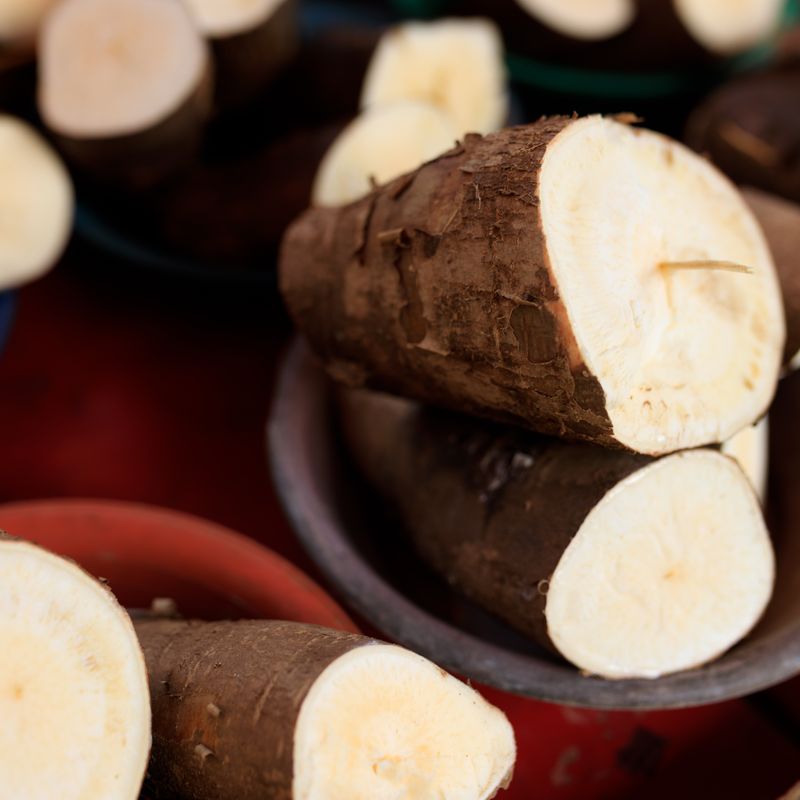
- Peel cassava and remove the fibrous core (see prep tip below)
- Preheat oven to 450°F (230°C)
- Have all ingredients measured and ready before roasting
Prepare cassava cubes
- Line a sheet pan with parchment paper or lightly oil it.
- Toss the cassava cubes with 3 tablespoons (45 ml) olive oil, 1 teaspoon (6 g) sea salt, and 0.5 teaspoon (1 g) black pepper until evenly coated.
- Spread in a single layer on the prepared pan.
+ Show details− Hide details
Tip: Don't skip peeling and removing the tough fibrous core running through the center—use a sharp knife to cut it away after peeling.
Roast until charredOven 450°F / 230°C
- Roast at 450°F (230°C) for 30–35 minutes, stirring halfway through at the 15-minute mark.
- The cassava should be tender with dark golden to charred edges.
- If some pieces have blackened corners, that's desirable—it adds depth.
+ Show details− Hide details
Ready when: Cassava is fork-tender and has dark golden or lightly charred edges; no hard pieces remain
Tip: Stir halfway through to ensure even browning. Don't crowd the pan—the cassava needs space for dry-roasting edges.
Cool slightly
- Remove the pan from the oven and let the roasted cassava rest for 10 minutes.
- This lets it cool enough to handle and allows the flavors to settle.
Blend cassava smooth
- Transfer the roasted cassava to a food processor.
- Add 1 cup (240 ml) coconut milk and 0.75 teaspoon (4 g) turmeric.
- Pulse and blend until completely smooth, scraping the sides as needed.
- This should take 2–3 minutes.
- The mixture will be thick and creamy.
+ Show details− Hide details
Ready when: Cassava is completely smooth with no visible chunks or graininess
Tip: If the mixture seems too thick to blend smoothly, add 2–3 tablespoons (30–45 ml) more coconut milk a splash at a time.
Warm and finish in pan
- Transfer the blended cassava mixture to a medium saucepan over medium-low heat.
- Stir in 3 tablespoons (45 ml) fresh lime juice, 1 minced garlic clove, and 0.5 cup (15 g) cilantro.
- Warm for 2–3 minutes, stirring constantly, until heated through but not simmering.
+ Show details− Hide details
Ready when: Dip is steaming and warm throughout; it moves slowly when stirred
Tip: Keep heat low so the cilantro and lime don't lose their bright character. Don't boil.
Taste and adjust
- Taste the warm dip and add sea salt to taste (typically another 0.25–0.5 teaspoon).
- If you want more brightness, add another squeeze of lime juice.
- Adjust turmeric warmth or cilantro freshness to your preference.
+ Show details− Hide details
Tip: Taste before serving—the flavors deepen as it cools, so a little under-seasoning when warm is fine.
Serve
- Transfer to a serving bowl.
- Serve warm or let cool to room temperature.
- Offer cassava chips, plantain chips, sweet potato chips, or fresh vegetables (cucumber slices, bell pepper strips, carrot sticks) for dipping.
+ Show details− Hide details
Tip: The dip will thicken slightly as it cools. If it becomes too stiff, gently reheat or stir in 1–2 tablespoons (15–30 ml) coconut milk.
Good to know
Tips
- Charring is the star: don't shy away from dark edges on the cassava. This caramelization creates depth and sweetness that plain roasted cassava lacks.
- Cassava texture matters: blend until completely smooth. Any graininess indicates undercooking or underblending. If stuck, add coconut milk gradually and blend longer.
- Cilantro timing: add it at the end and keep heat gentle to preserve its fresh, grassy character. Overcooking wilts the flavor.
- Consistency control: the dip thickens as it cools. Serve it slightly looser than your preferred final texture; add coconut milk or broth while reheating if it's too stiff.
Make ahead
Prepare the cassava and roast it up to 8 hours ahead; store in an airtight container at room temperature. The dip can be blended and cooled, then refrigerated for up to 3 days. Warm gently in a saucepan over medium-low heat before serving, adding a splash of coconut milk if needed to restore creaminess.
Storage & reheating
Room temperature (2 hours): Store covered with plastic wrap. Refrigerator (3 days): Transfer to an airtight container; reheat gently over medium-low heat, stirring often. Freezer (1 month): Freeze in an airtight container; thaw overnight in the fridge and reheat slowly to avoid separation. The dip may thicken upon cooling—stir in warm coconut milk or warm broth to loosen, 1 tablespoon (15 ml) at a time.
Substitutions
- fresh cilantro leaves → Fresh parsley or a mix of parsley and mint. Cilantro adds a signature Caribbean note, but parsley or mint work if cilantro isn't available or you prefer a milder herb.
- unsweetened coconut milk, full-fat → Unsweetened oat milk or cashew cream. For a lighter dip or dairy-free adaptation, use the same amount of unsweetened oat milk or cashew cream, though the flavor will be less tropical.
- ground turmeric → Ground ginger or omit entirely. Ground ginger (0.5 teaspoon / 2 g) adds spice and warmth instead; omitting turmeric yields a neutral, milder dip.
- fresh lime juice → Lemon juice or lime zest with citric acid. Fresh lemon juice works if lime isn't available. For a stronger lime flavor without extra liquid, add 1 teaspoon (2 g) lime zest instead of some juice.