Char Siu Pork Steamed Buns
Pillowy soft steamed buns filled with tender, caramelized char siu pork glazed in a sweet-savory barbecue sauce. These bao make an impressive dim sum appetizer or light meal, with a lightly sweetened dough that contrasts beautifully with the rich filling.
Steps
Before you start
- Bring all liquids and eggs to room temperature 30 minutes before starting
- Set up a steamer with water simmering before you shape the buns
- Cut 8 squares of parchment paper (3×3 inches/7×7 cm) for the buns to rest on
Mix the dough
- In a large mixing bowl, combine 2.5 cups (315 g) flour, 1.5 teaspoons (5 g) instant yeast, 2 tablespoons (25 g) sugar, and 0.5 teaspoon (3 g) salt.
- Stir until evenly mixed.
- Pour in 0.75 cup (180 ml) warm water and 0.25 cup (60 ml) room-temperature milk.
- Mix until shaggy, then add 1 tablespoon (15 ml) oil.
- Using a stand mixer with the dough hook or mixing by hand, knead for 10 minutes until the dough is smooth, elastic, and slightly sticky to the touch.
+ Show details− Hide details
Ready when: Dough is smooth, elastic, and springs back when poked
Tip: If the dough is too wet to handle, add flour 1 tablespoon at a time. If too dry, add water 1 teaspoon at a time.
First rise
- Lightly oil the same bowl and place the dough inside, turning it to coat.
- Cover with a damp towel or plastic wrap.
- Let rise at room temperature for 60 minutes until the dough is roughly doubled in volume.
+ Show details− Hide details
Ready when: Dough has nearly doubled and feels airy when gently poked
Tip: A poke test: your finger leaves a slight indent that doesn't spring back quickly, indicating proper rise.
Prepare the filling
- While the dough rises, prepare the filling.
- In a small saucepan, combine 2 tablespoons (30 ml) soy sauce, 1.5 tablespoons (22 g) hoisin sauce, 1 tablespoon (12 g) brown sugar, and 1 tablespoon (15 ml) rice vinegar.
- Heat over medium heat, stirring until sugar dissolves, about 1 minute.
- Add the sliced or diced char siu pork (0.75 lb/340 g)—ensure it has been cooked to a safe internal temperature of 145°F (63°C) or higher—and stir to coat.
- In a small cup, mix 1.5 teaspoons (5 g) cornstarch with 1.5 tablespoons (22 ml) water until smooth.
- Pour the slurry into the pork and stir constantly for 2–3 minutes until the sauce thickens and coats the meat.
- If using scallions and sesame oil, stir them in now.
- Transfer to a bowl and cool to room temperature.
+ Show details− Hide details
Ready when: Sauce is glossy and coats the pork; filling is cool enough to handle
Tip: The cornstarch slurry prevents a runny filling that would seep out during steaming. Stir the filling just before using, as the sauce settles at the bottom.
Shape the buns
- Turn the risen dough onto a lightly floured surface and gently press out any excess gas.
- Divide into 8 equal pieces (about 2 oz/55 g each).
- Roll each piece into a smooth ball by tucking the seams underneath.
- Let rest for 5 minutes under a damp towel.
- Flatten each ball into a 3.5-inch (9 cm) round disc, slightly thicker at the edges than the center.
- Place about 2 tablespoons (30 g) of the cooled char siu filling in the center of each disc.
- Gather the edges up and over the filling and pinch firmly to seal, creating a gathered knot at the top.
- Place each sealed bun seam-side down on a 3×3-inch (7×7 cm) square of parchment paper.
+ Show details− Hide details
Ready when: Buns are sealed and rest on parchment squares
Tip: Don't overwork the dough when shaping or it becomes tough. A generous pinch at the seam prevents the filling from leaking during steaming.
Second rise and prepare steamer
- Place the shaped buns on their parchment squares on a clean towel or tray, spacing them 2 inches (5 cm) apart.
- Cover loosely with another damp towel.
- Let rise for 30 minutes until slightly puffy and soft to the touch.
- Meanwhile, fill a large pot with water (about 2–3 inches/5–8 cm depth) and bring to a steady simmer.
- If using a bamboo steamer, line the bottom and any additional tiers with parchment paper or cabbage leaves to prevent sticking.
+ Show details− Hide details
Ready when: Buns jiggle slightly when the surface is gently shaken
Tip: Do not overproof—the buns should be soft but still hold their shape. Overproofing leads to flat, deflated buns.
Steam the buns
- Carefully transfer the buns on their parchment squares to the steamer basket in a single layer, leaving space between each bun for steam circulation.
- If all buns don't fit, you'll need to steam in batches.
- Cover the steamer and place it over the simmering water.
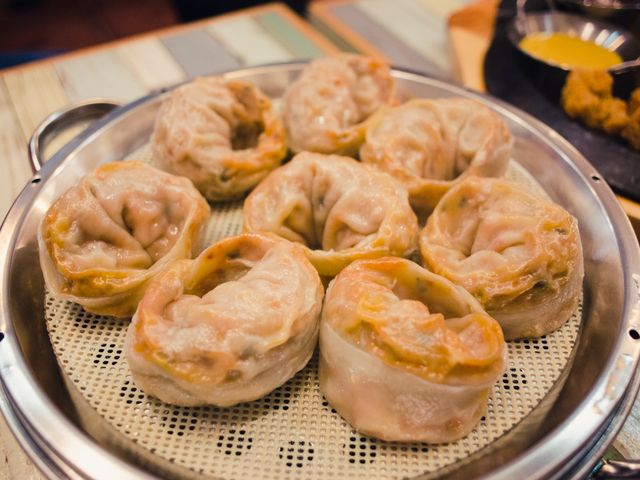
- Steam for 12–15 minutes until the buns are puffy, glossy, and spring back immediately when lightly pressed.
- The buns will appear brighter white and slightly translucent.
+ Show details− Hide details
Ready when: Buns are fluffy, glossy, and spring back when pressed; no raw dough taste remains
Tip: Keep the water at a steady simmer but not a rolling boil, which can cause the buns to develop a dented top. If condensation drips onto the buns, fold the steamer lid with a thin towel to catch drips.
Rest and serve
- Remove the steamer from the heat.
- Let the buns rest in the closed steamer for 2–3 minutes to firm up slightly before opening the lid.
- Carefully lift the steamer away from the pot.
- Using tongs or chopsticks, transfer the buns to a serving platter, leaving them on the parchment for easy handling.
- Serve warm with extra soy sauce or your favorite dipping sauce on the side.
+ Show details− Hide details
Ready when: Buns are set and no longer extremely hot to the touch
Tip: The buns are most tender and delicious when eaten within 30 minutes of steaming, but they can be reheated by steaming again for 3–4 minutes.
Good to know
Tips
- For the best results, use warm water at exactly 110°F (43°C). Water that's too hot kills the yeast; water that's too cool slows fermentation. Use a thermometer if you have one.
- If your kitchen is cold (below 70°F/21°C), the dough will rise more slowly. Place the bowl in a warm spot—on top of a warm (not hot) oven, in a slow cooker set to its lowest setting with the lid off, or in a turned-off oven with the light on.
- Char siu pork is widely available at Asian grocery stores in the refrigerated case or can be made at home with pork shoulder, soy sauce, hoisin, and char siu powder. If unavailable, any roasted or barbecued pork works beautifully.
- These buns are best steamed on the day of serving, but the dough can be mixed and shaped a few hours ahead and refrigerated, bringing it to room temperature and allowing a 45-minute second rise before steaming.
Make ahead
The buns can be shaped and frozen (on parchment squares, then transferred to a freezer bag) for up to 1 month. Steam from frozen without thawing, adding 3–4 minutes to the steaming time.
Storage & reheating
Room temperature: up to 4 hours, covered with a towel. Refrigerator: up to 3 days in an airtight container. Reheat by steaming for 3–4 minutes. Freezer: up to 1 month (freeze on a tray, then transfer to a freezer bag). Thaw at room temperature and steam as above, or steam directly from frozen.
Substitutions
- char siu pork or barbecued pork → store-bought roasted pork, duck, or even shredded cooked chicken breast. Prepare the filling the same way; any protein will work as long as it's pre-cooked and thinly sliced or diced.
- hoisin sauce → additional soy sauce (1.5 tablespoons total) or oyster sauce. Hoisin adds sweetness and umami; oyster sauce is savory and earthy. The flavor will be slightly different but equally delicious.
- all-purpose flour → cake flour or bread flour (reduce by 2 tablespoons if using bread flour due to its higher gluten content). Cake flour will yield slightly softer buns; bread flour will be slightly chewier.
- instant yeast → 0.5 teaspoon (1.5 g) active dry yeast or 0.25 teaspoon instant yeast plus a 30-minute autolyse. Active dry yeast is coarser and may require an extra 10 minutes of rise time. Instant yeast is the preferred choice for fastest, most reliable results.