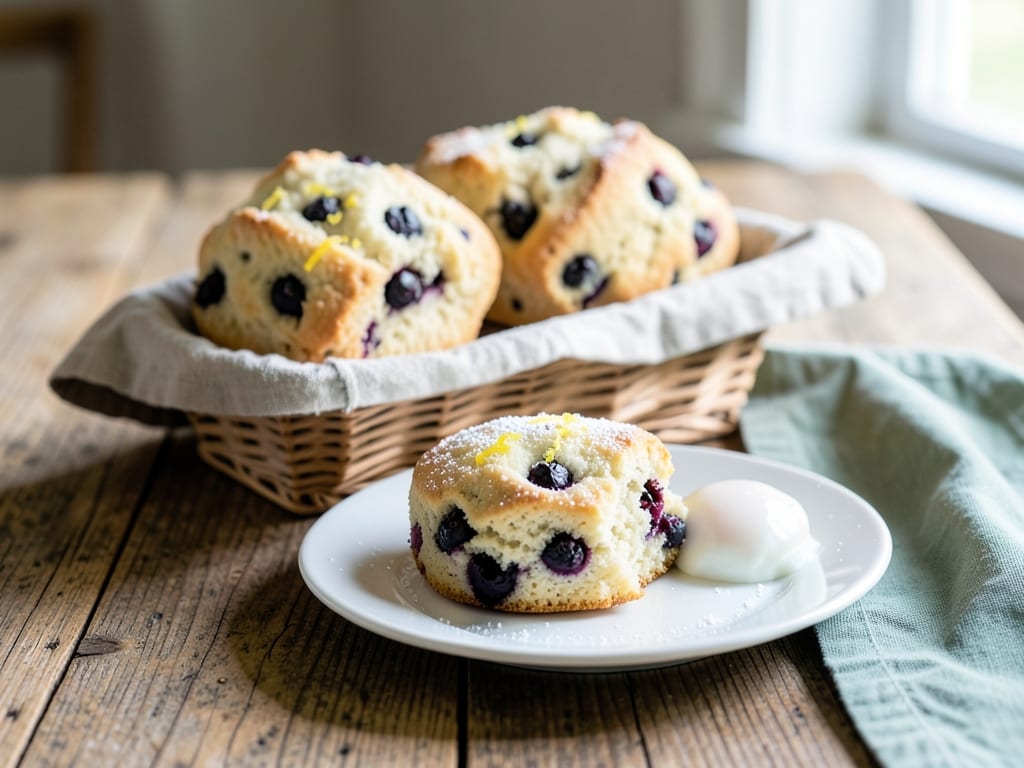
Blueberry Lemon Scones
Tender, crumbly scones studded with fresh blueberries and bright with lemon zest. These scones are baked until golden and served warm with jam, clotted cream, or whipped butter. The key to fluffy scones is keeping the butter cold and handling the dough minimally—this recipe yields 8 wedges with a tender crumb and crisp exterior.
- Prep
- 15 min
- Cook
- 18 min
- Wait
- 5 min
- Total
- 38 min
- Makes
- 8 scones (1 batch)
Steps
Before you start
- Preheat oven to 400°F (200°C)
- Cut butter into ½-inch cubes and keep it cold in the freezer
- Have blueberries at room temperature (not frozen)
- Line a baking sheet with parchment paper
Mix dry ingredients
- In a large bowl, whisk together 2 cups (250 g) flour, 3 tablespoons (38 g) sugar, 2 teaspoons (9 g) baking powder, ½ teaspoon (3 g) salt, and 2 teaspoons (4 g) lemon zest until evenly combined.
+ Show details− Hide details
Ready when: mixture looks uniform with no lumps of sugar or baking powder
Tip: Sift dry ingredients if the flour seems compacted, but whisking is fine for this recipe
Cut in cold butter
- Add the cold butter cubes to the dry mixture and use a pastry cutter, two forks, or your fingertips to break the butter into pea-sized pieces.
- Work quickly to keep the butter cold.
- The mixture should look crumbly and coarse.
+ Show details− Hide details
Ready when: butter pieces are roughly pea-sized and the mixture looks like coarse breadcrumbs
Tip: If your kitchen is warm, freeze the bowl and utensils for 5 minutes before starting. Do not overwork or the scones will be tough and dense.
Add buttermilk gently
- Pour ¾ cup (180 ml) cold buttermilk over the mixture and fold it in with a silicone spatula or wooden spoon until just combined.
- The dough will be shaggy and slightly moist—stop folding as soon as no dry flour streaks remain.
- Do not overmix.
+ Show details− Hide details
Ready when: dough comes together with no visible dry flour; it should look slightly shaggy and wet
Tip: Overmixing develops gluten and makes scones tough. Fold gently until just combined, even if a few streaks of flour remain—they'll incorporate from the residual folding.
Fold in blueberries
- Gently fold 1¼ cups (155 g) fresh blueberries into the dough using 3–4 slow folds with a spatula.
- Some berries will break and stain the dough slightly, which is fine.
- Be gentle so the dough doesn't deflate.
+ Show details− Hide details
Ready when: blueberries are evenly distributed throughout the dough
Tip: If using frozen blueberries, do not thaw them—toss them in a tablespoon of flour first so they don't sink to the bottom
Shape and chill doughOven 400°F / 205°C
- Turn the dough out onto a lightly floured surface and gently pat it into a 1-inch-thick disk about 7 inches (18 cm) wide.
- Place it on the prepared baking sheet, cover loosely with plastic wrap, and refrigerate for 5 minutes while you preheat the oven to 400°F (200°C).
+ Show details− Hide details
Ready when: dough feels cold and holds its shape when lightly pressed
Tip: Do not press or knead the dough; pat it gently into shape to keep the crumb tender
Cut into wedges
- Remove the chilled dough disk from the refrigerator.
- Using a sharp chef's knife or bench scraper dipped in water, cut the disk into 8 equal wedges like a pizza, wiping the knife between cuts.
- Space the wedges ½ inch (1 cm) apart on the baking sheet.
+ Show details− Hide details
Ready when: 8 evenly sized triangular pieces
Tip: A wet knife makes clean cuts without dragging the dough and crushing the blueberries
Egg wash and top
- In a small bowl, lightly beat 1 large egg.
- Brush the top of each scone wedge with the egg wash using a pastry brush.
- Sprinkle about ⅛ teaspoon of demerara sugar on top of each wedge.
+ Show details− Hide details
Ready when: all scones are glossy and topped with coarse sugar crystals
Tip: Egg wash adds shine and helps the sugar adhere; do not skip it
Bake until goldenOven 400°F / 205°C
- Bake at 400°F (200°C) for 16–18 minutes, until the tops are golden brown and the edges are set.
- A wooden pick inserted into the side of a scone should come out with just a few moist crumbs clinging to it.
+ Show details− Hide details
Ready when: tops are deep golden brown; a wooden pick inserted into the side comes out with a few moist crumbs
Tip: Do not overbake or the scones will be dry. If the tops brown too quickly before the centers are done, loosely tent with foil for the last 5 minutes.
Cool briefly and serve
- Let the scones cool on the baking sheet for 2 minutes, then transfer them to a wire rack or serve directly.
- Scones are best eaten warm, within 2 hours of baking, with jam, clotted cream, or whipped butter.
+ Show details− Hide details
Ready when: scones are cool enough to handle without burning your fingers
Tip: Cooling them on the baking sheet for just 2 minutes keeps them warm and tender; do not cool completely or they will lose their fluffy texture
Good to know
Tips
- Keep all ingredients cold, especially the butter and buttermilk—warmth is the enemy of tender scones. If your kitchen is hot, work quickly or chill the mixing bowl and utensils.
- Do not overmix the dough. Fold the buttermilk and blueberries in gently until just combined; a slightly shaggy dough yields the best crumb.
- Cut the dough into scones with a wet knife to avoid compressing or dragging the dough, which toughens them.
- Blueberries release juice as they bake, creating colorful veins in the scone. This is normal and adds visual appeal.
Make ahead
Bake the scones the morning you plan to serve them. You can prepare the dough through step 5 (chilling) up to 12 hours ahead, wrap it well, and refrigerate; add 2–3 minutes to baking time if baking from a cold dough. Do not freeze the shaped dough because blueberries will bleed excessively."
Storage & reheating
Store room-temperature scones in an airtight container for up to 2 days. To reheat, wrap in foil and warm in a 350°F (175°C) oven for 8–10 minutes until warm through. Scones are best fresh but can be frozen in an airtight freezer bag for up to 1 month; thaw at room temperature for 1 hour, then reheat wrapped in foil.
Substitutions
- buttermilk, cold → Greek yogurt thinned with milk (½ cup yogurt + ¼ cup milk). Gives a slightly more tender crumb and tangy flavor; ensure the mixture is pourable
- fresh blueberries → fresh raspberries, blackberries, or frozen blueberries (unthawed). Use the same weight; if using frozen berries, toss them in 1 tablespoon flour first to prevent sinking
- lemon zest → ½ teaspoon vanilla extract or ¼ teaspoon almond extract. Omits the citrus note but adds warmth; do not add both
- demerara or coarse sugar → raw cane sugar or regular granulated sugar. Demerara gives a more pronounced crunch, but either works; use the same amount