
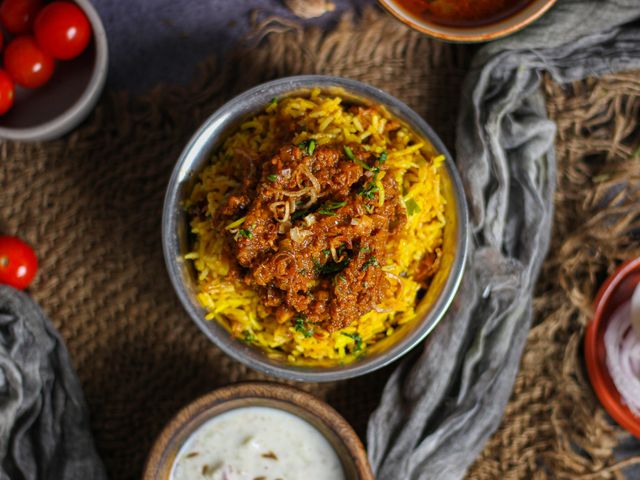
Aromatic Mixed Vegetable Biryani
A fragrant, layered vegetarian biryani slow-cooked with basmati rice, tender vegetables, and aromatic spices. Cooked using the dum pukht method—sealed and steamed—so the rice absorbs all the spiced yogurt flavors while staying fluffy and distinct. The vegetables soften into the rice without turning mushy, creating a complete one-pot meal with caramelized onions and fresh herbs.
- Prep
- 30 min
- Cook
- 50 min
- Wait
- 25 min
- Total
- 1 hr 45 min
- Makes
- 4 servings (about 1.5 cups per person)
Steps
Before you start
- Soak basmati rice in cold water for 20–30 minutes before cooking
- Have all spices measured and ready (mise en place) since the dum pukht step happens fast
- Cut all vegetables to similar size (about ½ inch) so they cook evenly
- Keep warm plates and a serving spoon nearby
Fry the onions
- Heat 6 tablespoons (85 g) of the ghee in a large 12-inch (30 cm) skillet over medium-high heat.
- Once shimmering, add the sliced onions in two batches so they cook evenly without crowding.
- Stir frequently for 10–12 minutes until the onions turn deep golden brown and caramelize at the edges.
- They should be soft and slightly crispy.
- Remove to a plate, reserving the ghee and browned bits in the pan for the next step.
+ Show details− Hide details
Ready when: Onions are deep golden brown and caramelized
Tip: Don't rush this step—proper caramelization builds the dish's flavor foundation. Stir constantly to prevent burning.
Sauté vegetables and spices
- In the same skillet with the remaining ghee and browned onion bits, reduce heat to medium.
- Add cumin seeds, coriander seeds, cardamom pods, cinnamon stick, bay leaves, and cloves.
- Toast for 1 minute until fragrant.
- Stir in the ginger-garlic paste and green chili peppers, cooking for 1 minute.
- Add the carrots, potatoes, and cauliflower.
- Stir in turmeric and salt (about 1½ teaspoons to start), and cook uncovered for 4–5 minutes, stirring often, until the vegetables are lightly coated and beginning to soften slightly.
+ Show details− Hide details
Ready when: Vegetables are lightly coated and starting to soften; spices are fragrant
Tip: Toast the whole spices first to release their oils, then add wet ingredients to avoid sputtering.
Mix yogurt and peas
- In a small bowl, whisk the yogurt until smooth (this prevents lumps).
- Stir in the garam masala powder and the peas.
- Pour this mixture over the vegetables in the skillet and fold gently with a spatula for 2 minutes until everything is evenly coated.
+ Show details− Hide details
Ready when: Yogurt is evenly distributed and vegetables are coated
Tip: Whisking yogurt before adding prevents curdling when it hits the hot pan.
Boil the rice
- Bring 4 cups (950 ml) of water to a boil in the heavy-bottomed 3–4 quart (3–4 L) pot.
- Add salt (about 1 teaspoon).
- Pour in the drained rice and stir gently.
- Boil uncovered for 6–7 minutes until the rice is about 70% cooked (grains should be tender but still have a slight firmness at the center when bitten).
- Drain the rice in a colander and set aside.
+ Show details− Hide details
Ready when: Rice is about 70% cooked—tender with a slight firmness in the center
Tip: Parboil the rice rather than cooking it fully; it will finish cooking in the dum pukht steam, creating fluffy grains that don't stick together.
Layer rice and vegetables
- Wipe out the skillet or transfer the vegetable mixture to the large heavy-bottomed pot.
- Spread half of the parboiled rice over the vegetable layer.
- Sprinkle half of the caramelized onions on top.
- Spread the remaining rice, then top with the remaining caramelized onions.
- Dot with the remaining 1 tablespoon (14 g) ghee.
+ Show details− Hide details
Ready when: Rice and onions are arranged in even layers
Tip: Even, organized layers help the steam circulate evenly, preventing dry spots and ensuring all rice cooks uniformly.
Seal and steam (dum pukht)Oven 180°F / 80°C
- Place the lid firmly on the pot.
- If it does not seal tightly, wrap aluminum foil around the rim before placing the lid to create an airtight seal.
- Reduce heat to low (about 180°F / 82°C if using a burner with a temperature dial, or the lowest setting).
- Cook undisturbed for 20–25 minutes.
- You should hear a faint hiss or see a bit of steam escaping; if not, increase heat very slightly.
- The moisture will cook the rice fully and meld all flavors.
+ Show details− Hide details
Ready when: Rice is fully cooked and fluffy; steam escapes when lid is lifted
Tip: Do not stir or peek frequently during dum pukht—each opening lets steam escape and extends cooking time. Trust the process; the sealed pot creates the right environment.
Rest and finish
- Remove the pot from heat.
- Let it rest undisturbed for 2 minutes with the lid on.
- Carefully remove the lid (steam will be hot) and fluff the biryani gently with a fork, breaking up any clumps and mixing the layers slightly.
- Taste a grain of rice and adjust salt if needed.
- Scatter fresh cilantro and mint over the top if desired.
+ Show details− Hide details
Ready when: Rice is fluffy and grains are separate; aroma is fragrant and aromatic
Tip: Use a fork to fluff gently—pressing or stirring vigorously can mash the rice and vegetables.
Good to know
Tips
- Toast whole spices (cumin, coriander, cardamom, cinnamon, bay, clove) briefly before adding wet ingredients—this blooms their essential oils and deepens flavor without bitterness.
- Parboil the rice to exactly 70% doneness; underdone and it won't cook through in the dum pukht time, overdone and it turns mushy. A quick taste tells you when to drain.
- Never lift the lid during the dum pukht stage—steam escapes and cooking halts. If you must check, do so only after 20 minutes, and replace the lid immediately.
- For extra depth, sprinkle a pinch of saffron strands (soaked in warm milk for 10 minutes) over the rice layers before sealing, then pour the saffron milk over the top—this adds color and floral notes.
Make ahead
You can prep all vegetables and measure spices 4–6 hours ahead. Caramelize the onions up to 2 hours before, then reheat in the skillet before adding other vegetables. Do not cook the full biryani ahead; it's best assembled and cooked fresh to preserve texture.
Storage & reheating
Store leftovers in an airtight container in the refrigerator for up to 3 days. To reheat, add 2–3 tablespoons water, cover, and warm over low heat for 5–7 minutes, or microwave covered for 2–3 minutes, stirring gently. Biryani does not freeze well because the rice becomes mushy upon thawing, so eat fresh within 3 days.
Substitutions
- ghee (clarified butter) → Unsalted butter or vegetable oil. Ghee has a higher smoke point and deeper flavor, but butter works fine if ghee is unavailable. Use the same amount. Avoid olive oil, which overpowers the spices.
- basmati rice → Jasmine rice (if basmati is unavailable). Jasmine has a similar grain length and cooking time. The flavor will be slightly different but the texture remains fluffy. Do not use short-grain or sushi rice, which will become mushy.
- fresh cauliflower → Diced green bell pepper, mushrooms, or extra carrots. Substitute 1.5 cups of any of these. Peppers add brightness; mushrooms add umami. Cut to the same ½-inch size so they cook in the same time.
- ginger-garlic paste → 2 tablespoons (15 g) minced fresh ginger + 2 cloves garlic, minced or grated. Use this if you prefer fresh over paste. Mince very finely so the flavors distribute evenly. Add the same amount of salt as listed, and taste at the end to adjust.
More biryani
See all →


Find more like this
- Meal
- Dinner
- Cuisine
- Indian
- Main ingredient
- Basmati RiceCauliflowerCarrots