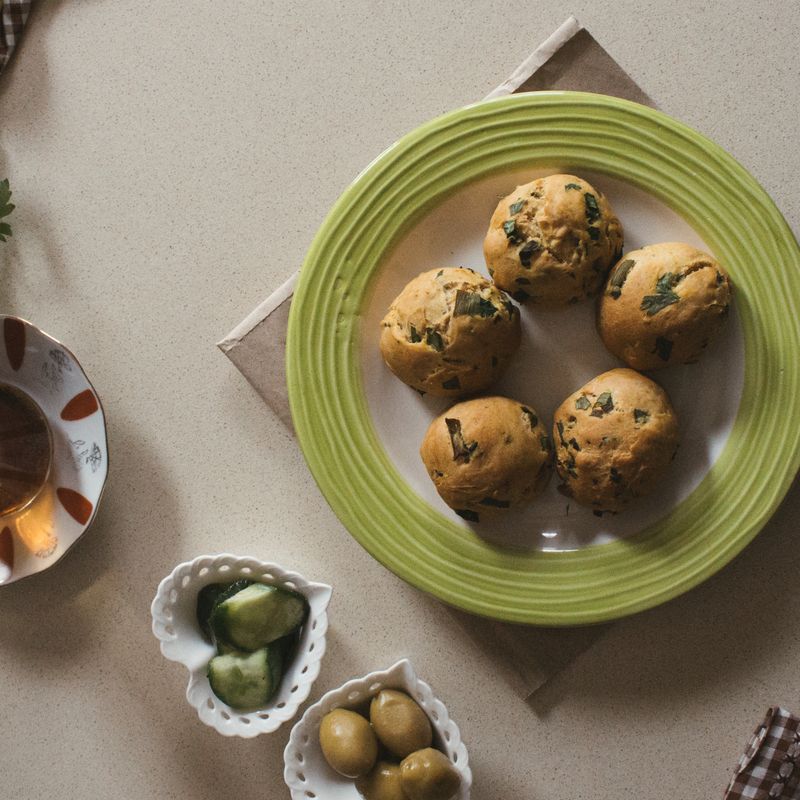
30-Minute Leek and Gruyère Savory Breakfast Scones
Tender, buttery scones studded with caramelized leeks and sharp Gruyère cheese. These French-inspired breakfast scones are ready in 30 minutes—perfect for a sophisticated morning. The leeks cook briefly until golden, then fold into cold butter-enriched dough for a flaky crumb and savory depth.
Steps
Before you start
- Cut butter into ½-inch cubes and chill in the freezer for 10 minutes
- Preheat oven to 425°F (220°C)
- Line a baking sheet with parchment paper
Sauté the leeks
- Heat a 10-inch skillet over medium heat.
- Add 1 tablespoon butter and let it foam, about 30 seconds.
- Add the sliced leeks and ¼ teaspoon salt.
- Stir occasionally until the leeks soften and turn golden brown, 5 to 6 minutes.
- They should be translucent at the edges and caramelized in spots.
- Transfer to a small bowl and cool to room temperature while you prepare the dough.
+ Show details− Hide details
Ready when: Leeks are golden and tender, with some caramelized spots
Tip: Don't skip the cooling step—hot leeks will warm the butter and make the dough tough.
Mix dry ingredients
- In a large bowl, whisk together 2 cups flour, 1½ teaspoons baking powder, ½ teaspoon black pepper, and ¾ teaspoon salt.
- Make sure there are no lumps in the baking powder.
- Set aside.
+ Show details− Hide details
Ready when: Ingredients are evenly combined
Tip: Whisk the dry ingredients twice if you don't have a sifter—this aerates the flour for a lighter scone.
Cut in cold butter
- Add the 6 tablespoons of cold butter cubes to the flour mixture.
- Using a box grater, bench scraper, or two knives, cut the butter into the flour using quick, light motions until the mixture resembles coarse breadcrumbs with pea-sized pieces of butter visible.
- This should take 2 to 3 minutes.
- Work quickly so the butter stays cold.
+ Show details− Hide details
Ready when: Mixture resembles coarse breadcrumbs with visible pea-sized butter pieces
Tip: If the mixture starts to look greasy or powdery, you've overworked it—stop immediately. Cold butter = flaky scones.
Fold in cheese and leeks
- Add the grated Gruyère and the cooled leeks (including any liquid in the bowl) to the flour mixture.
- Using a wooden spoon or spatula, fold gently until the cheese and leeks are evenly distributed.
- Do not overmix.
+ Show details− Hide details
Ready when: Cheese and leeks are evenly distributed throughout
Tip: Fold by turning the bowl and scraping from the bottom—avoid stirring in circular motions, which develops gluten.
Add buttermilk and form dough
- Pour ½ cup cold buttermilk over the mixture.
- Fold gently until just combined and a shaggy, slightly wet dough forms.
- Do not knead.
- The dough should come together but still look rough and slightly dry in spots.
- If it seems too dry to hold together, add 1 tablespoon more buttermilk.
+ Show details− Hide details
Ready when: Dough just holds together when pressed, with visible dry and wet spots
Tip: Overmixing develops gluten and toughens the scones—stop as soon as the dough comes together.
Turn out and cut scones
- Turn the dough onto a lightly floured work surface.
- Gently pat it into a ¾-inch-thick disk, about 6 inches across.
- Do not knead or overwork.
- Using a ½-inch round biscuit cutter (or the rim of a drinking glass dipped in flour), cut 8 scones from the dough.
- Reroll scraps minimally and cut one or two more if needed, but handle them gently.
+ Show details− Hide details
Ready when: 8 round scones cut cleanly from the dough
Tip: Avoid twisting the cutter—press straight down and lift straight up. Twisting seals the edges and prevents rise.
Brush and bakeOven 425°F / 220°C
- Place the scones on the parchment-lined baking sheet about 1 inch apart.
- Brush the tops lightly with the beaten egg wash, and sprinkle with optional fresh thyme if using.
- Bake in a preheated 425°F (220°C) oven for 12 to 13 minutes until the scones are golden brown on top and a skewer inserted into the center comes out clean.
+ Show details− Hide details
Ready when: Scone tops are deep golden brown and a skewer inserted in the center comes out clean
Tip: Don't open the oven door in the first 10 minutes—a draft can cause them to fall.
Cool and serve
- Remove the baking sheet from the oven.
- Let the scones rest on the sheet for 1 to 2 minutes, then transfer to a wire rack or serve warm.
- They are best eaten within 2 hours of baking but still excellent at room temperature.
+ Show details− Hide details
Ready when: Scones are set enough to move without breaking
Tip: Serve while still warm with softened butter, crème fraîche, or a simple green salad.
Good to know
Tips
- Keep all ingredients, especially butter and buttermilk, as cold as possible—this ensures a flaky crumb and prevents the dough from becoming sticky.
- Leeks hold water; if your cooked leeks are very wet, drain them on paper towels before folding into the dough. Excess moisture can make scones dense.
- For uniform baking, make sure all scones are roughly the same thickness. Uneven scones brown unevenly.
- Serve scones warm for the best texture and flavor. Reheating dries them out slightly, so store them uncovered at room temperature if you plan to eat within a few hours.
Make ahead
Prepare the dough up to step 5 (just before adding buttermilk), cover tightly, and refrigerate for up to 4 hours. Add buttermilk and proceed from step 5. Scones taste best baked fresh, but you can wrap cooled scones and freeze for up to 1 month; reheat gently in a 300°F oven for 5 minutes.
Storage & reheating
Store cooled scones in an airtight container at room temperature for up to 1 day. They don't keep well beyond that due to the buttermilk. Freeze cooled scones for up to 1 month; thaw at room temperature for 1 hour or reheat gently in a 300°F (150°C) oven for 5 minutes. Do not refrigerate—cold temperatures dry them out.
Substitutions
- Gruyère cheese, aged 12 months → aged Emmental or mature Cheddar. Use an assertive cheese with similar sharpness. Avoid mild or young cheeses, which lack depth.
- leeks, light green and white parts, halved lengthwise and thinly sliced → caramelized onions (1½ cups cooked) or sliced scallions. If using scallions, add them raw in step 4 for a fresher bite. Use caramelized onions for a deeper, sweeter flavor.
- buttermilk, cold → sour cream thinned with 2 tablespoons milk, or milk mixed with 1 tablespoon lemon juice. The acid in buttermilk activates the baking powder; substitutes must be similarly acidic.
- baking powder → ½ teaspoon baking soda + ½ teaspoon cream of tartar. This produces the same rise. Mix with the dry ingredients, not separately.
More scones & biscuits
See all →




Find more like this
- Meal
- Breakfast