Spaghetti Carbonara
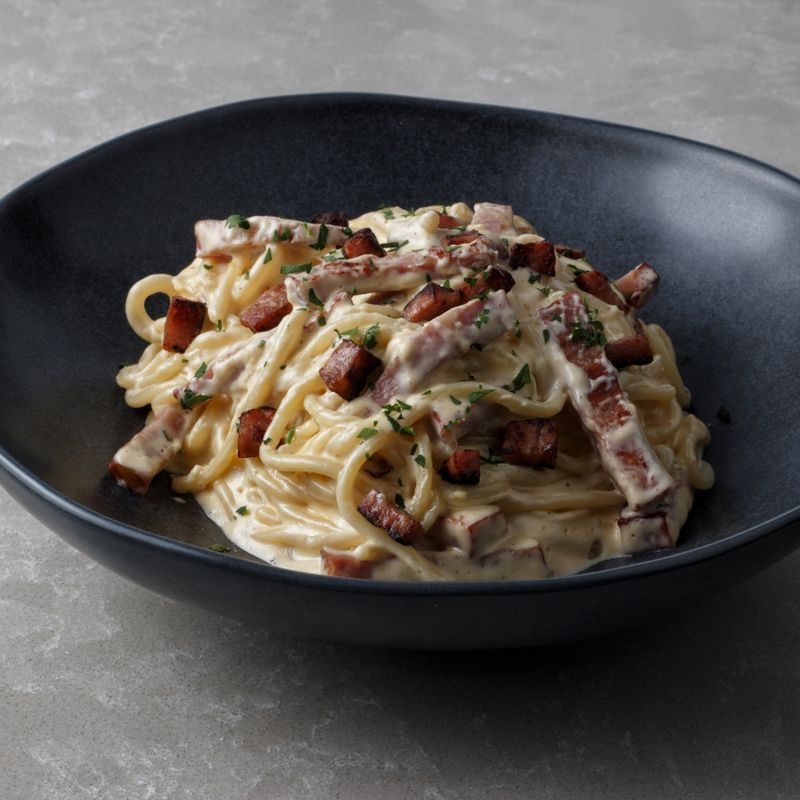
The classic Roman carbonara: crisp, rendered guanciale, a glossy sauce of egg, Pecorino Romano, and black pepper, and no cream. The creamy sauce comes from starchy pasta water and gentle residual heat.
- Prep
- 15 min
- Cook
- 20 min
- Wait
- 10 min
- Total
- 45 min
- Makes
- 4 generous main-course servings (about 6 cups)
Steps
Before you start
- Take the eggs out of the fridge 20 minutes ahead. Room-temperature eggs blend smoothly and are less likely to seize.
- Finely grate the Pecorino Romano with a rasp-style grater. Coarse shreds clump instead of melting into the sauce.
- Read the whole recipe first. Once the pasta is cooked, the last steps move fast, so have the egg mixture, a serving bowl, and warmed plates ready.
- Use a skillet or sauté pan at least 12 inches (30 cm) wide so you can toss all the pasta in it.
Boil the water
- Combine the 4 quarts (3.8 L) water and the kosher salt in a large pot, cover, and bring to a full rolling boil over high heat.
- The water should taste lightly salty, like mild broth.
- Pecorino is salty, so don't add more salt.
+ Show details− Hide details
Ready when: Large, rapid bubbles break the surface continuously
Tip: Cover the pot to speed things up, but uncover it before adding the pasta.
Cut the guanciale
- Trim off and discard the tough rind from the guanciale.
- Cut the meat into ¼-inch (6 mm) thick slices, then into strips about 1 inch (2.5 cm) long.
- Keep the pieces a uniform size so they render and crisp evenly.
+ Show details− Hide details
Ready when: Strips are even, with a similar ratio of fat to meat
Tip: Chill the guanciale for 10 minutes in the freezer if it's soft. Firm meat slices much more cleanly.
Mix the egg paste
- In a medium bowl, whisk together the egg yolks, whole egg, grated Pecorino, and 1 tsp of the ground pepper until a thick, smooth paste forms.
- Set it aside near the stove.
- Reserve the remaining 1 tsp pepper for the skillet.
+ Show details− Hide details
Ready when: Mixture is thick, pale yellow, and has no streaks of egg white or lumps of cheese
Tip: It will look stiff, almost like a paste. That's correct, because pasta water thins it later.
Render the guanciale
- Put the guanciale in the cold 12-inch (30 cm) skillet in a single layer.
- Set it over medium-low heat and cook, stirring occasionally, for 10 to 12 minutes.
- The fat should slowly melt out and the pieces turn deep golden with crisp edges and slightly chewy centers.
- Turn off the heat and stir in the reserved 1 tsp pepper.
- Let it sizzle in the fat for 30 seconds to bloom the aroma.
+ Show details− Hide details
Ready when: Pieces are golden brown and crisp at the edges, with about 3 to 4 tablespoons of clear fat pooled in the pan
Tip: Starting in a cold pan renders the fat gently. High heat browns the outside before the fat melts out.
Cook the spaghetti
- Add the spaghetti to the boiling water, pressing it down as it softens, and stir well in the first minute so the strands don't stick.
- Cook for 1 minute less than the package time, usually 8 to 9 minutes, until flexible and tender outside with a thin, firm core in the center.
- Before draining, scoop out and set aside 1½ cups (360 ml) of the starchy cooking water.
+ Show details− Hide details
Ready when: Pasta is al dente. When you bite a strand, you see a pinpoint of firm, slightly lighter center
Tip: Don't rinse the pasta. The starch on its surface helps the sauce cling.
Loosen the egg paste
- While the pasta finishes, whisk 3 tablespoons (45 ml) of the hot pasta water into the egg paste, a spoonful at a time.
- This warms the eggs gently and thins the paste to the consistency of heavy cream.
+ Show details− Hide details
Ready when: Mixture is smooth and pourable, like heavy cream
Tip: Add the water slowly while whisking. Dumping it in at once can scramble the eggs.
Toss pasta with guanciale
- Using tongs, transfer the drained spaghetti straight into the skillet with the guanciale and fat.
- Keep the skillet off the heat.
- Toss for 30 seconds to coat every strand in the rendered fat, adding ¼ cup (60 ml) of reserved pasta water to help it glide.
+ Show details− Hide details
Ready when: Strands look glossy and evenly coated in fat
Tip: Let the skillet cool for 30 to 60 seconds before adding the eggs. If it is too hot to hold your hand over comfortably, the eggs will scramble.
Emulsify the sauce
- Pour the egg mixture over the pasta in a steady stream while tossing constantly with tongs for 1 to 2 minutes.
- The residual heat gently cooks the eggs into a creamy sauce.
- If it looks thick or sticky, add more reserved pasta water, 2 tablespoons (30 ml) at a time, until the sauce is silky and flows loosely around the strands.
+ Show details− Hide details
Ready when: Sauce is creamy, glossy, and coats the strands with no visible raw egg or scrambled bits
Tip: If the sauce starts to look grainy, immediately add a splash of pasta water and keep tossing off the heat to smooth it out.
Serve right away
- Divide the carbonara among 4 warmed plates or shallow bowls, twirling the pasta into nests and spooning any remaining sauce and crisp guanciale over the top.
- Finish with extra grated Pecorino and a few turns of freshly ground black pepper.
- Eat immediately, because the sauce thickens as it cools.
+ Show details− Hide details
Ready when: Pasta is steaming and the sauce is still loose and glossy
Tip: Warm the plates under hot tap water and dry them. Cold plates make the sauce seize quickly.
Good to know
Tips
- Never put the skillet back on direct heat after adding the eggs. Residual heat from the pasta is enough to cook them gently.
- Save pasta water before draining. Its starch is what turns egg and cheese into a creamy emulsion without cream.
- If your stove runs hot, move the skillet to a trivet or folded towel while tossing to keep the pan from overheating the eggs.
- Use a coarse grind for the pepper. Whole peppercorns cracked in a mortar give the best flavor and bite.
Make ahead
Carbonara is best made fresh. To save time, cut the guanciale, grate the Pecorino, and mix the egg and cheese paste (without pasta water) up to 4 hours ahead. Cover and refrigerate the paste, then bring it to room temperature for 20 minutes before using.
Storage & reheating
Room temperature: serve immediately; do not leave out more than 2 hours. Fridge: store in an airtight container for up to 2 days. Freezer: not recommended, since the sauce breaks and turns grainy. Reheat gently in a skillet over low heat with a splash of water, stirring constantly, until just warmed through (about 3 minutes). Don't microwave on high.
Substitutions
- guanciale → pancetta (unsmoked). Closest substitute. Slightly leaner and less rich, so add 1 tablespoon olive oil to the pan when rendering.
- guanciale → thick-cut bacon. Works in a pinch, but the smoky flavor changes the dish. Blanch the strips in boiling water for 1 minute first to tone it down.
- Pecorino Romano → Parmigiano-Reggiano. Milder and nuttier. Use a 50/50 blend with Pecorino for a rounder, less sharp flavor, or use all Parmigiano and add a pinch of salt.
- dried spaghetti → rigatoni or bucatini. Both hold the sauce well. Cook according to package directions, less 1 minute.