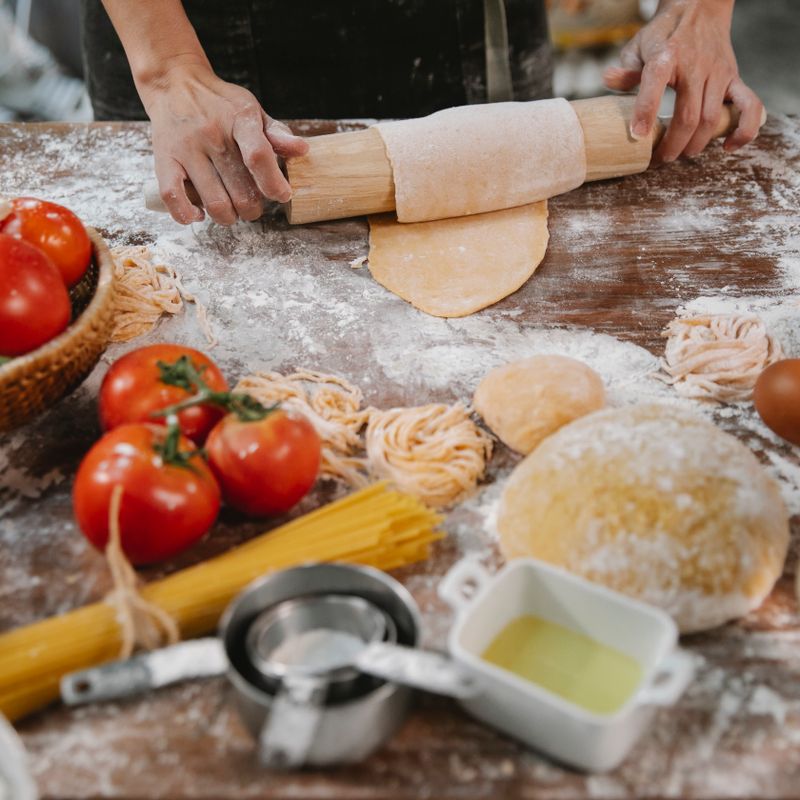
Homemade Hand-Rolled Egg Pasta Dough
A silky, golden Italian egg dough made with just 00 flour, eggs, a little olive oil and salt, rolled by hand with a rolling pin and cut into tender tagliatelle ribbons. No machine needed.
- Prep
- 49 min
- Cook
- 3 min
- Wait
- 40 min
- Total
- 1 hr 32 min
- Makes
- About 1 lb (450 g) fresh pasta, serving 4 as a main course
Steps
Before you start
- Clear a large, clean work surface of at least 24×24 inches (60×60 cm). Wood, marble or laminate all work.
- Set the eggs out 30 minutes ahead so they are at room temperature; cold eggs make a stiffer, harder-to-knead dough.
- Plan for a 30-minute rest after kneading. The dough cannot be rolled thin without it.
- Weigh the flour on a kitchen scale if you can. Cup measures vary, and flour-to-egg ratio is what makes or breaks the dough.
- Eggs are raw in the dough, so wash hands and surfaces after handling it.
Build the flour well
- Pour the 300 g (2⅓ cups) 00 flour onto your work surface and mix in the ½ tsp fine sea salt with your fingers.
- Shape the flour into a mound, then press a wide well in the center, about 5 inches (12 cm) across, with walls at least 1½ inches (4 cm) tall so the eggs cannot escape.
+ Show details− Hide details
Ready when: The well has thick, even walls and a visible floor of bare work surface.
Tip: Make the walls thick and sturdy. Thin spots are where the egg runs out.
Add eggs and oil
- Crack the 3 room-temperature eggs into the well and add the 1 tbsp olive oil.
- Using a fork, beat the eggs and oil together for about 1 minute, staying in the center and breaking the yolks.
+ Show details− Hide details
Ready when: The egg mixture is uniformly yellow and slightly frothy, with no streaks of white.
Draw in the flour
- Keep whisking with the fork in small circles, gradually pulling flour from the inner walls into the eggs.
- When the center becomes a thick, sticky paste and the walls start to slump, use a bench scraper to fold the remaining flour over the paste.
- Then use your hands to press everything into a shaggy mass.
- If there are dry floury patches that will not stick, sprinkle the 1 tbsp water (optional) over them and press again.
+ Show details− Hide details
Ready when: The dough forms a rough, shaggy ball that holds together and picks up most of the loose flour.
Tip: Add water only a few drops at a time. The dough should feel firm, not sticky. It is better slightly dry than wet.
Knead until smooth
- Scrape the work surface clean.
- Knead by pressing the dough forward with the heel of your hand, folding it back over itself, and giving it a quarter turn.
- Repeat for 8 to 10 minutes.
- The dough will start crumbly and stiff, then become progressively smoother and more elastic.
+ Show details− Hide details
Ready when: The dough is smooth, satiny and firm, and when you press a fingertip into it the dent slowly springs back. A cut surface shows no air pockets.
Tip: If the dough sticks to your hands or the work surface, dust with a pinch of flour. If it cracks and will not smooth out, wet your hands and keep kneading.
Rest the dough
- Shape the dough into a flattened disc, wrap it tightly in plastic wrap, and let it rest at room temperature for 30 minutes.
- This relaxes the gluten so the dough rolls out thin without springing back.
+ Show details− Hide details
Ready when: The dough is noticeably softer and more pliable when pressed.
Tip: Wrap tightly. Any exposed dough dries into a crust that will crack when rolled.
Divide the dough
- Cut the rested dough into 4 equal pieces (about 110 g each).
- Keep 3 pieces wrapped in plastic wrap while you work with one.
- Lightly dust your work surface with a little 00 flour, and flatten the first piece into an oval with your palm.
+ Show details− Hide details
Tip: Unwrapped dough dries out within minutes, so keep the pieces you are not using covered.
Roll out the sheets
- Roll the oval with a rolling pin from the center outward, rotating the dough a quarter turn after every few passes so it stays round and even.
- As it gets larger, wrap the dough loosely around the pin, then roll it forward while pressing the pin outward with your palms to stretch it.
- Unroll, turn it, and repeat.
- Continue until the sheet is about 1/16 inch (1.5 mm) thick and about 18 inches (45 cm) across.
- This takes 3 to 4 minutes per piece.
- Lay each finished sheet on a clean towel while you roll the others, keeping unrolled pieces wrapped.
+ Show details− Hide details
Ready when: The sheet is thin enough that you can see the color of your hand or the work surface through it, and it is evenly yellow with no thick spots.
Tip: Dust with flour only if it sticks. Too much flour makes the dough dry and brittle, so use as little as you can.
Dry slightly and cut
- Let the sheets rest for about 10 minutes on the towel, until the surface feels leathery but is still flexible and not brittle.
- Meanwhile, bring the 4 quarts (4 L) water to a boil in a large pot over high heat.
- Dust a sheet lightly with semolina and loosely roll it up into a flat roll, like a scroll.
- Using a sharp knife, cut crosswise into ¼-inch (6 mm) ribbons for tagliatelle.
- Gently shake the ribbons out and toss them with a pinch of semolina.
- Repeat with the remaining sheets.
+ Show details− Hide details
Ready when: The sheets feel like soft suede: dry to the touch but still bendable without cracking.
Tip: If the sheet feels tacky when rolled up, wait 5 more minutes. If it cracks, it has dried too much, so cut right away.
Nest the pasta
- Dust the towel-lined baking sheet with semolina.
- Gather a loose handful of ribbons and twist it into a nest on the tray.
- Make about 12 nests, spacing them apart so they do not touch.
- Use right away, or let them dry for up to 30 minutes.
+ Show details− Hide details
Ready when: The nests hold their shape and nothing is sticking to the towel.
Boil and serve
- Add the 2 tbsp kosher salt to the boiling water; it should taste pleasantly salty like the sea.
- Lower in the nests, shaking each one gently so the strands separate, and stir once.
- Cook at a rolling boil for 2 to 3 minutes.
- Lift out with a spider or tongs, reserving ½ cup (120 ml) of the cooking water, and toss right away with your sauce.
+ Show details− Hide details
Ready when: The pasta floats and is tender with a slight chew in the center when you bite a strand (al dente).
Tip: Fresh pasta cooks much faster than dried. Start tasting at 2 minutes, because it goes from perfect to mushy quickly.
Good to know
Tips
- Egg size matters. If your eggs are smaller or larger than 50 g each, weigh them: you want about 150 g beaten egg to 300 g flour, then adjust with a spoonful of flour or water.
- Do not rush the rest. A 30-minute rest is the difference between dough that fights back and dough that rolls out easily.
- Roll thinner than seems right, since the pasta nearly doubles in thickness when cooked.
- Cook in plenty of well-salted boiling water so the strands stay separate and do not stick together.
Make ahead
"Wrap the kneaded dough tightly in plastic and refrigerate for up to 24 hours; let it sit at room temperature for 30 minutes before rolling. Cut pasta can also be dried on the tray for up to 2 hours at room temperature, or frozen (see storage)."
Storage & reheating
"Uncooked nests: refrigerate in an airtight container, dusted with semolina, up to 2 days. Freeze: place nests on a tray until solid (about 1 hour), then transfer to a freezer bag for up to 2 months; cook straight from frozen, adding about 1 minute to the cooking time. Wrapped dough keeps 24 hours in the fridge. Cooked pasta is best eaten immediately; leftovers keep 2 days in the fridge and can be reheated in a skillet with a splash of water or sauce over medium-low heat."
Substitutions
- 00 flour → All-purpose flour. Works well, with a slightly chewier, less silky bite. You may need an extra teaspoon of water.
- semolina flour → Cornmeal or extra 00 flour. Semolina's coarse grain prevents sticking best, but fine cornmeal or flour works for dusting.
- extra-virgin olive oil → Leave it out. The dough works without oil. Oil only makes it a bit more supple and easier to roll.
- large eggs → 6 egg yolks plus 1 whole egg. Gives a richer, more golden, more tender pasta similar to northern Italian tajarin.
More pasta & noodles
See all →

Find more like this
- Meal
- Dinner
- Cuisine
- Italian
- Method
- Stovetop
- Quick & Easy
- 5 Ingredients or LessMake Ahead