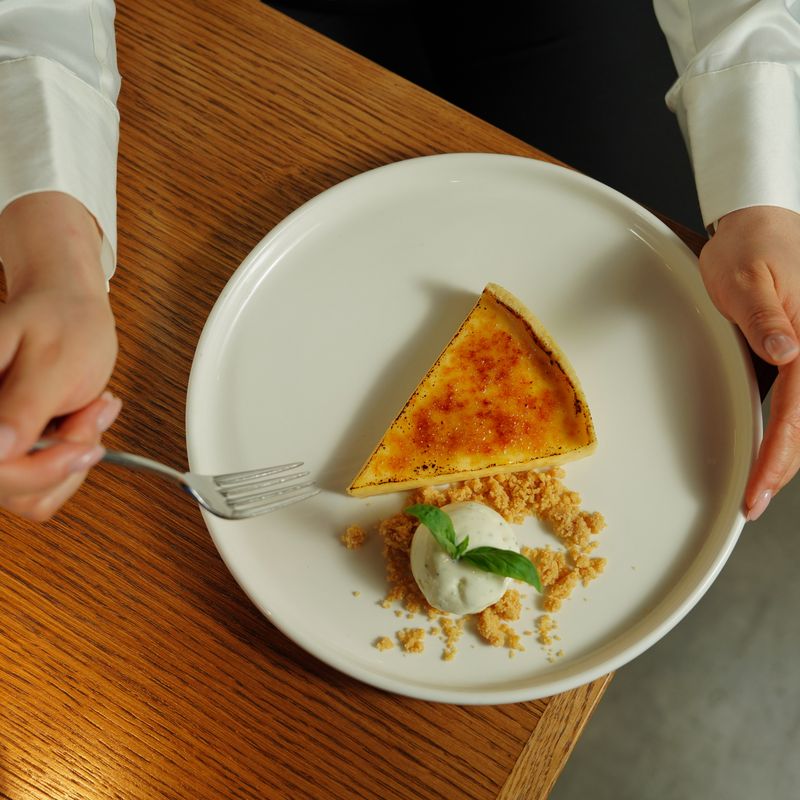
Classic Vanilla Bean Crème Brûlée
Silky, baked-in-a-water-bath vanilla custard under a thin, glassy crackle of caramelized sugar. This version uses only a handful of ingredients and gives reliably smooth, never-scrambled results.
- Prep
- 31 min
- Cook
- 40 min
- Wait
- 4 hr 58 min
- Total
- 6 hr 9 min
- Makes
- 6 custards (6-ounce / 180 ml ramekins)
Steps
Before you start
- The custards need at least 4 hours of chilling after baking, so start in the morning for an evening dessert (or the day before).
- Separate the eggs while they are cold, since the yolks are easier to separate that way, then let the yolks sit out while you warm the cream. Save the whites for meringue or an omelet.
- Don't boil the bath water yet. You'll boil it later, right before the bake step, so it is still steaming hot when it goes into the pan.
- Check that your roasting pan holds all six ramekins with at least ½ inch (1 cm) between them, and that its sides are at least 2 inches (5 cm) tall.
Heat the ovenOven 325°F / 165°C
- Position a rack in the center of the oven and preheat to 325°F (160°C).
- Set six 6-ounce (180 ml) ramekins in a large roasting pan (about 16×12 inches / 40×30 cm, sides at least 2 inches / 5 cm tall), in two rows of three with at least ½ inch (1 cm) between them and the pan walls.
- Leave the pan on the counter for now.
+ Show details− Hide details
Ready when: Oven reads 325°F (160°C) and the six ramekins sit in the pan without touching.
Tip: Don't boil the bath water yet; it would cool off long before the custards are ready.
Warm the cream
- In a medium saucepan, combine the cream, the scraped vanilla seeds, the empty vanilla pod, and the salt.
- Warm over medium-low heat, stirring occasionally, for about 5 minutes, until small bubbles form around the edge and steam rises.
- Remove from the heat before it boils.
+ Show details− Hide details
Ready when: Tiny bubbles at the edge, steaming, and a thermometer reads about 175°F (80°C). Not boiling.
Tip: Pull it off the heat as soon as it steams; boiling cream reduces and changes the custard's texture.
Infuse the vanilla
- Cover the saucepan and let the cream stand off the heat for 20 minutes so the vanilla flavors the cream.
- Meanwhile, set the large mixing bowl on a damp kitchen towel so it stays put for whisking.
+ Show details− Hide details
Ready when: The cream smells strongly of vanilla and is speckled with seeds.
Whisk yolks and sugar
- In the large bowl, whisk the egg yolks and the ⅓ cup (67 g) sugar for about 1 minute, just until smooth and pale yellow.
- Do not whip until foamy or the custard will have bubbles.
+ Show details− Hide details
Ready when: Mixture is smooth, pale yellow, and thick like paste, with no visible sugar grains and no foam.
Tip: Whisk gently in a back-and-forth motion, not a vigorous circle, to keep air out.
Temper the yolks
- Remove the vanilla pod from the cream (rinse and dry it to use later in sugar if you like).
- Rewarm the cream briefly over medium-low heat if it has cooled below steaming.
- While whisking the yolks constantly, pour in about ½ cup (120 ml) of the warm cream in a thin stream.
- Then slowly whisk in the rest of the cream in 3 or 4 additions.
+ Show details− Hide details
Ready when: Custard is uniform, liquid, and warm to the touch, with no streaks of yolk.
Tip: Adding the cream slowly is the key step. Dumping it in at once can scramble the yolks.
Strain and fill
- Pour the custard through a fine-mesh strainer into a large spouted measuring cup.
- Skim off any foam with a spoon, or pop surface bubbles with the tip of a knife.
- Divide the custard evenly among the ramekins in the pan, about ⅔ cup (150 ml) each, filling to just under ½ inch (1 cm) from the rim.
+ Show details− Hide details
Ready when: Surfaces are smooth and free of bubbles.
Tip: Bubbles on top bake into pockmarks and make the sugar crust uneven, so remove them now.
Boil the bath waterOven 325°F / 165°C
- Now fill the kettle with about 2 quarts (2 liters) of water and bring it to a full boil, so the water is as hot as possible when it goes into the pan.
- Slide the oven rack out partway and set the filled pan on it.
+ Show details− Hide details
Ready when: The kettle has just boiled and the pan sits on the pulled-out oven rack.
Tip: Boil a little extra; the roasting pan may need more water than you expect.
Bake in a water bathOven 325°F / 165°C
- With the pan on the pulled-out rack, carefully pour the boiling water into the pan, around (not into) the ramekins, until it reaches halfway up their sides.
- Gently slide the rack back in.
- Cover the pan loosely with foil if you like for a pale top.
- Bake at 325°F (160°C) for 30 to 40 minutes, starting to check at 30 minutes by gently nudging the pan.
+ Show details− Hide details
Ready when: Edges are set, but the center 1½ inches (4 cm) still jiggles like gelatin when nudged. A thermometer in the center reads about 170°F (77°C).
Tip: Pour the water in with the pan on the rack so you don't slosh it into the custards while carrying.
Rest, then lift out
- Turn off the oven and slide the rack halfway out.
- Leave the ramekins in the water bath, undisturbed, for 15 minutes.
- Then lift each ramekin out with a jar lifter or rubber-tipped tongs, supporting it from underneath, and set it on a wire rack.
- Let the custards cool for another 15 minutes at room temperature.
+ Show details− Hide details
Ready when: Ramekins are warm, not hot, and the centers have firmed slightly.
Tip: Don't carry the pan of hot water; lift the ramekins out of it instead.
Chill until firm
- Cover each ramekin with plastic wrap, pressing lightly so it doesn't touch the surface, and refrigerate at least 4 hours or up to 3 days, until completely cold and firm.
+ Show details− Hide details
Ready when: Custard is fully cold and holds its shape when you gently tilt the ramekin.
Tip: Chilling thoroughly matters: a warm custard turns soupy under the torch.
Torch the tops
- Blot any condensation off the custards with a paper towel.
- Sprinkle about 1½ teaspoons (6 g) of the topping sugar over each custard and tilt the ramekin so it forms a thin, even layer.
- Hold a kitchen torch 2 to 3 inches (5 to 7 cm) away and move the flame in slow circles until the sugar melts and turns deep amber.
- Let the tops harden for 5 minutes before serving.
+ Show details− Hide details
Ready when: The sugar is deep amber, bubbling stops, and the top taps like glass once hardened.
Tip: Serve within about 1 hour of torching, since the crust softens as it sits.
Good to know
Tips
- If you don't have a torch, set the oven rack 4 inches (10 cm) below the broiler, place the chilled ramekins on a baking sheet surrounded by ice if possible, and broil on high for 1 to 3 minutes, watching constantly. Results are less even than a torch.
- Use a thin sugar layer. Thick sugar burns on top before it melts underneath and makes a hard crust that is difficult to crack.
- Overbaking causes a grainy or curdled custard. Pull the custards when the centers still wobble; they firm up as they cool.
- Strain the custard even if it looks smooth. This catches bits of cooked egg and gives the silkiest texture.
Make ahead
Bake and chill the custards (through the chilling step) up to 3 days ahead, covered, in the refrigerator. Torch the sugar just before serving.
Storage & reheating
Un-torched custards keep, covered, in the refrigerator for up to 3 days. Do not freeze; the texture turns grainy and watery. Torched custards are best eaten within 1 hour at room temperature and do not store well because the crust softens. Serve cold; there is no reheating.
Substitutions
- vanilla bean → 1 tablespoon (15 ml) vanilla bean paste or 1 tablespoon pure vanilla extract. Warm the cream with the salt only, then stir the paste or extract in off the heat before tempering. Skip the 20-minute infusion if using extract.
- heavy cream → 2½ cups (600 ml) heavy cream plus ½ cup (120 ml) whole milk. A slightly lighter custard that is still set and creamy.
- granulated or turbinado sugar → Turbinado or superfine sugar. Turbinado gives a crunchier, deeper caramel; superfine melts most evenly.
- granulated sugar → Light brown sugar, same weight. Adds a subtle caramel flavor, with a slightly darker custard.
More puddings & custards
See all →


Find more like this
- Meal
- Dessert
- Cuisine
- French
- Main ingredient
- Eggs
- Method
- Oven
- Quick & Easy
- Make Ahead