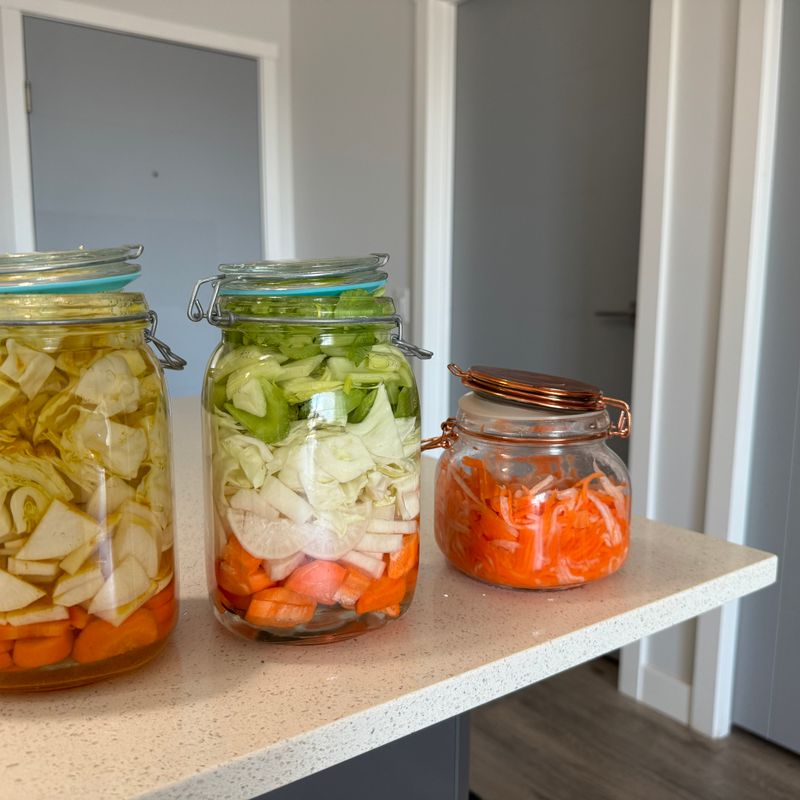
Vietnamese Pickled Vegetable Slaw
A bright, tangy slaw of julienned cabbage, carrot, and daikon radish pickled in a simple vinegar-and-sugar brine. This versatile Vietnamese-style slaw is crisp, refreshing, and pairs perfectly with grilled meats, bánh mì, spring rolls, or other Southeast Asian dishes. Ready in under an hour.
Steps
Before you start
- Wash all vegetables and pat dry before beginning
- Prepare a sharp knife or julienne peeler for clean, even cuts
- Have a 1-quart (1-liter) jar or container ready to store the finished slaw
Julienne the cabbage
- Remove the outer leaves from the Napa cabbage and discard.
- Rinse the cabbage head under cold water.
- Cut the head in half lengthwise, then cut each half into thin strips about 1/4 inch (6 mm) wide.
- You should have about 500 g (about 4 cups) of julienned cabbage.
- Don't worry if some pieces are irregular; they will still pickle beautifully.
+ Show details− Hide details
Ready when: Cabbage is cut into thin, even strips
Tip: A sharp knife is essential here—a dull blade will crush the cabbage rather than cutting it cleanly
Julienne the carrots and daikon
- Peel the 3 carrots and 1 medium daikon radish under cold running water.
- Using a sharp knife, a vegetable peeler, or a julienne tool, cut the carrots and daikon into thin matchsticks about 1/4 inch (6 mm) wide and 2–3 inches (5–7 cm) long.
- Work carefully to make them as uniform as possible so they pickle evenly.
- You should have about 200 g of carrot and 300 g of daikon.
+ Show details− Hide details
Ready when: All vegetables are cut into thin, even matchsticks
Tip: A mandoline or julienne peeler makes this much faster and more uniform than a knife, though a sharp knife works fine
Make the pickling brine
- In a medium bowl, combine 3/4 cup (180 ml) rice vinegar, 3 tablespoons (35 g) granulated sugar, 1 teaspoon (5 g) kosher salt, and 1/2 cup (120 ml) water.
- Whisk until the sugar and salt are completely dissolved.
- If using garlic and Thai chili for extra flavor, add 2 minced cloves of garlic and 1 thinly sliced Thai chili to the brine now.
+ Show details− Hide details
Ready when: Sugar and salt are fully dissolved; the brine is clear
Tip: Make sure all the granules of sugar and salt are dissolved so the brine will be smooth and evenly flavored
Combine vegetables with brine
- Place all the julienned vegetables (cabbage, carrots, and daikon) in a large bowl or a 1-quart (1-liter) jar.
- Pour the brine over the vegetables, making sure to include any garlic or chili.
- Toss well with your hands or a fork, working for about 1–2 minutes, until every piece of vegetable is coated with the pickling liquid and the vegetables begin to wilt slightly.
+ Show details− Hide details
Ready when: All vegetables are evenly coated with brine
Tip: Don't skimp on the tossing—make sure the brine reaches all the vegetables, especially those at the bottom
Let the slaw pickle
- Cover the bowl or jar and let it sit at room temperature for at least 30 minutes.
- During this time, the vegetables will soften, the flavors will blend, and the slaw will develop its characteristic tangy, slightly sweet taste.
- For a deeper flavor, you can refrigerate it for several hours or overnight.
- Stir or shake the container occasionally if you'd like, though it's not necessary.
+ Show details− Hide details
Ready when: Vegetables are slightly softened and have absorbed the pickle flavor (taste a piece to check)
Tip: The longer you let it sit, the softer and more flavorful the slaw becomes. After 30 minutes it's delicious, but 2–3 hours develops even better flavor
Finish and serve
- When ready to serve, if the slaw seems too wet or briny, drain off some of the liquid.
- Taste a piece and adjust seasoning if needed (add a pinch more salt, vinegar, or sugar to taste).
- Transfer to a serving bowl and optionally garnish with 1 tablespoon of sesame seeds.
- Serve well-chilled or at room temperature alongside Vietnamese grilled meats, bánh mì sandwiches, spring rolls, or other Southeast Asian dishes.
+ Show details− Hide details
Ready when: Slaw is ready to serve
Good to know
Tips
- For maximum crunchiness, chill the vegetables in the refrigerator for at least 1 hour before pickling. Cold vegetables stay crisper during the pickling process.
- Use a sharp knife or mandoline for clean cuts—a dull blade will crush the vegetables and create an uneven texture.
- Taste the slaw after 30 minutes and adjust the seasoning. If it's too sour, add a teaspoon of sugar; if not tangy enough, add a splash of vinegar.
- This slaw pairs beautifully with rich grilled meats, crispy spring rolls, or fresh bánh mì sandwiches. The acidity and crunch balance heavier dishes perfectly.
Make ahead
This slaw can be made 1–5 days ahead and stored in the refrigerator. The flavors deepen and meld over time, making it even more delicious after 24 hours.
Storage & reheating
Room temperature: up to 4 hours (though the vegetables will continue to soften and become less crisp). Refrigerator: up to 5 days in an airtight container with the brine. Freezer: Not recommended—the vegetables will become mushy when thawed. To reheat: This slaw is best served cold or at room temperature and does not need reheating.
Substitutions
- Napa cabbage → Green or red cabbage. Provides a slightly different flavor and texture; red cabbage will stain the brine but is beautiful. Use the same weight.
- rice vinegar → Apple cider vinegar or white vinegar. Will be slightly sharper in flavor; you may want to reduce the amount to 1/2 cup (120 ml) and taste before serving.
- medium daikon radish → Jicama or Asian pear. Adds sweetness and crunch; use the same weight and prepare the same way.
- water → Replace half the water with fresh lime juice. Adds brightness and a Southeast Asian flavor profile; adjust salt and sugar to taste.
More slaws
See all →
Find more like this
- Meal
- Lunch
- Cuisine
- Vietnamese
- Method
- No-Cook
- Quick & Easy
- 5 Ingredients or LessEasyBeginner
- Season
- Summer