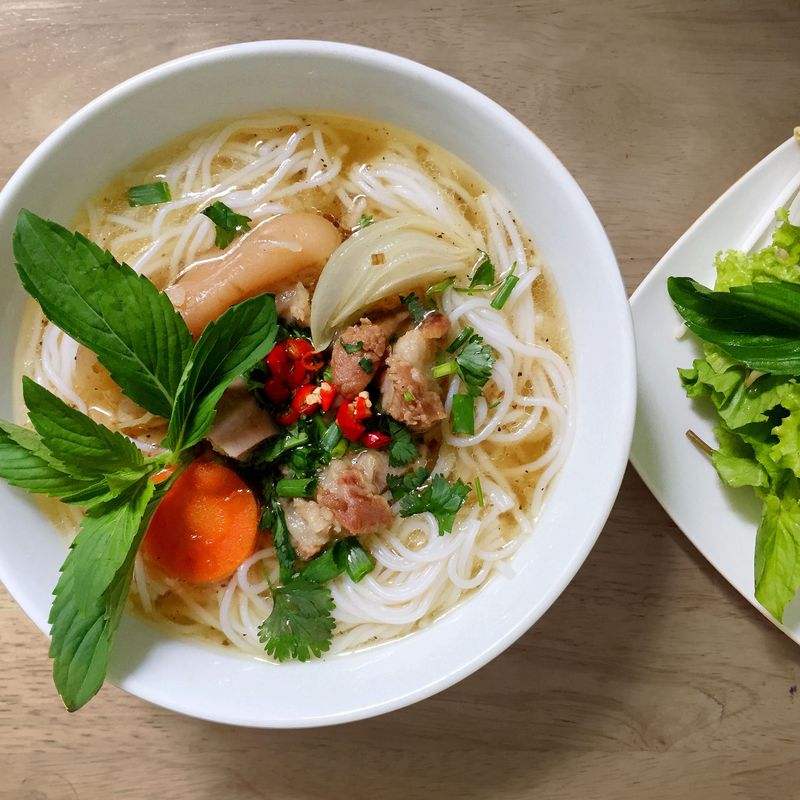
Vietnamese Pho Noodle Casserole
A baked casserole inspired by Vietnamese pho, combining tender beef brisket, rice noodles, and an aromatic broth infused with star anise, cinnamon, cloves, and ginger. Unlike traditional pho served as a soup, this casserole layers everything together and bakes until the noodles absorb the fragrant, savory broth, creating a cozy, one-dish meal with all the complex flavors you love about pho.
- Prep
- 20 min
- Cook
- 1 hr 15 min
- Wait
- 3 hr
- Total
- 4 hr 35 min
- Makes
- 1 casserole (6 servings)
Steps
Before you start
- Preheat oven to 325°F (163°C) 15 minutes before baking
- Trim excess fat from the beef brisket, leaving a thin layer for flavor
- Measure out all dry spices so they're ready to toast
- Read through the recipe: the beef simmers first on the stovetop to build broth, then the whole dish bakes in the oven
Toast the spices
- In a large stockpot or saucepan over medium heat, combine the star anise, cinnamon stick, cloves, and black peppercorns.
- Toast for 2–3 minutes, shaking the pan occasionally, until fragrant and the spices darken slightly.
- You should smell warm, sweet, spicy aromas.
+ Show details− Hide details
Ready when: Spices are fragrant and slightly darkened; cloves release their aroma
Tip: Don't let the spices burn—they should darken slightly, not blacken. If they scorch, start over with fresh spices.
Sear the beef
- Add the beef brisket chunks to the pot with the toasted spices.
- Increase heat to medium-high.
- Cook for 6–8 minutes, stirring occasionally, until the meat is browned on the outside but not cooked through.
- You'll see a deep golden-brown crust on the chunks.
+ Show details− Hide details
Ready when: Beef chunks are browned on all sides; spices still visible in the pan
Tip: Don't overcrowd the pan or move the meat too much—let it sit for 1–2 minutes per side to build color.
Build the broth base
- Add the halved onions (unpeeled), halved ginger piece, and beef broth to the pot.
- Stir to combine, scraping up any browned bits from the bottom of the pan.
- Bring to a boil over high heat, then reduce to medium-low and simmer for 40 minutes.
- The broth will deepen in color and the beef will begin to tenderize.
- You should see gentle bubbles rising to the surface.
+ Show details− Hide details
Ready when: Broth is fragrant and has a golden-brown color; beef is beginning to break apart slightly when pressed
Tip: Maintain a gentle simmer, not a rolling boil—this keeps the meat tender and the broth clear.
Strain and season the broth
- Strain the broth through a fine-mesh sieve into a bowl, discarding the onion skins, ginger, and whole spices (they've given their flavor).
- Return the broth to the pot with the beef.
- Stir in the fish sauce.
- Taste and season with salt and black pepper to taste—the broth should taste savory, slightly sweet, and aromatic.
+ Show details− Hide details
Ready when: Broth is clear and fragrant; beef is visible in the pot
Tip: Start with 1 teaspoon of salt, taste, then add more if needed. Fish sauce is salty, so adjust carefully.
Preheat and assembleOven 325°F / 165°C
- Preheat your oven to 325°F (163°C).
- Pour the hot broth with beef into a large 5-quart (4.7 L) Dutch oven or heavy casserole dish.
- Scatter the broken rice noodles evenly over the broth, pressing them down gently so they're mostly submerged.
- Sprinkle the white and light green scallion parts over the top (if using).
+ Show details− Hide details
Ready when: Noodles are scattered and mostly submerged in hot broth
Tip: Don't break the noodles too finely or they'll turn mushy. 2–3 inch pieces are ideal for this casserole.
Bake the casseroleOven 325°F / 165°C
- Cover the casserole with its lid (or foil if you don't have a lid) and place it in the preheated 325°F (163°C) oven.
- Bake for 25–30 minutes, until the noodles are tender and have absorbed most of the broth.
- The liquid should be mostly gone, the noodles soft, and the beef very tender—it should shred easily with a fork.
+ Show details− Hide details
Ready when: Noodles are tender and have absorbed most broth; beef easily shreds with a fork; rice noodles are opaque and soft, not al dente
Tip: Open the oven door once at the 20-minute mark to check that the noodles aren't drying out too quickly. If it looks very dry, add 1/2 cup of warm broth.
Finish and serve
- Remove the casserole from the oven and let it rest for 5 minutes off heat.
- Fluff the noodles gently with a fork.
- Top with fresh cilantro leaves and remaining scallion greens (if using).
- Serve with lime wedges and sriracha on the side so guests can customize heat and brightness.
+ Show details− Hide details
Ready when: Noodles are fluffed and separated; casserole is warm throughout
Tip: Cilantro and lime are essential for the fresh, bright finish—don't skip them if you want that classic pho flavor.
Good to know
Tips
- For extra umami and depth, use homemade beef stock instead of store-bought broth if you have it on hand.
- If your casserole noodles end up too thick or too thin, you're controlling the ratio of broth to noodles. For drier results, reduce broth by 1 cup next time; for brothier, increase by 1/2 cup.
- Toasting the whole spices before simmering is key—it unlocks their essential oils and is what makes this casserole taste like authentic pho, not just beefy noodle soup.
- Vietnamese pho is traditionally served with fresh herbs, acid (lime), and heat (sriracha/hot sauce) on the side—encourage your guests to add these to their own bowls for best flavor.
Make ahead
You can simmer the beef and broth up to 2 days ahead. Cool completely, cover, and refrigerate in an airtight container. Reheat gently on the stovetop over medium-low heat, adding the rice noodles to the hot broth just before baking (skip the earlier broth-simmering step and proceed directly to step 5). This saves 40 minutes on the day you want to serve.
Storage & reheating
Store leftovers in an airtight container in the refrigerator for up to 3 days. The noodles will soften further and absorb more broth over time. To reheat, cover and warm in a 300°F (150°C) oven for 10–15 minutes until heated through, or on the stovetop over medium-low heat with a splash of water or broth if it's too thick. The casserole does not freeze well because the noodles become mushy when thawed.
Substitutions
- beef brisket, cut into 1½-inch (4 cm) chunks → beef chuck roast or chuck steak, cut the same size. Chuck has good marbling and becomes tender with slow cooking; simmer time may be slightly shorter (35–38 minutes instead of 40).
- dried rice noodles (banh pho) → thin egg noodles or ramen noodles (minus the seasoning packet). Egg and ramen noodles cook faster; reduce baking time to 18–20 minutes and check tenderness earlier.
- fish sauce → soy sauce or tamari (use the same volume). You'll lose some of the traditional pho depth, but the casserole will still taste savory and aromatic. Add 1/2 teaspoon of soy sauce more than you would fish sauce to account for less saltiness.
- star anise pods → 1/2 teaspoon of fennel seeds, crushed. Fennel gives a similar licorice-forward flavor but is milder. Toast it with the other spices the same way.
More casseroles
See all →


Find more like this
- Meal
- Dinner
- Cuisine
- Vietnamese
- Main ingredient
- Stew Beef
- Method
- Oven