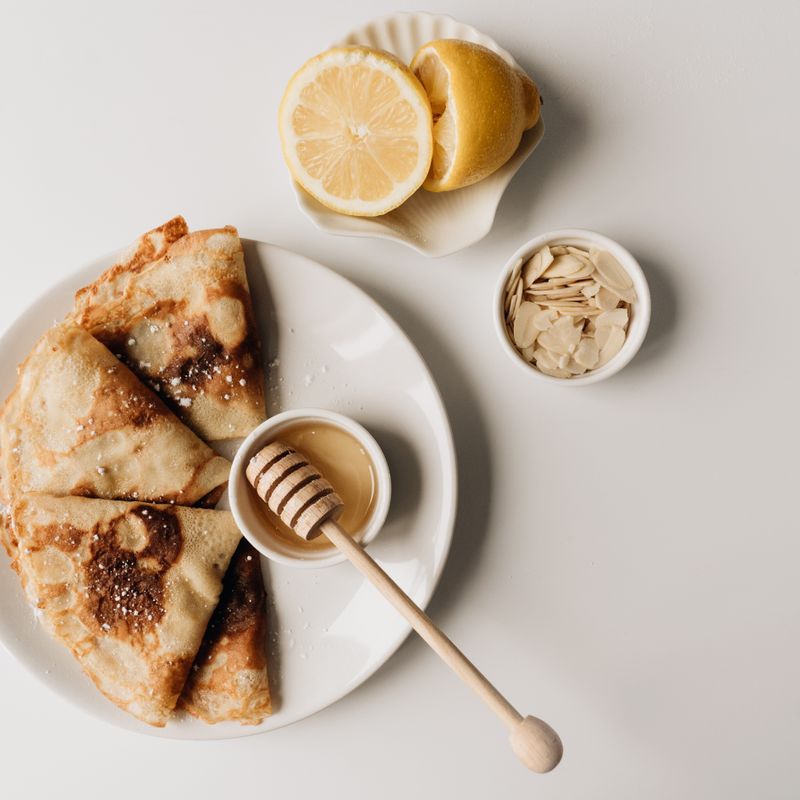
Vegan Blackberry Lemon Curd Crepes
Tender, paper-thin crepes filled with tangy vegan lemon curd and topped with fresh blackberries. This elegant dessert brings together the delicate texture of French crepes with vibrant citrus and berry flavors, all completely plant-based. Perfect for brunch, dessert, or a special occasion.
- Prep
- 25 min
- Cook
- 20 min
- Wait
- 30 min
- Total
- 1 hr 15 min
- Makes
- 8 crepes with filling and berries
Steps
Before you start
- Make the lemon curd at least 2 hours ahead and chill it thoroughly
- Have all crepe ingredients at room temperature (warm the plant milk to 110°F/43°C if it's been refrigerated)
- Set up a clean workspace near the stove with a plate ready to stack finished crepes
- If using store-bought lemon curd, ensure it's vegan; if making it, prepare it first
Whisk wet ingredients
- In a medium bowl, whisk together the plant milk, aquafaba, and vanilla extract until smooth and well combined.
- Set aside.
+ Show details− Hide details
Ready when: mixture is smooth and homogeneous
Tip: Use room-temperature liquids so the crepe batter cooks evenly and doesn't create thick edges.
Combine dry ingredients
- In a large bowl, sift together the flour, coconut sugar, and salt.
- This removes lumps and ensures an even, tender crumb.
+ Show details− Hide details
Ready when: dry mixture is uniform and lump-free
Tip: Sifting the flour is not optional for crepes—it prevents lumpy, tough batter.
Make the batter
- Create a well in the center of the dry ingredients.
- Pour the wet mixture into the well.
- Using a whisk, gently pull the dry ingredients into the liquid, stirring in a circular motion from the center outward.
- Stop when just combined—do not overmix.
- The batter should be thin and pourable, like heavy cream.
+ Show details− Hide details
Ready when: batter is smooth, thin, and pourable with no visible lumps
Tip: Overmixing develops gluten and makes crepes tough. A few small lumps are fine and will cook out.
Rest the batter
- Let the batter rest at room temperature for 20–30 minutes.
- This allows the flour to fully hydrate and the aquafaba to bind, ensuring tender, delicate crepes.
+ Show details− Hide details
Tip: Do not skip this rest—it is essential for light, tender crepes.
Heat the crepe pan
- Place an 8-inch non-stick crepe pan or non-stick skillet over medium-high heat.
- Let it heat for 2–3 minutes until a drop of water sizzles and evaporates immediately.
+ Show details− Hide details
Ready when: a drop of water sizzles and evaporates instantly
Tip: Proper pan temperature is critical; too cool and crepes will be thick and rubbery; too hot and they'll brown unevenly.
Coat the pan lightly
- Brush the hot pan with a tiny amount of melted coconut oil (about 1/4 teaspoon per crepe).
- You want a light, nearly invisible coating to prevent sticking without greasing the batter.
+ Show details− Hide details
Ready when: oil glistens in the pan but is not pooled
Tip: Too much oil makes the crepe greasy and slippery to fill. Less is more here.
Cook the first crepe
- Working quickly, pour 1/4 cup (60 ml) of batter into the center of the hot pan.
- Immediately pick up the pan and tilt it in a circular motion—clockwise, then counterclockwise—to spread the batter into a thin, even circle covering about 2/3 of the pan.
- The batter sets almost instantly; the crepe should be lacy and translucent in places.
- Cook for about 45–60 seconds until the bottom is pale golden and the top is set (it will still feel slightly moist but will not stick to your finger).
+ Show details− Hide details
Ready when: bottom is pale golden, top is set and no longer wet
Tip: Tilt the pan in one fluid motion and work quickly—the batter sets in seconds. If the first crepe is thick, your pan may not be hot enough or you poured too much batter.
Flip and finish
- Using a rubber spatula, gently loosen the edges and flip the crepe.
- Cook the second side for about 20–30 seconds until it is lightly speckled with golden spots.
- Do not overcook—the crepe should remain tender and pliable.
+ Show details− Hide details
Ready when: second side has light golden speckles and crepe is flexible
Tip: Crepes should be tender and slightly undercooked rather than firm. They will toughen quickly if overdone.
Stack and cool crepes
- Transfer the crepe to a clean plate.
- Repeat the oil, pour, tilt, cook, and flip process with the remaining batter, stacking finished crepes on the plate.
- After every 2–3 crepes, give the batter a gentle stir to redistribute any settled flour.
- You should have 8 crepes total.
+ Show details− Hide details
Ready when: all 8 crepes are cooked, tender, and stacked
Tip: If crepes start to tear or stick, reduce heat slightly to medium or adjust tilt technique. Crepes cool and firm slightly as they rest.
Fill the crepes
- Place a cooked crepe on a clean, dry surface.
- Spread about 1.5 tablespoons (22 ml) of chilled lemon curd over the crepe, leaving a 1/2-inch border.
- Scatter 3–4 blackberries over the curd.
- Fold the crepe in half, then in half again to form a triangle, or roll it loosely around the filling.
- Transfer to a serving plate.
- Repeat with remaining crepes.
+ Show details− Hide details
Ready when: all crepes are filled and arranged on the plate
Tip: Do not overfill—excess curd will squeeze out when you fold. A light hand ensures an elegant presentation.
Garnish and serve
- Dust the filled crepes lightly with powdered sugar if desired.
- Scatter a few extra fresh blackberries on the plate around the crepes.
- Add a pinch of lemon zest for a bright finishing touch.
- Serve immediately while the crepes are still warm and pliable.
+ Show details− Hide details
Ready when: crepes are plated and garnished
Tip: Serve within 10–15 minutes of assembling for the best texture; crepes stiffen as they cool.
Good to know
Tips
- Room-temperature ingredients are critical for vegan crepes: cold aquafaba and plant milk will result in thick, uneven crepes. Warm your plant milk gently to 110°F (43°C) if it's been refrigerated.
- The key to paper-thin crepes is tilting the pan immediately after pouring the batter—before it sets—and using the right pan temperature. Practice your first crepe; by the second or third, your technique will feel natural.
- If crepes are tearing or sticking, your pan may be too hot or not hot enough. Too hot: reduce to medium. Too cool: wait an extra minute or two before pouring. Adjust gradually.
- Aquafaba is essential for vegan crepes—it binds and lifts the batter without eggs, creating a tender, delicate texture. Do not skip it or substitute with cornstarch alone.
Make ahead
Vegan lemon curd can be made up to 5 days ahead and stored in an airtight container in the refrigerator. Crepes can be cooked up to 2 days ahead, stacked with parchment paper between each, wrapped tightly, and stored in an airtight container in the refrigerator. Reheat crepes in a dry skillet over low heat for 30 seconds per side before filling, or serve at room temperature. Do not fill crepes more than 15 minutes before serving.
Storage & reheating
Room temperature: Unfilled crepes keep for 1 day in an airtight container; reheat gently in a dry skillet. Refrigerator: Unfilled crepes keep for 2 days; filled crepes are best eaten within 1 hour but can be covered loosely and kept for up to 2 hours. Freezer: Unfilled crepes (stacked with parchment between each, wrapped tightly) keep for up to 3 months; thaw at room temperature for 1 hour, then warm gently in a dry skillet if desired. Do not freeze filled crepes.
Substitutions
- aquafaba (liquid from one 15 oz/425 g can chickpeas, or 3 tbsp fresh) → 1 flax egg (1 tbsp ground flaxseed mixed with 2.5 tbsp water, rested 15 minutes) or 1/4 cup unsweetened applesauce. Aquafaba provides the best binding and lift for tender crepes, but these alternatives work. Applesauce will make crepes slightly denser. Use one or the other, not both.
- coconut sugar → maple syrup (1.5 tbsp) or regular cane sugar (2 tbsp). Coconut sugar adds subtle caramel notes, but maple syrup or cane sugar work fine. If using maple syrup, reduce the plant milk slightly (to 3/4 cup plus 2 tbsp) to account for the liquid.
- unsweetened plant milk (almond, oat, or soy) → oat milk, soy milk, or cashew milk. Any unsweetened plant milk works. Avoid sweetened versions, which will make the crepe batter sweet and difficult to control. Oat milk creates the most tender crepes.
- fresh blackberries → raspberries, blueberries, or mixed berries. Any fresh berry works beautifully with lemon curd. If using softer berries like raspberries, add them just before serving to prevent them from collapsing or weeping into the curd.
More no-bake desserts
See all →



Find more like this
- Meal
- Dessert
- Cuisine
- French
- Diet
- VegetarianHalal
- Method
- Stovetop