Turkish Spiced Eggplant Imam Bayildi with Quinoa Pilaf
Imam Bayildi—the legendary Turkish dish whose name means "the imam fainted" from its deliciousness—gets a modern twist here. Tender eggplant halves are hollowed and filled with a fragrant mixture of caramelized onions, tomatoes, pine nuts, and warm spices, then baked until creamy inside. The quinoa pilaf, cooked in vegetable broth with cinnamon and dried apricots, provides a nutty, light complement. Serve warm or at room temperature.
- Prep
- 30 min
- Cook
- 1 hr
- Wait
- 15 min
- Total
- 1 hr 45 min
- Makes
- 4 servings (2 eggplant halves each, with 1 cup pilaf per serving)
Steps
Before you start
- Preheat your oven to 400°F (200°C)
- Read through both the eggplant and pilaf sections so you can time them to finish together
- Have all spices measured before you start cooking
Prepare eggplants
- Halve the eggplants lengthwise.
- Using a melon baller or sturdy spoon, scoop out the inner flesh, leaving a ¼-inch-thick shell all around.
- Score the remaining flesh lightly in a crosshatch pattern to help it soften.
- Chop the scooped flesh into ½-inch cubes (you'll have about 2 cups).
- Pat the eggplant halves dry with paper towels.
- Brush both sides with 3 tbsp (45 ml) olive oil, then season with ½ tsp (3 g) sea salt and ¼ tsp (0.5 g) black pepper.
- Place skin-side down on a large baking sheet.
+ Show details− Hide details
Ready when: Eggplant halves are hollowed with a thin shell remaining
Tip: Don't scoop the flesh away from the edges; a sturdy shell prevents collapse during baking.
Cook filling base
- Heat a large 12-inch (30 cm) skillet over medium heat.
- Add the sliced onions and cook slowly for 12–15 minutes, stirring often, until they turn golden brown and begin to caramelize.
- This builds sweetness and depth.
- Add the minced garlic and cook for 1 minute until fragrant.
+ Show details− Hide details
Ready when: Onions are deeply golden and soft, garlic is fragrant
Tip: Low and slow caramelization prevents burnt edges; resist the urge to raise heat.
Add spices and eggplant
- Stir in the cumin (1 tsp / 2.5 g), cinnamon (½ tsp / 1 g), smoked paprika (½ tsp / 1 g), and red pepper flakes (¼ tsp / 0.5 g).
- Cook for 30 seconds until fragrant.
- Add the chopped eggplant flesh and stir to coat with oil and spices.
- Cook for 3–4 minutes, stirring occasionally, until the eggplant begins to soften and release its juices.
+ Show details− Hide details
Ready when: Eggplant is beginning to soften and spices are fragrant
Tip: Toast the spices for just 30 seconds to bloom their flavors without burning.
Build filling with tomatoes
- Add the crushed tomatoes with their juice (14 oz / 400 g), lightly toasted pine nuts (½ cup / 70 g), chopped parsley (¼ cup / 15 g), and chopped mint if using (2 tbsp / 10 g).
- Stir well.
- Simmer uncovered over medium heat for 8–10 minutes, stirring occasionally, until the mixture thickens and the flavors meld.
- The filling should be thick enough that it doesn't run when spooned onto the eggplant halves.
+ Show details− Hide details
Ready when: Mixture is thick, jammy, and fragrant; a spoon dragged through leaves a trail
Tip: If your filling is too wet, simmer a few minutes longer; if too thick, add 2 tbsp tomato juice.
Start the pilaf
- While the filling simmers, begin the pilaf.
- In a medium saucepan, heat 2 tbsp (30 ml) olive oil over medium heat.
- Add the minced shallot and cook for 2–3 minutes, stirring, until softened and just beginning to turn golden.
- Add the rinsed quinoa and stir constantly for 2 minutes until it's lightly toasted and fragrant.
- Add the ground cinnamon (¼ tsp / 0.5 g), vegetable broth (2¾ cups / 650 ml), and sea salt (½ tsp / 3 g).
- Bring to a boil.
+ Show details− Hide details
Ready when: Broth is boiling
Tip: Toasting the quinoa for 2 minutes adds a subtle nutty flavor that elevates the pilaf.
Simmer pilaf
- Reduce heat to low, cover the saucepan with a lid, and simmer for 15 minutes.
- Do not stir or lift the lid during this time.
- After 15 minutes, remove from heat and let stand, covered, for 5 minutes.
- Fluff with a fork.
+ Show details− Hide details
Ready when: Quinoa is translucent with a small white germ showing, broth is absorbed, and grains are tender
Tip: Don't peek or stir—opening the lid releases steam and can result in undercooked grains.
Fill eggplant halves
- Once the filling has thickened, spoon it evenly among the four eggplant halves, mounding it slightly in the center.
- Use about ¾ to 1 cup of filling per half.
- Set the baking sheet with filled eggplants aside until the oven is ready.
+ Show details− Hide details
Ready when: Eggplant halves are evenly and generously filled
Tip: Divide the filling evenly so all eggplants cook at the same rate.
Bake eggplantsOven 400°F / 205°C
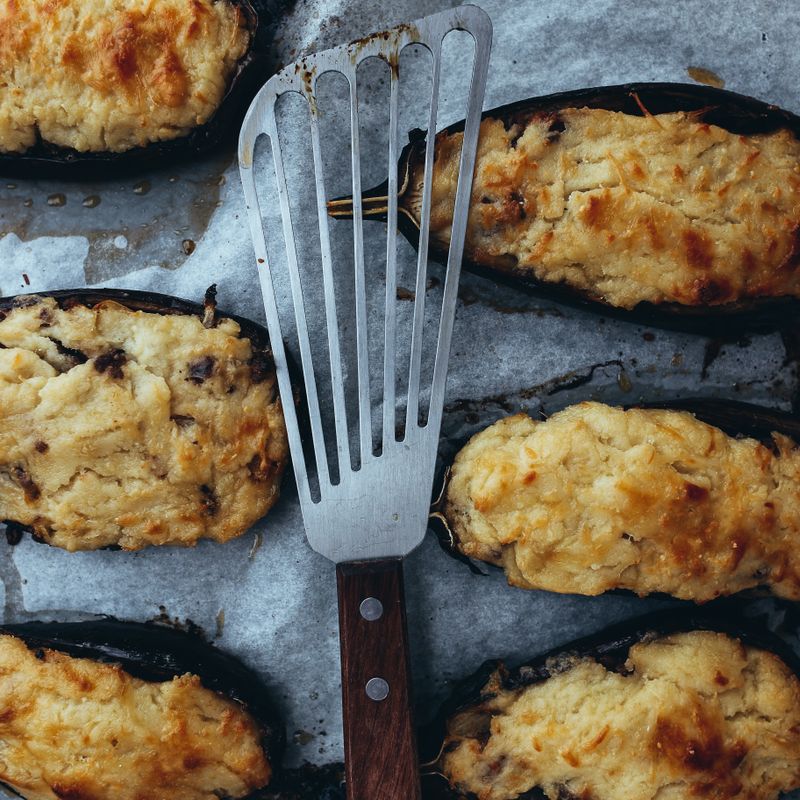
- Place the baking sheet into a preheated 400°F (200°C) oven and bake for 25–30 minutes, until the eggplant flesh is very tender when pierced with a fork and the tops are lightly browned.
- The skin should be soft enough to cut easily with the edge of a spoon.
+ Show details− Hide details
Ready when: Eggplant flesh is very tender when pierced with a fork, skin is soft, and tops are light golden
Tip: Eggplants continue to soften as they cool; slightly underbaked is better than mushy.
Finish pilaf
- Once the quinoa is fluffed, stir in the chopped dried apricots (½ cup / 85 g), toasted sliced almonds (¼ cup / 35 g), and black pepper (¼ tsp / 0.5 g).
- Taste and adjust salt if needed.
- Keep warm over very low heat or transfer to a bowl and cover loosely with foil.
+ Show details− Hide details
Ready when: Pilaf is fluffy, warm, and evenly studded with apricots and almonds
Tip: Add apricots and almonds at the last moment so they stay distinct and don't clump.
Rest and serve
- Remove the baking sheet from the oven and let the eggplants rest for 5 minutes.
- Place each eggplant half on a serving plate and spoon the warm quinoa pilaf alongside (about 1 cup per person).
- Drizzle any pan juices from the baking sheet over the eggplants if desired.
+ Show details− Hide details
Ready when: Eggplants have cooled slightly and are ready to plate
Tip: Resting prevents the eggplants from collapsing or falling apart when you lift them.
Good to know
Tips
- Choose medium eggplants that feel firm with glossy skin—too large or soft eggplants may be watery or bitter. The size ensures even cooking and a good shell-to-filling ratio.
- If your fresh tomatoes are in season, substitute 1 pound (450 g) of fresh tomatoes, cored and coarsely chopped, for the canned tomatoes. Increase the simmering time to 12–15 minutes to allow excess moisture to evaporate.
- Toasting the pine nuts and almonds just before using prevents them from turning rancid and deepens their flavor. Toast them in a dry skillet over medium heat for 2–3 minutes, shaking often, until golden and fragrant.
- Serve the dish warm, at room temperature, or even chilled the next day—it's equally delicious. If serving chilled, bring it to room temperature for 30 minutes first to restore the natural flavors.
Make ahead
Prepare the filling through step 4 up to 1 day ahead. Cover and refrigerate. Reheat gently in a skillet over medium-low heat for 5 minutes, stirring occasionally, before filling the eggplants. Scoop and oil the eggplant halves up to 4 hours ahead; cover with plastic wrap and refrigerate until ready to bake. The cooked eggplants can be served warm or at room temperature; cool completely and store covered in the fridge for up to 3 days. Reheat gently in a 325°F (160°C) oven for 15 minutes.
Storage & reheating
Room temperature: 2 hours, loosely covered. Refrigerator: up to 3 days in an airtight container; reheat gently in a 325°F (160°C) oven for 12–15 minutes, or microwave individual portions at 50% power for 3–4 minutes, stirring halfway. Freezer: up to 3 months; thaw overnight in the fridge, then reheat as above. The pilaf can be made separately and frozen for up to 1 month.
Substitutions
- pine nuts → sliced almonds or walnuts, lightly toasted. Almonds and walnuts add similar richness and crunch. Use the same weight; the flavor will be slightly less delicate but equally delicious.
- quinoa, uncooked → brown rice or farro, uncooked. Increase cooking liquid to 3 cups (710 ml) and simmer for 40–45 minutes for brown rice, or 30–35 minutes for farro. The nutty, chewy texture will complement the eggplant beautifully.
- dried apricots, unsweetened → dried dates, chopped, or golden raisins. Dates add deeper sweetness; raisins are lighter. Use the same weight. Both pair wonderfully with cinnamon and eggplant.
- fresh mint leaves → fresh basil or more fresh parsley. Basil adds Mediterranean flair; extra parsley keeps the herb profile grounded. Either works beautifully in the filling.