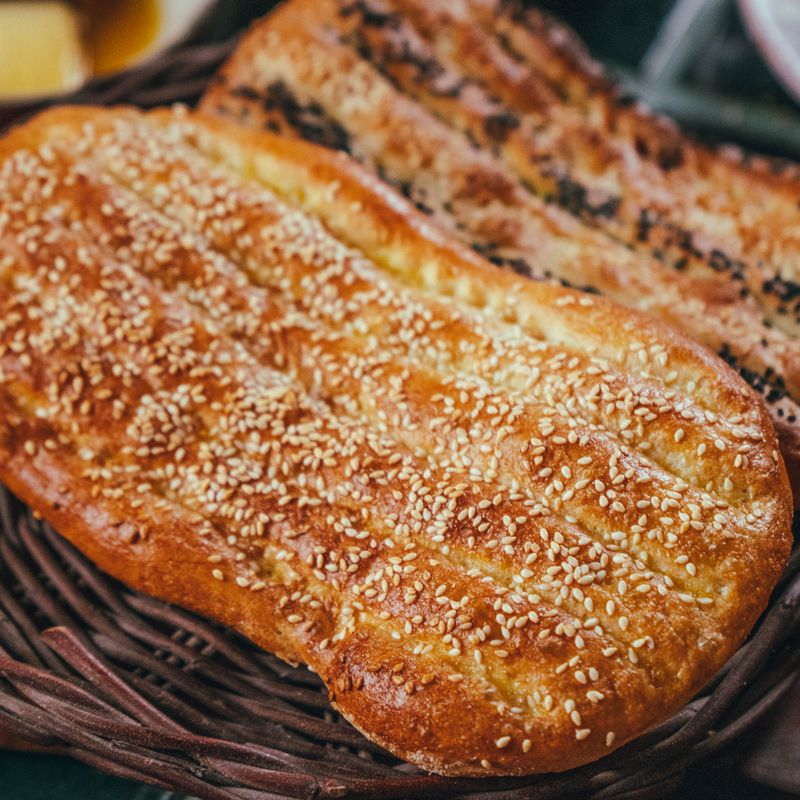
Turkish Poğaça with Feta, Parsley and Nigella Seeds
Soft, tender savory buns made with yogurt and a little butter, stuffed with salty feta and fresh parsley, and finished with a glossy egg wash and crunchy nigella seeds. There's no yeast and no rising, so they go from bowl to oven in under an hour.
Steps
Before you start
- Take the yogurt, egg and milk out of the fridge 30 minutes ahead so the dough comes together evenly. Cold yogurt will firm up the oil and butter.
- Melt the butter and let it cool until just warm to the touch, not hot, so it doesn't cook the egg.
- Crumble the feta and chop the parsley before you start. The filling should be ready when the dough finishes resting.
- Read the timing: the dough rests for 20 minutes and has no rise. Preheat the oven during the last 15 minutes of the rest.
Make the filling
- In a small bowl, combine the crumbled feta, chopped parsley and black pepper.
- Mash gently with a fork so the mixture holds together in clumps but still has some small pieces of feta.
- Do not add salt, because the feta is already salty.
- Cover and refrigerate until needed.
+ Show details− Hide details
Ready when: Mixture holds together when pinched
Tip: Pat wet feta dry with paper towels first. Extra brine can make the buns leak while baking.
Whisk dry ingredients
- In a large mixing bowl, whisk together the flour, baking powder, sugar and salt for about 30 seconds until evenly combined.
- Make a well in the center.
+ Show details− Hide details
Ready when: No streaks or pockets of baking powder
Combine wet ingredients
- In a medium bowl, whisk the yogurt, oil, cooled melted butter, beaten egg and lukewarm milk until smooth and fully blended.
- Pour the mixture into the well in the flour.
+ Show details− Hide details
Ready when: Liquid looks smooth with no streaks of yogurt
Tip: If the butter is hot it will scramble the egg. Let it cool first.
Mix and knead briefly
- Stir with a spatula until a shaggy dough forms, then knead in the bowl or on a lightly floured counter for 2 to 3 minutes.
- Stop as soon as the dough is smooth, very soft and slightly tacky but no longer sticks to your hands.
- If it clings heavily, knead in extra flour 1 tablespoon at a time, up to 3 tablespoons.
+ Show details− Hide details
Ready when: Soft, smooth, earlobe-like dough that springs back slowly when poked
Tip: Don't over-knead. Too much kneading makes the buns tough rather than tender.
Rest the doughOven 375°F / 190°C
- Cover the bowl with a damp towel or plastic wrap and let the dough rest at room temperature for 20 minutes.
- This relaxes the gluten and makes shaping easier.
- During the last 15 minutes, preheat the oven to 375°F (190°C) with a rack in the upper third and one in the lower third, and line two baking sheets with parchment.
+ Show details− Hide details
Ready when: Dough feels softer and is easy to stretch
Divide and portion
- Turn the dough onto a lightly floured counter and roll or pat it into a log.
- Cut it into 16 equal pieces of about 65 g (2⅓ oz) each, using a scale for even buns.
- Roll each piece into a smooth ball and keep the shaped ones covered with a towel.
+ Show details− Hide details
Ready when: 16 smooth balls of similar size
Fill and seal
- Flatten one ball into a 4-inch (10 cm) round, slightly thinner at the edges.
- Place a heaped tablespoon (about 12 g) of feta filling in the center.
- Pull the edges up and pinch firmly to seal, then roll gently into a ball.
- Place seam-side down on the lined baking sheet, 8 buns per sheet, at least 1½ inches (4 cm) apart.
+ Show details− Hide details
Ready when: No filling visible and seams tightly pinched
Tip: Don't overfill. Too much cheese will burst through the seam as the buns puff up.
Egg wash and top
- Whisk the egg yolk with the 1 tablespoon milk.
- Brush the tops and sides of each bun generously, avoiding puddles on the parchment.
- Sprinkle each bun with a generous pinch of nigella seeds, about ⅛ teaspoon each.
+ Show details− Hide details
Ready when: Buns look evenly glossy and speckled with seeds
Tip: Brush gently so you don't deflate the buns.
Bake the poğaçaOven 375°F / 190°C
- Bake both sheets at 375°F (190°C) for 22 to 25 minutes.
- Switch the sheets between the racks and rotate them front to back halfway through, at about 12 minutes.
- The buns are done when deep golden brown on top and the bottoms are golden and firm.
+ Show details− Hide details
Ready when: Deep golden tops, golden bottoms, and a hollow sound when tapped underneath
Tip: If the tops brown too fast before the bottoms are golden, tent loosely with foil.
Cool and serve
- Slide the parchment with the buns onto a wire rack and cool for at least 10 minutes.
- The filling will be very hot at first.
- Serve warm or at room temperature.
+ Show details− Hide details
Ready when: Buns feel firm and no longer steam heavily
Good to know
Tips
- Keep the dough soft. It should feel slightly tacky; too much added flour makes dry, dense buns.
- Seal the seams well and bake seam-side down so the cheese stays inside.
- Use a scale for 65 g dough pieces so every bun bakes in the same time.
- For extra flavor, add 1 teaspoon of Aleppo pepper flakes or a pinch of dried mint to the filling.
Make ahead
Shape and fill the buns, place them on a lined tray, cover tightly and refrigerate for up to 12 hours. Brush with egg wash and top with nigella just before baking, adding 3 to 5 minutes to the bake time. You can also freeze the unbaked, shaped buns for up to 2 months and bake from frozen at 350°F (175°C) for 30 to 35 minutes.
Storage & reheating
Room temperature in an airtight container for up to 1 day. Refrigerate for up to 4 days. Freeze baked buns in a zip-top bag for up to 2 months. Reheat from room temperature or the fridge on a baking sheet at 325°F (160°C) for 8 to 10 minutes, or from frozen for 15 minutes, until warm throughout.
Substitutions
- feta cheese → Turkish beyaz peynir, or 100 g feta mixed with 100 g crumbled whole-milk ricotta. Beyaz peynir is the traditional choice. Ricotta gives a milder, creamier filling.
- plain whole-milk yogurt → Full-fat sour cream or labneh thinned with a splash of milk. The dough will be slightly richer. Use the same weight.
- nigella seeds (çörek otu) → White or black sesame seeds. The flavor is nuttier and milder, but the look is similar.
- fresh flat-leaf parsley → Fresh dill or chopped scallions. Use the same amount. Dill is common in Turkish bakeries.