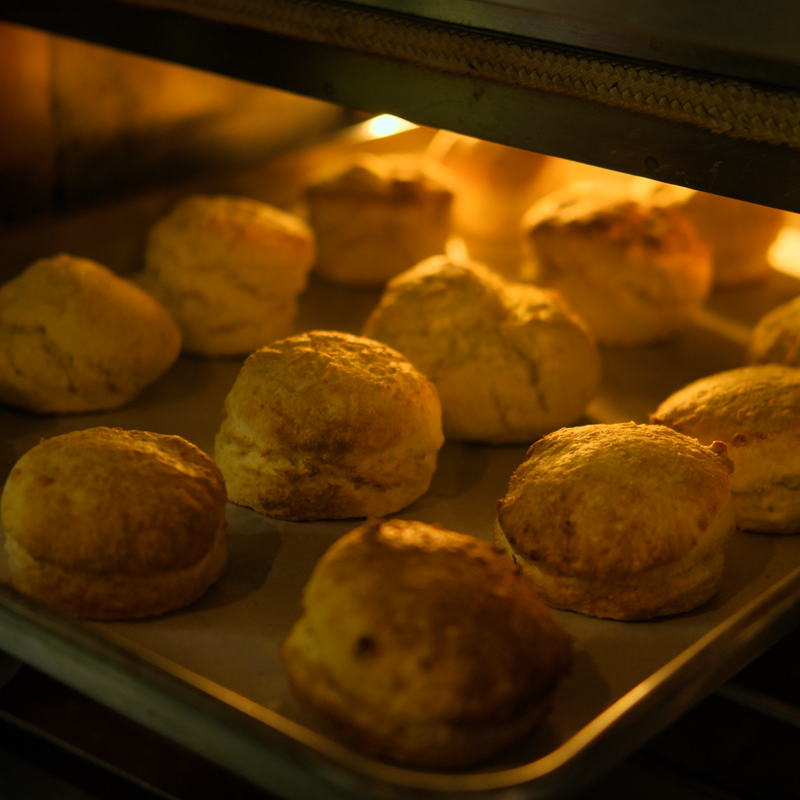
Turkish Peynirli Poğaça (Feta-Stuffed Savory Rolls with Nigella Seeds)
Soft, tender yogurt-and-oil rolls folded around a salty feta and parsley filling, brushed with egg yolk and sprinkled with nigella seeds. No yeast and no rising, so they go from bowl to table in about 90 minutes. They are a classic Turkish breakfast and tea-time bake.
- Prep
- 35 min
- Cook
- 25 min
- Wait
- 30 min
- Total
- 1 hr 30 min
- Makes
- 16 filled rolls (about 2 per serving)
Steps
Before you start
- Take the egg and yogurt out of the fridge 30 minutes ahead so the dough comes together evenly.
- Warm the milk until it feels just lukewarm (about 100°F/38°C). It should not feel hot, or it can cook the egg.
- Taste your feta before you start. If it is very salty, rinse it briefly and pat it dry, or use the lesser amount of salt in the dough.
- Plan for about 90 minutes in total, including a 20-minute dough rest and a 10-minute cool before serving.
Heat oven, line pansOven 375°F / 190°C
- Position two racks in the upper and lower thirds of the oven and preheat to 375°F (190°C).
- Line two large rimmed baking sheets with parchment paper.
+ Show details− Hide details
Ready when: Oven reads 375°F (190°C) and both pans are lined.
Tip: If your oven runs hot or has a strong fan, lower it to 350°F (175°C) and check a few minutes early.
Whisk dry ingredients
- In a large bowl, whisk together the flour, baking powder, salt, and sugar for 30 seconds so the baking powder is evenly distributed.
- Make a well in the center.
+ Show details− Hide details
Ready when: The mixture looks uniform with no clumps of baking powder.
Mix wet ingredients
- In a medium bowl, whisk the egg, ½ cup (125 g) yogurt, oil, and lukewarm milk until smooth and fully blended.
- Pour this into the well in the flour.
+ Show details− Hide details
Ready when: The liquid is smooth and uniform, with no streaks of yogurt or egg.
Knead soft dough
- Stir with a fork until a shaggy dough forms, then turn it out onto a lightly floured surface.
- Knead gently for 2 to 3 minutes, just until the dough is smooth and holds together.
- It should be soft, a little oily, and slightly tacky but not sticking to your hands.
- If it is sticky, knead in 1 to 2 tablespoons of extra flour.
+ Show details− Hide details
Ready when: Dough is smooth, soft like an earlobe, and springs back slowly when pressed.
Tip: Don't over-knead. Too much kneading makes the poğaça tough instead of tender.
Rest the dough
- Cover the dough with the mixing bowl turned upside down, or with a damp towel, and let it rest at room temperature for 20 minutes.
- This relaxes the gluten and makes it easier to shape.
+ Show details− Hide details
Ready when: The dough feels softer and stretches easily when pulled gently.
Prepare the filling
- While the dough rests, combine the crumbled feta and chopped parsley in a medium bowl.
- Mix with a fork, leaving small crumbly pieces.
- Do not mash it into a paste.
- Set aside.
+ Show details− Hide details
Ready when: Cheese is in small crumbles evenly flecked with green parsley.
Tip: Squeeze very moist feta in a paper towel first. Wet cheese can leak out while baking.
Divide and fill
- Divide the dough into 16 pieces of about 60 g each (roll it into a log and cut it into 16 equal pieces).
- Roll each piece into a ball, then flatten it on a lightly floured surface into a round about 4 inches (10 cm) across, with the edges slightly thinner than the center.
- Place a heaping tablespoon (about 12 g) of filling in the center.
- Fold the dough over into a half-moon and pinch the edge firmly to seal.
- Press the edge with a fork to close it tightly.
- Place on the lined pans about 1½ inches (4 cm) apart.
+ Show details− Hide details
Ready when: Each half-moon is fully sealed with no filling showing at the edges.
Tip: Keep filling away from the edge. Even a little cheese on the seam will stop it from sealing and it will burst open.
Glaze and sprinkle
- In a small bowl, beat the egg yolk with 1 tablespoon yogurt until smooth.
- Brush this lightly over the top of each poğaça, avoiding pooling at the base.
- Sprinkle generously with nigella seeds, about ½ teaspoon per roll.
+ Show details− Hide details
Ready when: Tops are evenly shiny and covered with seeds.
Tip: Don't let the glaze drip down the sides onto the parchment, as that can glue the rolls to the paper.
Bake until goldenOven 375°F / 190°C
- Bake at 375°F (190°C) for 22 to 25 minutes, swapping the pans between racks and rotating them front to back after 12 minutes, until the poğaça are deep golden brown on top and the bottoms are golden.
+ Show details− Hide details
Ready when: Tops are deep golden brown, bottoms are golden, and they feel light and firm when lifted.
Tip: If the tops brown before the bottoms are done, tent loosely with foil for the last 5 minutes.
Cool briefly, serve
- Slide the parchment with the rolls onto a wire rack and cool for 10 minutes.
- The cheese filling will be very hot at first.
- Serve warm with Turkish tea.
+ Show details− Hide details
Ready when: Rolls are warm, not hot, and the crust is slightly crisp.
Good to know
Tips
- Weigh the dough pieces for even rolls that all bake in the same time.
- Keep the dough soft. A slightly tacky dough produces tender poğaça, while a dry dough bakes up crumbly and dense.
- Seal the edges firmly and keep filling off the seam to prevent the cheese from leaking out.
- Serve them warm, as the cheese is at its best right after baking, but let them cool for 10 minutes first to avoid burning your mouth.
Make ahead
"Shape and fill the rolls, arrange them on the lined pans, cover tightly, and refrigerate up to 12 hours. Glaze and top with nigella seeds just before baking, adding 2 to 3 minutes to the baking time. You can also freeze the unbaked, shaped rolls on the pan until firm, then bag them for up to 2 months. Bake from frozen at 350°F (175°C) for 30 to 35 minutes."
Storage & reheating
"Room temperature: up to 1 day in an airtight container. Fridge: up to 4 days. Freezer: baked rolls up to 2 months, wrapped well. Reheat refrigerated or thawed rolls on a baking sheet at 325°F (160°C) for 8 to 10 minutes, or from frozen for 15 minutes, until warmed through and the crust has crisped."
Substitutions
- Turkish white cheese (beyaz peynir) or feta → Equal weight of crumbled ricotta salata, or half feta and half shredded mozzarella. Mozzarella gives a milder, stretchier filling. Add a pinch of salt if using a mild cheese.
- nigella seeds (çörek otu) → Sesame seeds, or half sesame and half poppy seeds. The flavor will be nuttier and less peppery, but the look and crunch are similar.
- sunflower oil (or other neutral oil) → Melted unsalted butter, cooled slightly. This gives a richer, more buttery flavor and a slightly less tender crumb.
- fresh flat-leaf parsley → Fresh dill or chopped scallion greens. Use the same quantity. Dill is also common in Turkish versions.