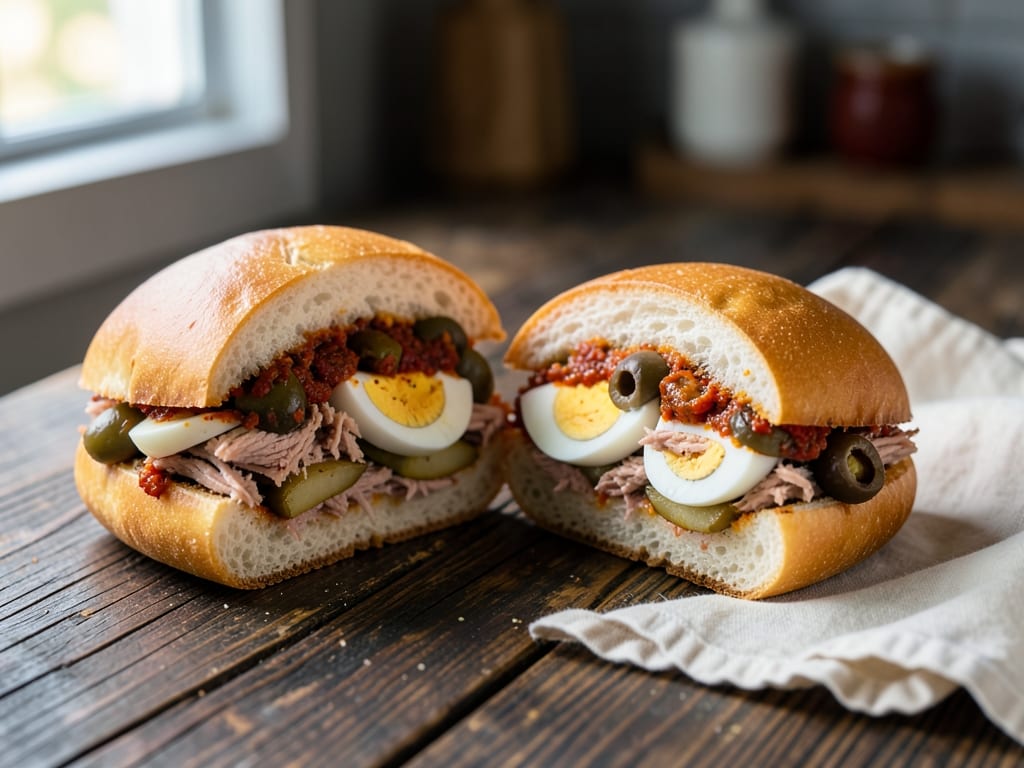
Tunisian Fricassé Sandwiches with Tuna, Harissa, Olives and Egg
Soft, golden yeast rolls are deep-fried until puffed, then split and stuffed with oil-packed tuna, potato, hard-boiled egg, olives and a punchy harissa dressing. This is Tunisia's favorite street-food sandwich, made at home.
- Prep
- 1 hr 7 min
- Cook
- 20 min
- Wait
- 1 hr 25 min
- Total
- 2 hr 52 min
- Makes
- 8 sandwiches (one 4-inch / 10 cm roll each)
Steps
Before you start
- Read the timing: the dough needs about 80 minutes of rising. Boil the potatoes and eggs and make the filling while it rises.
- Measure the flour by weight (500 g) if you can. Scooped cups can pack heavily and give a dry dough.
- Set up a frying station before you start: a tray lined with paper towels, a slotted spoon or spider, and a deep-fry or candy thermometer.
- Harissa brands vary a lot in heat. Start with the smaller amount in the dressing and taste before adding more.
Mix the dough
- In a large bowl, whisk 500 g (4 cups) flour, the yeast, sugar and 1½ tsp salt.
- Add the lukewarm water and 60 ml (4 tbsp) olive oil.
- Stir with a wooden spoon until no dry flour remains and a shaggy, sticky dough forms.
+ Show details− Hide details
Ready when: No dry flour remains and the dough looks shaggy and sticky.
Tip: If the water feels hot on your wrist, let it cool. Hot water can kill the yeast.
Knead until smooth
- Knead on a lightly floured surface for 8 minutes, or for 6 minutes in a stand mixer on medium-low.
- The dough should be soft and slightly tacky.
- Add flour 1 tbsp at a time only if it sticks stubbornly to your hands.
+ Show details− Hide details
Ready when: The dough is smooth and elastic. When you poke it, it springs back slowly.
Tip: Soft, slightly sticky dough gives light rolls. Too much extra flour makes them dense.
First rise
- Rub a large bowl with a little olive oil.
- Add the dough, turn it once to coat and cover with a damp towel or plastic wrap.
- Leave it in a warm spot (75–80°F / 24–27°C) for 60 minutes.
+ Show details− Hide details
Ready when: The dough has doubled and a floured fingertip pressed in leaves a dent that fills back slowly.
Tip: Use this hour to do the next two steps.
Boil potatoes and eggs
- Put the whole potatoes in a medium saucepan, cover with cold water by 1 inch (2.5 cm) and add a generous pinch of salt.
- Bring to a boil over medium-high heat, then reduce to a steady simmer and cook 15 minutes.
- Lower the eggs into the same pot for the last 10 minutes of cooking.
- Drain, then cool the eggs in a bowl of ice water for 5 minutes.
- Peel the potatoes and cut them into ½-inch (1 cm) cubes.
- Peel the eggs and cut each into 4 wedges.
+ Show details− Hide details
Ready when: A knife slides into the potato with no resistance. Egg yolks are fully set and pale yellow, with no wet center.
Tip: Peel potatoes while still warm, holding them in a kitchen towel. They peel easily and will absorb the dressing better.
Make the filling
- In a medium bowl, whisk the harissa, 3 tbsp olive oil and the lemon juice into a loose red dressing.
- Add the flaked tuna, sliced olives, chopped capers and cubed potatoes.
- Fold gently so the potatoes keep their shape.
- Taste and add salt, remembering that olives and capers are salty.
- Keep the egg wedges separate for assembly.
+ Show details− Hide details
Ready when: Everything is evenly coated in orange-red dressing and the filling tastes bright, salty and spicy.
Tip: Add more harissa 1 tsp at a time. The heat deepens as the filling sits.
Shape the rolls
- Turn the risen dough onto a lightly floured surface and gently press out the large air bubbles.
- Divide into 8 pieces of about 105 g (3¾ oz) each.
- Shape each piece into a ball, then press and stretch it into an oval about 4 inches (10 cm) long and ½ inch (1.25 cm) thick.
- Place the ovals on a floured baking sheet, leaving 2 inches (5 cm) between them.
+ Show details− Hide details
Ready when: The 8 ovals are even in size and smooth on top, with no tears.
Tip: Keep the ovals flat. Thick, round pieces stay raw in the center by the time the outside browns.
Second rise
- Cover the shaped rolls loosely with a towel and let them rest for 20 minutes.
- They will look slightly puffy but not doubled.
+ Show details− Hide details
Ready when: The rolls look puffy and a floured fingertip leaves a dent that slowly fills back.
Tip: Heat the oil in the next step while the rolls rest.
Heat the frying oilOven 340°F / 170°C
- Pour 1500 ml (6 cups) neutral oil into a 5-quart Dutch oven; it should be about 2 inches (5 cm) deep and no more than half full.
- Heat over medium heat until a thermometer reads 340°F (170°C), about 10 minutes.
- Adjust the heat to hold that temperature.
- Set a wire rack lined with paper towels nearby.
+ Show details− Hide details
Ready when: The thermometer holds steady at 340°F (170°C).
Tip: If the oil is too cool, the rolls soak it up and turn greasy. If it is too hot, they brown before cooking through.
Fry in batchesOven 340°F / 170°C
- Fry 2 rolls at a time.
- Lower each roll in gently, away from you.
- It will sink, then float and puff within 30 seconds.
- Fry 2 to 2½ minutes per side, turning once with a slotted spoon, until deep golden brown.
- Lift out, let the oil drip back into the pot, and set on the rack.
- Bring the oil back to 340°F (170°C) between batches.
+ Show details− Hide details
Ready when: Rolls are deep golden brown, puffed and hollow-sounding when tapped, and feel light for their size.
Tip: Don't crowd the pot. More than 2–3 rolls at once drops the oil temperature sharply.
Drain and cool slightly
- Let the fried rolls drain on the rack for 5 minutes.
- They should be cool enough to handle but still warm, which makes them easy to split without crumbling.
+ Show details− Hide details
Ready when: The rolls are warm, not hot, and the surface is dry to the touch.
Fill and serve
- With a serrated knife, slice each roll open along one long side, leaving the other side attached like a pocket.
- Spoon about ⅓ cup of tuna filling into each, then tuck in 2 egg wedges.
- Serve right away, with extra harissa on the side if you like.
+ Show details− Hide details
Ready when: Each pocket is generously packed and the roll still holds together.
Tip: Fill just before serving. The crisp crust softens as the filling sits.
Good to know
Tips
- Keep the rolls flat, about ½ inch thick. Thicker rolls brown on the outside before the center cooks.
- Check the oil temperature between batches. Aim for 340°F (170°C) the whole time.
- Drain the tuna well. Excess oil makes the filling greasy and the rolls soggy.
- Serve with extra harissa, lemon wedges and a few pickled vegetables for a more traditional spread.
Make ahead
Make the filling up to 1 day ahead and refrigerate it in a covered container; keep the egg wedges separate. The dough can be shaped and refrigerated, covered, on the baking sheet for up to 12 hours. Let it sit at room temperature for 30 minutes before frying.
Storage & reheating
Fried rolls keep, unfilled, in a paper bag or loosely covered at room temperature for up to 1 day, or in an airtight bag in the freezer for up to 1 month. Reheat at 350°F (175°C) for 6–8 minutes (or 8–10 from frozen) until crisp. Store filling in the fridge for up to 2 days. Filled sandwiches are best eaten within 30 minutes.
Substitutions
- harissa paste → Sambal oelek, or tomato paste with cayenne and a pinch of ground caraway. Gives similar heat but less depth; adjust spice to taste.
- oil-packed tuna → Oil-packed canned sardines or mackerel. Stronger flavor; drain well and mash lightly.
- pitted green olives → Black olives or a mix of green and black. Black olives are milder and slightly sweeter.
- all-purpose flour → Bread flour. Gives a chewier roll; add 1–2 tbsp more water if the dough feels stiff.