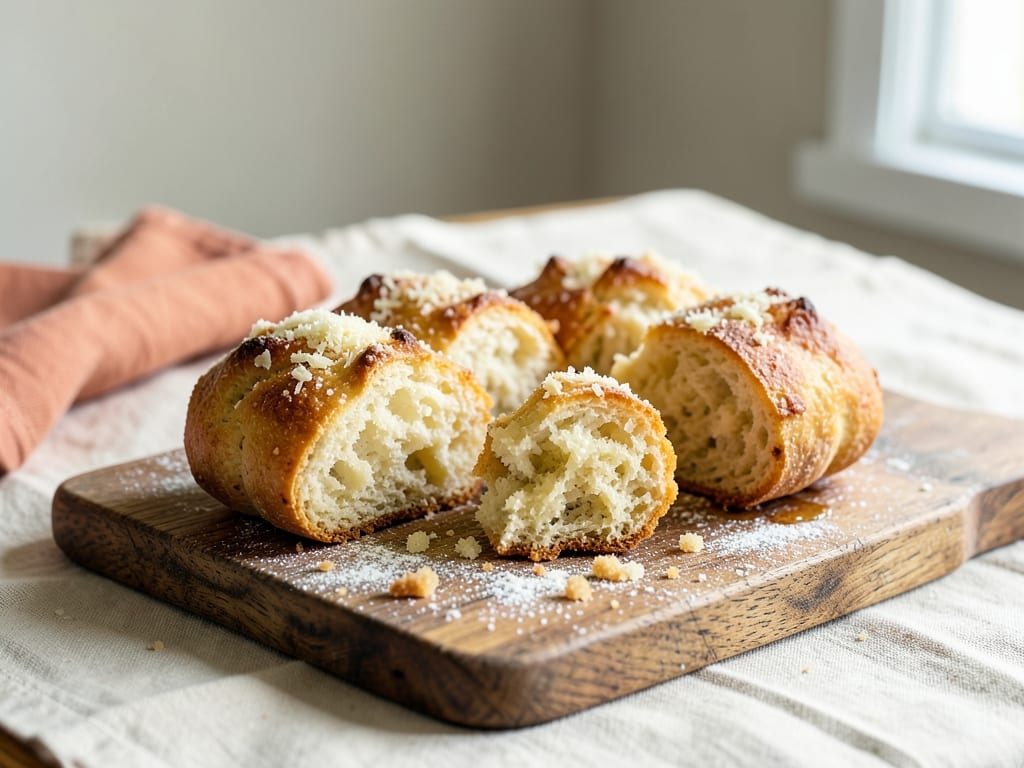
Tunisian Brick Pastry with Egg and Harissa
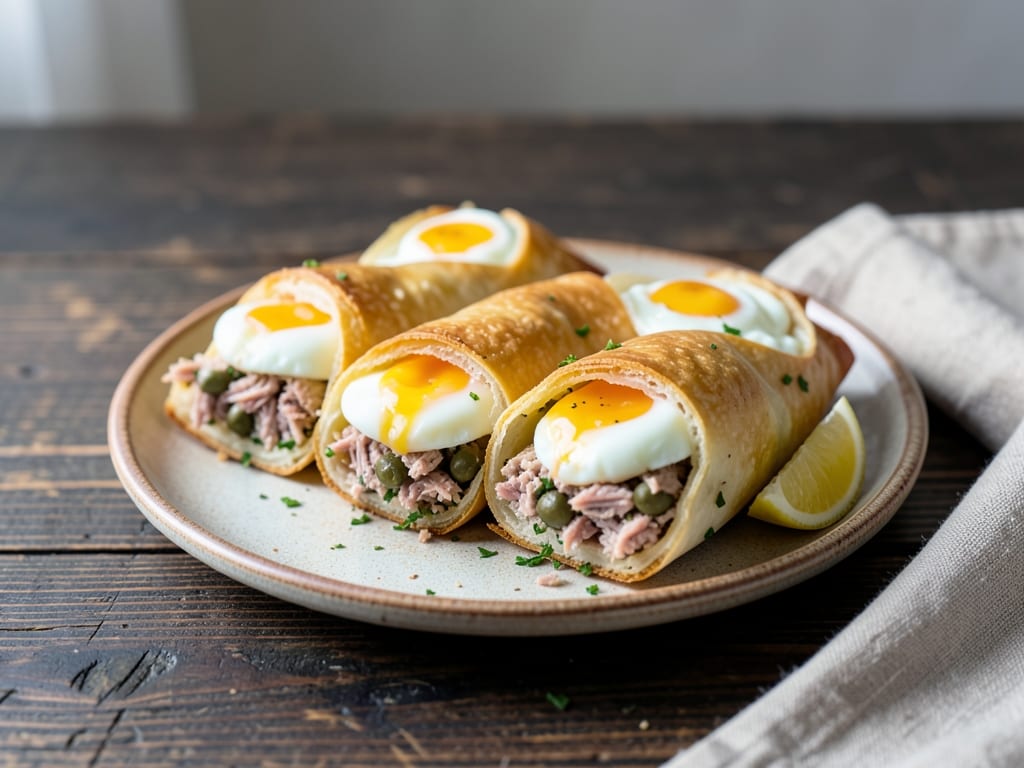
Crispy fried brick dough folded into a pocket with a raw egg, harissa, and grated Parmesan. The pastry shatters when you cut into it, releasing a warm, runny yolk that mingles with spicy harissa. A classic Tunisian street food and appetizer, best eaten fresh and hot.
Steps
Before you start
- Have all filling ingredients ready before you start folding—brick dough dries out quickly once unrolled.
- Use fresh brick dough sheets if available; if frozen, thaw in the refrigerator for 2 hours.
- Line a plate with paper towels for draining the finished bricks.
Prepare filling components
- In a small bowl, stir the harissa with 1 teaspoon of water until smooth.
- Measure out the grated Parmesan into a separate small bowl.
- Season lightly with salt and black pepper.
- Have everything near your workspace—brick dough dries quickly once unrolled.
+ Show details− Hide details
Tip: Do not mix the egg into any filling—it must be raw when the brick is sealed.
Build first brick
- Lay one brick sheet on a dry work surface.
- In the center of the sheet, arrange in a horizontal line: a small streak of diluted harissa (about ½ teaspoon), a sprinkle of Parmesan (about 1 tablespoon / 6 g), leaving a 1-inch (2.5 cm) border on all sides.
+ Show details− Hide details
Tip: Keep remaining brick sheets stacked under a damp towel so they don't dry out.
Add egg and seal
- Crack one cold egg directly into the center of the filling, keeping the yolk intact.
- Fold the brick sheet in half lengthwise over the egg, then fold the right side and left side toward the center to form a closed packet about 4×5 inches (10×13 cm).
- The egg yolk should be enclosed.
- Gently press the edges together so they stay sealed but do not press so hard that you crack the yolk.
+ Show details− Hide details
Tip: If the dough tears or the yolk breaks, discard and start with a fresh sheet—a broken yolk will leak into the oil.
Repeat for remaining bricks
- Repeat steps 2 and 3 with the remaining 3 brick sheets and 3 eggs.
- Place the finished bricks on a plate, seam-side down, in a single layer.
+ Show details− Hide details
Tip: Work quickly so the first bricks don't dry out while you finish the last ones.
Heat oil for fryingOven 350°F / 175°C
- Pour 1.5 cups (360 ml) of olive or vegetable oil into a large skillet (12 inches / 30 cm).
- Heat over medium-high heat until the surface shimmers and a small piece of dough sizzles immediately when dropped in, about 2–3 minutes.
- The oil should reach 350°F (175°C); use an instant-read thermometer if available.
+ Show details− Hide details
Ready when: Oil shimmers and a test piece of dough sizzles immediately; temperature should reach 350°F (175°C)
Tip: Oil that is too cool will produce greasy, soggy bricks; too hot will burn the outside before the inside cooks.
Fry first batch
- Carefully slide 2 bricks seam-side down into the hot oil, holding them gently for a second to prevent them from sticking.
- Fry for 2–2.5 minutes without moving them, until the bottom is deep golden brown and crispy.
- Flip carefully using a slotted spoon and fry the other side for 1.5–2 minutes until also deep golden and crispy.
- The egg should feel gently set but the yolk warm to the touch when you gently press the brick.
+ Show details− Hide details
Ready when: Both sides are deep golden brown; the pastry is crispy and crackles when you tap it; the egg inside is warm
Tip: Do not flip too early—the bottom needs a crispy crust before turning. If the brick tears, stop cooking that one and discard carefully.
Remove and drain
- Using a slotted spoon, lift each brick from the oil and place on a plate lined with paper towels.
- Blot gently to remove excess oil.
- Season immediately with a small pinch of salt and black pepper while still hot.
+ Show details− Hide details
Tip: Drain immediately so residual heat continues to cook the egg slightly without the yolk solidifying.
Fry second batchOven 350°F / 175°C
- If needed, adjust the heat very slightly to maintain 350°F (175°C).
- Repeat step 6 with the remaining 2 bricks.
- Place on the same paper-towel-lined plate.
+ Show details− Hide details
Ready when: Both sides are deep golden brown and crispy
Tip: If the oil temperature drops after the first batch, let it come back to 350°F (175°C) before starting the second batch.
Serve immediately
- Transfer the hot bricks to a serving plate.
- Eat while the pastry is still crispy (within minutes)—the yolk will ooze out when you cut or bite into the brick, mixing with the harissa and melting slightly into the crispy layers.
+ Show details− Hide details
Tip: Brick pastries lose their crispy texture quickly as they cool. Serve immediately to your guests.
Good to know
Tips
- To ensure the yolk stays runny, use very cold eggs straight from the refrigerator and do not overcook—2 to 2.5 minutes per side is correct for a warm but liquid yolk.
- Brick dough (malsouka) is sold in the frozen or refrigerated section of specialty Middle Eastern and North African markets, and increasingly in mainstream grocery stores. Do not confuse it with brick pastry sheets meant for dessert, which are thinner and may burn more easily.
- For a milder version, reduce harissa to 1 teaspoon per brick, or thin it with an extra teaspoon of water and a squeeze of lemon juice for brightness.
- Have clean hands and a dry workspace ready—wet or greasy surfaces will cause the dough to slip or tear. Keep unfolded brick sheets under a damp (not wet) kitchen towel to prevent them from drying out completely.
Storage & reheating
Brick pastries are best eaten fresh and hot. Leftover cooked bricks can be stored in an airtight container at room temperature for up to 2 hours (they will lose crispness). Refrigerate in a sealed container for up to 1 day; reheat gently in a 300°F (150°C) oven for 5 minutes to restore some crispness, though the interior will not be runny. Freezing is not recommended due to the raw egg yolk.
Substitutions
- brick dough sheets (also called malsouka or brick pastry) → Phyllo dough (use 2–3 sheets layered and brushed lightly with olive oil instead of one brick sheet). Phyllo is more delicate and may tear more easily, but produces an equally crispy result if handled carefully.
- harissa paste (Tunisian red chili paste) → Sambal oelek or other red chili paste. Use the same amount. Harissa has a distinctive smoky, caraway-tinged flavor, but any hot chili paste provides similar heat and moisture.
- Parmesan cheese, finely grated → Feta cheese, crumbled finely. Use the same weight. Feta adds tang and saltiness instead of nutty richness; reduce added salt slightly.
- olive oil or vegetable oil → Vegetable, canola, or peanut oil. Any neutral oil with a high smoke point works. Olive oil is traditional but not essential; use pure olive oil, not extra virgin, for frying.