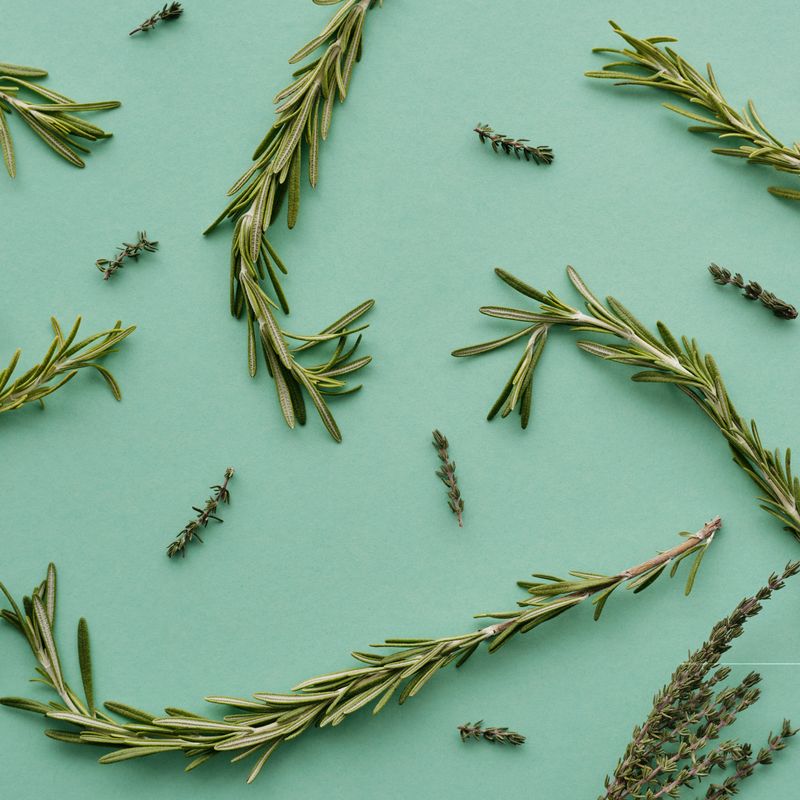
Thyme Rosemary Herb Blend
A fragrant dry herb blend combining thyme, rosemary, marjoram, and bay leaf—a European staple for seasoning soups, stews, roasted vegetables, and meats. Mix once and store in an airtight jar for months of convenient, homemade seasoning.
- Prep
- 5 min
- Cook
- —
- Total
- 5 min
- Makes
- About ¼ cup (12 grams) herb blend
Steps
Before you start
- Verify all dried herbs are fresh (within 1 year of purchase; older herbs lose potency)
- Use a clean, dry jar and measuring spoons
- If your herbs are stored in humid conditions, ensure the jar is completely dry before sealing
Check herb quality and measure
- Open each dried herb container and smell them—they should have a vibrant aroma without mustiness or staleness.
- Check that the herbs have retained their color (thyme should be green, rosemary greenish-gray, marjoram greenish, bay leaves greenish-brown).
- Using measuring spoons, measure out 2 tablespoons (6 g) dried thyme, 1½ tablespoons (4 g) dried rosemary, 1 tablespoon (3 g) dried marjoram, and 2 whole dried bay leaves into a small mixing bowl.
+ Show details− Hide details
Ready when: All measured herbs are in the bowl and smell fresh and aromatic
Tip: If any herb smells dull, musty, or lacks aroma, it's past its prime and should be replaced. Old herbs will result in a weak, flavorless blend.
Prepare bay leaves
- Take the 2 whole bay leaves and break them into small, ½-inch (1 cm) pieces with your fingers.
- This ensures they distribute evenly throughout the blend and won't overpower individual pinches.
- Add the broken bay leaf pieces to the bowl with the other herbs.
+ Show details− Hide details
Ready when: Bay leaves are broken into small, uniform pieces and added to the bowl
Tip: Crush the bay leaves finely so they don't stick out and dominate the first spoonful. Leaving them whole risks one piece overpowering a serving.
Mix herbs thoroughly
- Stir the herbs together with a spoon for about 1 minute, using gentle, circular motions and breaking up any clumps.
- Push the mixture around the bowl edges and fold it back toward the center to ensure every herb is evenly distributed.
- There should be no pockets where only one type of herb sits.
+ Show details− Hide details
Ready when: Herbs are uniformly mixed throughout with no visible clumping or color separation
Tip: Mix gently to avoid crushing the herbs into powder. Powdered herbs lose aroma quickly and become less visually appealing in the jar.
Transfer and seal
- Using a spoon, transfer the blended herbs into a clean, dry glass jar with a tight-fitting lid.
- Fill the jar only ¾ full to leave room for air circulation if you plan to add more herbs later, or fill completely if this is your final batch.
- Seal the jar immediately with the lid and twist tightly to create an airtight seal.
+ Show details− Hide details
Ready when: Blend is fully sealed in a dry, airtight glass container
Tip: Glass jars with rubber-sealed lids preserve herbs far better than plastic or paper. Store in a cool, dark cupboard away from direct sunlight, heat, and moisture to maximize shelf life.
Good to know
Tips
- Use this blend as a foundation: ½ to 1 teaspoon seasons a pot of soup or stew for 4–6 servings. Adjust to taste and account for the fact that dried herbs are more concentrated than fresh.
- For fresh herb substitution: replace ½ teaspoon of this dried blend with 1½ teaspoons of finely chopped fresh thyme, rosemary, or marjoram combined in similar proportions.
- Toast the herb blend gently in a dry pan over low heat for 30–60 seconds before using in dishes where you want deeper, more pronounced flavor—this awakens the essential oils.
- Bay leaves are quite potent; if you find your blend tastes too strongly of bay, reduce to 1 leaf in future batches.
Storage & reheating
Store in an airtight glass jar away from direct sunlight and heat. The blend will remain potent for up to 8–10 months at room temperature. After that, flavors fade; you can still use it but increase the quantity slightly. For maximum longevity, store in the freezer in a sealed jar for up to 1 year (thaw before opening to prevent condensation).
Substitutions
- dried marjoram → dried oregano (½ tablespoon / 2 g). Oregano is more robust than marjoram; use slightly less. The blend will be earthier and more Mediterranean.
- dried bay leaves → omit or replace with ½ teaspoon dried sage (½ teaspoon / 1 g). Sage adds a woodsy note instead of the subtle vanilla flavor of bay. The overall profile becomes more robust.
- dried rosemary → dried savory (1½ tablespoons / 4 g). Savory has a peppery quality; the blend will be less woody and more spice-forward.
- dried thyme leaves → dried tarragon or dried chervil (2 tablespoons / 6 g). Tarragon or chervil create a more delicate, anise-forward blend suited to lighter dishes and fish.


