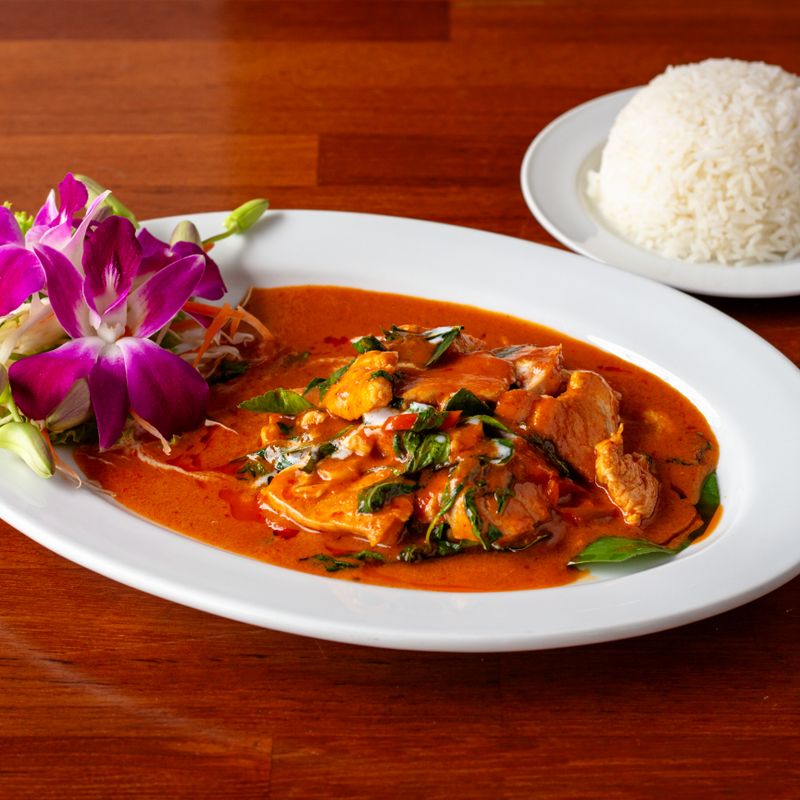
Thai Red Curry Rice
A fragrant, aromatic rice dish infused with Thai red curry paste, coconut milk, and fresh vegetables. The curry paste is toasted to deepen its flavors, then builds a richly seasoned cooking liquid that infuses every grain of jasmine rice. Diced red bell pepper and aromatics add texture and color, while fresh lime juice and cilantro brighten the finished dish. This is a satisfying side that works beautifully alongside grilled meats or as a vegetarian main with a protein added.
- Prep
- 10 min
- Cook
- 34 min
- Wait
- 5 min
- Total
- 50 min
- Makes
- About 6 cups (5 servings)
Steps
Before you start
- Gather and measure all ingredients before you start cooking—this stovetop dish moves quickly once you begin
- Use full-fat coconut milk for richness; light versions produce a thin, watery result
- Have all vegetables diced and ready to go
Prep all ingredients
- Rinse the jasmine rice under cold running water, stirring gently with your hand, until the water runs mostly clear (2–3 passes).
- Drain well in a fine-mesh sieve.
- Dice the red bell pepper into 1/4-inch (6 mm) pieces, removing and discarding the core, seeds, and white ribs.
- Dice the yellow onion into similar-sized pieces.
- Mince the garlic cloves finely.
- Have all ingredients measured and ready before you begin cooking.
+ Show details− Hide details
Tip: Rinsing removes excess starch that would make the rice gummy. Prepping everything ahead keeps the cooking process smooth and ensures nothing burns while you're chopping.
Toast the curry paste
- Heat a large heavy-bottomed pot over medium heat.
- Add the curry paste and stir constantly for 2–3 minutes.
- The paste will become very fragrant and begin to deepen in color slightly.
- This toasting step wakes up the spices and compounds in the curry, transforming a one-dimensional seasoning into something rich and complex.
- Be careful not to let it scorch—keep stirring.
+ Show details− Hide details
Ready when: Curry paste is very fragrant and slightly darkened, with aromatic oils visible on the surface
Tip: Don't skip this step—toasting the paste is what makes this dish special. It takes only minutes and makes a huge flavor difference.
Sauté the aromatics
- Add the diced onion to the toasted curry paste and stir well, scraping the sides and bottom of the pot to break up any clumps.
- Cook over medium heat for 3 minutes, stirring occasionally, until the onion becomes translucent at the edges and begins to soften.
- Add the minced garlic and stir, cooking for another 30–45 seconds until fragrant.
- The mixture should smell intoxicating—curry, caramelized onion, and toasted garlic.
+ Show details− Hide details
Ready when: Onion is translucent at the edges and garlic is fragrant; the mixture appears glossy
Tip: If the curry paste sticks heavily to the bottom, add a splash of water or broth. Constant stirring prevents burning and helps flavors bloom.
Add the bell pepper
- Stir in the diced red bell pepper and cook for 2 minutes over medium heat, stirring occasionally.
- The pepper should be heated through but still slightly firm at the edges.
- This brief cooking helps release its natural sweetness and pairs it with the curry and aromatics.
+ Show details− Hide details
Ready when: Pepper is heated through and just beginning to soften at the edges; no raw smell remains
Toast the rice
- Add the drained, rinsed jasmine rice to the pot and stir constantly for 1–2 minutes.
- The rice grains will become translucent around their edges and the entire pot will smell wonderfully nutty and toasted.
- This step coats each grain with the curry oil, helps them stay separate during cooking, and adds subtle depth.
+ Show details− Hide details
Ready when: Rice grains are translucent at the edges; the pot smells nutty and fragrant
Tip: Keep stirring constantly to prevent sticking. You should see a light, aromatic haze rising from the pot.
Add the liquid
- Pour the coconut milk and vegetable broth into the pot slowly, stirring constantly to help break up any clumps of curry paste and to distribute it evenly.
- Add the fish sauce and brown sugar, stirring until the sugar dissolves completely.
- The liquid should look creamy from the coconut milk and smell complex—curry, toasted rice, and bright herbs.
+ Show details− Hide details
Ready when: Liquid is well combined, brown sugar is fully dissolved, no lumps of curry paste visible
Tip: If you see clumps of paste, mash them against the side of the pot with the back of a spoon. Getting everything dissolved now prevents bumpy curry in the finished rice.
Bring to a boil
- Increase the heat to medium-high and bring the mixture to a gentle rolling boil, stirring occasionally (this takes 3–5 minutes depending on your stove).
- Once you see large bubbles breaking the surface and steam rising, immediately reduce the heat to low.
- Don't walk away—watch for the boil to catch it before it boils over the sides of the pot.
+ Show details− Hide details
Ready when: Mixture reaches a rolling boil with steam rising and large bubbles breaking the surface consistently
Tip: If the mixture starts to boil over, reduce heat immediately and remove the pot from the burner briefly.
Simmer the rice covered
- Cover the pot with a tight-fitting lid and reduce the heat to low.
- Simmer undisturbed for 18–20 minutes.
- Do not lift the lid, peek, or stir during this time—the trapped steam is essential for cooking the rice evenly.
- The rice is done when all the liquid has been absorbed and you see small steam vents appearing on the surface through the rice.
- You may also notice a faint toasted aroma from the pot.
+ Show details− Hide details
Ready when: All liquid is absorbed, steam vents appear on the surface, light toasted aroma is noticeable
Tip: Resist the urge to check on the rice. Opening the lid lets steam escape and can result in unevenly cooked, dry rice. Trust the time and the process.
Rest the rice
- Remove the pot from the heat and let it sit, still covered, for 5 minutes.
- This allows any remaining moisture to be absorbed fully and the rice grains to firm up and separate, making them fluffy rather than mushy or gluey.
+ Show details− Hide details
Tip: Even 5 minutes makes a visible difference in texture. Don't skip this step for the best result.
Fluff and finish
- Uncover the pot and fluff the rice gently with a fork, stirring carefully to separate the grains without crushing them.
- Try not to mash any grains.
- Squeeze the juice of the lime over the rice and stir in the chopped cilantro (if using).
- Taste a spoonful and adjust the flavors to your preference: if you want more umami and savory depth, add a few drops more fish sauce; if you want more sweetness, add a tiny pinch more brown sugar.
- Serve warm.
+ Show details− Hide details
Ready when: Rice grains are well separated, fluffy, and well coated with the curry-coconut sauce; lime juice is distributed throughout
Tip: Use a fork rather than a spoon or paddle to fluff—the gentle tines separate grains without crushing them. The lime juice adds brightness that ties everything together.
Good to know
Tips
- Full-fat coconut milk is essential—it provides the richness and creamy mouthfeel that makes this dish special. Light or reduced-fat versions produce a thin, watery result that disappoints.
- Don't skip the toasting steps (curry paste and rice). These few extra minutes build layers of flavor that transform the dish from okay to memorable. It's the difference between boiling rice in flavored water and infusing it.
- If your rice comes out slightly dry or unevenly cooked, the most common causes are: (1) the liquid wasn't measured accurately, (2) your pot lid doesn't seal tightly and steam escaped, or (3) your stove's low setting runs hotter than expected. Note this for next time and adjust the broth amount or heat level accordingly.
- For a complete meal, stir in cooked shrimp, diced rotisserie chicken, or cooked chickpeas during the last minute of simmering, or fold them in just before serving. This transforms the rice into a satisfying main course.
Make ahead
The rice can be made up to 2 days ahead and stored in an airtight container in the refrigerator. To reheat, add 2–3 tablespoons of water per cup of rice and warm gently over medium-low heat, stirring occasionally, until heated through (about 5 minutes). Alternatively, microwave in a covered microwave-safe bowl with a splash of water for 2–3 minutes, stirring halfway through.
Storage & reheating
Room temperature: Best served fresh but can sit covered at room temperature for up to 1 hour. Refrigerator: Up to 3 days in an airtight container. Freezer: Up to 1 month in a freezer-safe container; thaw overnight in the fridge and reheat as described above.
Substitutions
- Thai red curry paste → Thai yellow or green curry paste. Yellow curry will be milder and more turmeric-forward with earthier notes. Green curry will be significantly spicier with a brighter, more herbaceous flavor. Use the same amount (4 tablespoons).
- unsweetened full-fat coconut milk → Coconut cream mixed with water in a 1:1 ratio. This creates a richer, creamier texture. Mix 200 ml coconut cream with 200 ml water to approximate the standard can. Reduce the vegetable broth by 1/4 cup to avoid too much liquid.
- fresh cilantro, chopped → Thai basil or mint. Thai basil adds peppery, licorice-forward notes; mint adds cooling sweetness and brightness. Either works beautifully freshly added at the end. Use the same amount (1/4 cup fresh leaves).
- fish sauce → Soy sauce or tamari. Use 1.5 tablespoons soy sauce or tamari in place of fish sauce. The umami depth will be similar, though the flavor profile shifts slightly toward salty rather than briny.
More pilaf
See all →



Find more like this
- Meal
- Dinner
- Cuisine
- Thai
- Main ingredient
- Bell PeppersRice
- Method
- Stovetop