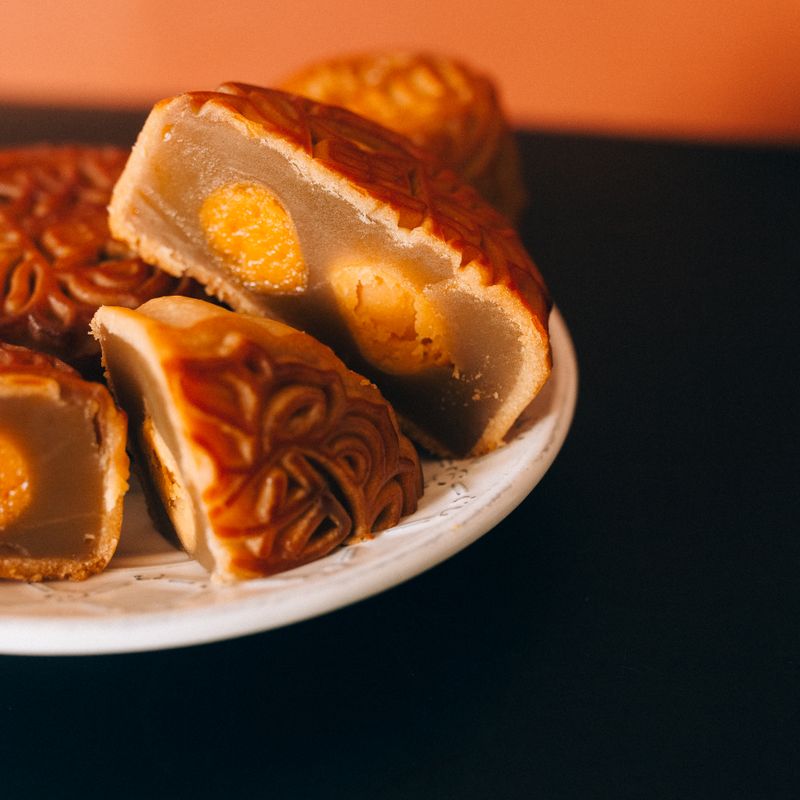
Tahini Mooncakes with Pistachio Filling
Tender, golden mooncake pastry made with golden syrup and a spoonful of tahini, wrapped around a fragrant, nutty filling of toasted pistachios, tahini and a whisper of rose water. A Chinese-Middle Eastern fusion that keeps the classic stamped pattern and soft, glossy crust.
- Prep
- 1 hr 16 min
- Cook
- 28 min
- Wait
- 1 hr 50 min
- Total
- 3 hr 34 min
- Makes
- 12 mooncakes (about 50 g each, made in a 50 g mold)
Steps
Before you start
- Use a kitchen scale: mooncakes depend on a precise skin-to-filling ratio (20 g dough to 29 g filling), and cups alone are not accurate enough.
- Golden syrup is essential. Honey or maple syrup will brown too fast and change the dough texture (see substitutions for the only workable swaps).
- Use raw, unsalted, shelled pistachios. Roasted salted ones will make the filling too salty and dull the green color.
- Read the timing: the dough must rest 1 hour, and the finished cakes taste and look best after resting 1 day (optional but recommended).
- You need a 50 g plunger-style mooncake mold (about 6 cm / 2½ in wide). With a different size, adjust the portions but keep the 2:3 dough-to-filling weight ratio.
Toast the pistachiosOven 325°F / 165°C
- Position a rack in the center of the oven and heat to 325°F (160°C).
- Spread the 170 g pistachios on a rimmed baking sheet in a single layer and toast for 8 minutes, shaking the pan once halfway, until they smell nutty and are just slightly deeper in color.
- They should still be mostly green inside.
+ Show details− Hide details
Ready when: Nutty aroma and slightly deepened color; no browning
Tip: Do not let them brown, as browned pistachios lose their bright green color and taste bitter.
Cool and grind
- Cool the pistachios on the pan for 10 minutes until no longer warm to the touch.
- Tip them into a food processor with the 50 g powdered sugar.
- Pulse in 1-second bursts for about 30 seconds until you have a fine, sandy meal with a few tiny flecks of nuts.
+ Show details− Hide details
Ready when: Fine, dry, crumbly meal that holds together when pinched
Tip: Grinding with the sugar absorbs oil and stops the nuts from turning into paste. Stop as soon as the mixture is sandy.
Mix the filling
- Toast the 15 g flour in a dry medium skillet over medium-low heat, stirring constantly, for 3 minutes until it smells biscuity and is pale tan.
- Tip it into a medium bowl and let it cool for a minute.
- Add the ground pistachio mixture, 48 g tahini, 32 g golden syrup, melted butter, rose water and salt.
- Mix with a spatula, then knead with your hands for 1 minute until a thick, smooth, pliable paste forms that holds a shape when squeezed.
+ Show details− Hide details
Ready when: Paste holds together like soft modeling clay and does not stick to your palms
Tip: If the filling is too sticky to roll, add 1 tsp more flour. If it is crumbly, add 1 tsp of golden syrup.
Make and rest dough
- In a large bowl, whisk the 75 g golden syrup, 30 g oil and 15 g tahini until smooth.
- Dissolve the baking soda in the 1 tsp warm water, then whisk it in.
- Add the 110 g flour and fold with a spatula until no dry flour remains, then press and knead gently in the bowl for 1 minute.
- The dough should be soft, slightly tacky and smooth.
- Cover tightly with plastic wrap and rest at room temperature for 1 hour.
- Meanwhile, cover the filling and let it firm up.
+ Show details− Hide details
Ready when: Smooth, soft, slightly tacky dough that does not stick to clean fingers
Tip: Mix just until combined. Overworking develops gluten and the skin turns tough and shrinks when baked.
Portion dough and filling
- Weigh the filling into 12 portions of 29 g each and roll into smooth balls.
- Weigh the rested dough into 12 portions of 20 g each and roll into balls.
- Keep the dough balls covered with a damp towel or plastic wrap so they do not form a skin.
+ Show details− Hide details
Ready when: 12 filling balls and 12 dough balls of matching weights
Tip: Accurate weights matter. If the skin is too thick it will crowd the filling; if too thin it will tear.
Wrap and mold
- Dust the work surface lightly with the dusting flour.
- Flatten a dough ball into a 3-inch (8 cm) round, slightly thinner at the edges than the center.
- Place a filling ball in the middle and gradually push the dough up and around the filling with your thumb and fingers, pinching to seal fully and rolling gently so the surface is smooth.
- Dust the mold with flour and tap out the excess.
- Drop the ball in, seam side up, press the plunger down firmly and evenly, then press the cake out onto the lined baking sheet.
- Repeat with all 12, spacing them 1½ inches (4 cm) apart.
+ Show details− Hide details
Ready when: Each cake has a crisp, deeply stamped pattern with no cracks or exposed filling
Tip: Use only a very thin dusting of flour. Too much flour leaves white patches after baking and blurs the pattern.
Bake to set patternOven 375°F / 190°C
- Preheat the oven to 375°F (190°C) while you finish molding.
- Bake the mooncakes on the center rack for 6 minutes.
- They will look pale and slightly puffed with the pattern still sharp.
+ Show details− Hide details
Ready when: Pattern is set and the edges are just beginning to color
Tip: Do not skip this short bake. Applying egg wash to unset dough blurs the stamped design.
Cool and egg washOven 325°F / 165°C
- Remove the pan from the oven and cool the mooncakes for 10 minutes.
- Reduce the oven to 325°F (160°C).
- Whisk the egg yolk with the 1 tsp water until smooth, then brush a very thin layer over the tops and sides with a soft pastry brush, avoiding the grooves of the pattern.
+ Show details− Hide details
Ready when: A thin, even, glossy yellow coating with no puddles in the pattern
Tip: A thick layer of egg wash pools in the grooves and hides the design. Brush lightly and blot excess.
Finish bakingOven 325°F / 165°C
- Return the mooncakes to the 325°F (160°C) oven and bake for 14 minutes, rotating the pan after 7 minutes, until the tops are a deep, even golden brown and the sides feel firm when gently pressed.
+ Show details− Hide details
Ready when: Deep golden-brown tops, lightly golden sides and a firm skin
Tip: If the tops brown faster than the sides, tent loosely with foil for the last 5 minutes.
Cool and mature
- Let the mooncakes cool on the pan for 10 minutes, then transfer to a rack and cool completely, about 20 more minutes.
- Once cool, store in an airtight container at room temperature for 24 hours before eating.
- The crust softens and turns glossy and tender as it absorbs oil from the filling.
+ Show details− Hide details
Ready when: Fully cool to the touch; after resting, the crust is soft and slightly shiny
Tip: They are edible once cool, but the crust will be crisp and dry until it matures overnight.
Good to know
Tips
- Weigh everything. A 2:3 dough-to-filling ratio by weight gives a thin skin that holds the pattern without bursting.
- Press the plunger straight down and evenly; twisting or angled pressure blurs the pattern.
- If the dough becomes sticky while molding, chill it for 10 minutes rather than adding much flour.
- Check tahini for freshness; rancid or very bitter tahini will dominate the filling. It should taste nutty and smooth.
Make ahead
Make the filling up to 3 days ahead and keep it covered in the fridge; bring it to room temperature before portioning. The dough can be made a day ahead and refrigerated, then brought to room temperature for 30 minutes before use. Baked mooncakes are best after resting for 1 day.
Storage & reheating
Room temperature in an airtight container: up to 4 days (best on days 2 to 3). Refrigerator: up to 1 week; bring to room temperature for 30 minutes before serving. Freezer: up to 2 months, individually wrapped; thaw overnight in the fridge. To refresh, warm at 300°F (150°C) for 5 minutes.
Substitutions
- golden syrup → Light corn syrup. Works 1:1 by weight but gives a paler, less caramelly crust. Honey and maple syrup brown too quickly.
- raw unsalted shelled pistachios → Blanched almonds or raw cashews. Use the same weight. The filling will be paler and milder, so the green color will be lost.
- rose water → Orange blossom water. Use the same amount for a similar floral note; or omit and add ½ tsp vanilla extract.
- neutral oil (such as sunflower or grapeseed) → Peanut oil. Swap 1:1 by weight. Peanut oil is traditional and gives a classic aroma.