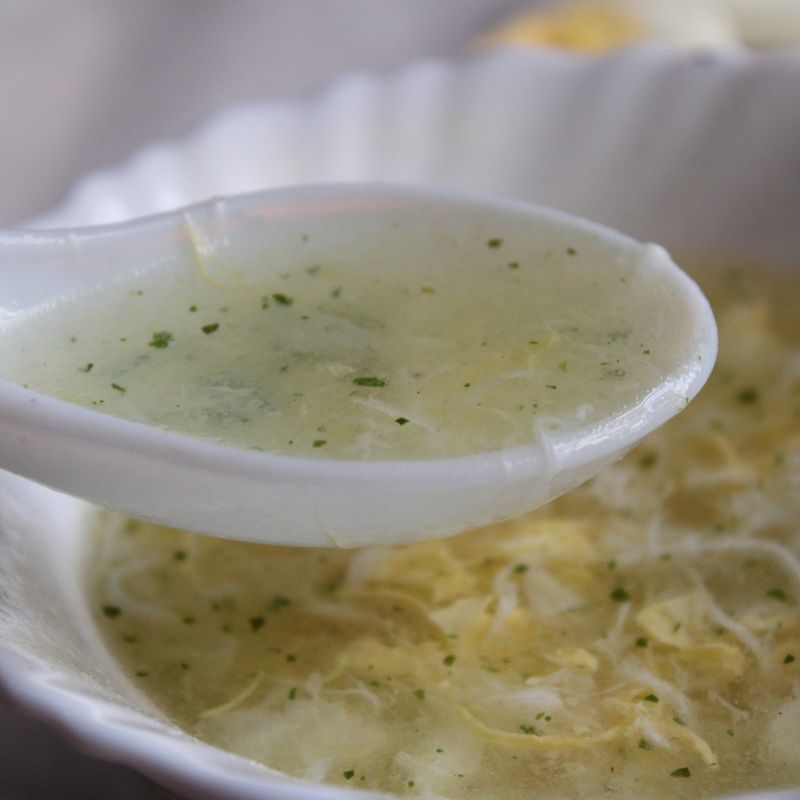
Sweet Fermented Rice Egg Drop Soup Drink (Jiuniang Dan Hua)
A warming, lightly boozy-sweet Chinese dessert drink: fermented glutinous rice (jiuniang) simmered with rock sugar, thickened gently with cornstarch, and swirled with silky ribbons of egg and fragrant osmanthus. Comforting on cold days and ready in 15 minutes.
- Prep
- 5 min
- Cook
- 10 min
- Wait
- 1 min
- Total
- 16 min
- Makes
- About 2 cups (500 ml), 2 small bowls
Steps
Before you start
- Use fresh, store-bought or homemade jiuniang (sweet fermented glutinous rice) that smells sweet and winey, not sour or sharp; discard any that is pink, gray or fuzzy.
- Crack the eggs into a small bowl and beat lightly just before cooking so they can be poured in a thin stream.
- Mix the cornstarch with cold water in a small cup; stir again right before using because it settles.
- The small amount of alcohol in jiuniang mostly cooks off, but skip this drink if serving children, pregnant guests, or anyone avoiding alcohol.
Prepare the mixtures
- Stir the cornstarch into the 1½ tbsp (22 ml) cold water in a small cup until smooth and milky.
- Lightly beat the eggs in a small bowl with a fork until uniform and no streaks of white remain.
- Rinse the osmanthus and optional goji berries and drain.
+ Show details− Hide details
Ready when: Slurry is smooth with no lumps; eggs are evenly yellow.
Tip: Keep the slurry nearby; it sinks to the bottom within a minute.
Heat water and sugar
- In a small saucepan, combine the 1½ cups (360 ml) water, rock sugar, and goji berries if using.
- Bring to a gentle boil over medium heat, stirring occasionally, 3 to 4 minutes.
+ Show details− Hide details
Ready when: Sugar crystals have fully dissolved and the water is bubbling at the edges.
Add fermented rice
- Reduce the heat to low and stir in the jiuniang with its liquid.
- Simmer gently for 2 minutes, just to warm it through and soften the grains.
+ Show details− Hide details
Ready when: Broth smells sweet and winey with tiny bubbles at the edges, and the rice grains are hot.
Tip: Don't boil hard or for long; it turns sour and the delicate fermented flavor fades.
Lightly thicken
- Stir the cornstarch slurry again, then drizzle it into the simmering soup while stirring constantly.
- Cook 30 to 60 seconds.
+ Show details− Hide details
Ready when: Liquid turns slightly glossy and lightly thickened, coating the back of a spoon thinly.
Tip: Add the slurry slowly while stirring to prevent lumps.
Drizzle in eggs
- Keep the soup at a gentle simmer.
- Slowly pour the beaten eggs in a thin stream from about 8 inches (20 cm) above the pot while stirring slowly in one direction with a spoon or chopsticks.
- Stop stirring once all the egg is in and let it set for 20 seconds.
+ Show details− Hide details
Ready when: Egg forms soft, pale-yellow ribbons floating in the soup and is fully opaque, with no raw liquid.
Tip: A thin stream and gentle swirl give delicate ribbons; dumping the egg in or stirring hard makes clumps.
Add osmanthus and serve
- Turn off the heat and stir in the osmanthus.
- Let the soup rest 1 minute so the aroma blooms, then ladle into two bowls and serve hot.
+ Show details− Hide details
Ready when: Soup smells floral and sweet, with golden egg ribbons and tiny flowers throughout.
Tip: Taste before serving; add another teaspoon of sugar if your jiuniang is not very sweet.
Good to know
Tips
- Choose jiuniang that tastes mildly sweet; a very sour or sharp batch has over-fermented and will make the soup unpleasant.
- Pour the egg into a gently simmering, not hard-boiling, soup for fine silky ribbons.
- For a thicker, more dessert-like bowl, use 3 tsp cornstarch; for a lighter drink, use 1 tsp.
- Serve in small bowls with a spoon so the rice grains and egg are eaten along with the sweet broth.
Storage & reheating
Best eaten immediately. Refrigerate leftovers in a covered container up to 1 day; reheat gently in a saucepan over low heat until steaming (do not boil), adding a splash of water if too thick. Not recommended for freezing, as the egg texture turns rubbery.
Substitutions
- rock sugar → Granulated white sugar or brown sugar. Use the same weight; the flavor is slightly less clean and mellow than rock sugar.
- cornstarch → Potato starch or tapioca starch. Use the same amount; potato starch gives a slightly silkier texture.
- dried or sugared osmanthus flowers (gui hua) → 1 tsp osmanthus syrup or honey, or omit. Syrup adds sweetness, so reduce the rock sugar by about 1 tsp.
- goji berries → Dried longan or a few small dried jujube slices. Add with the water and sugar so they soften.