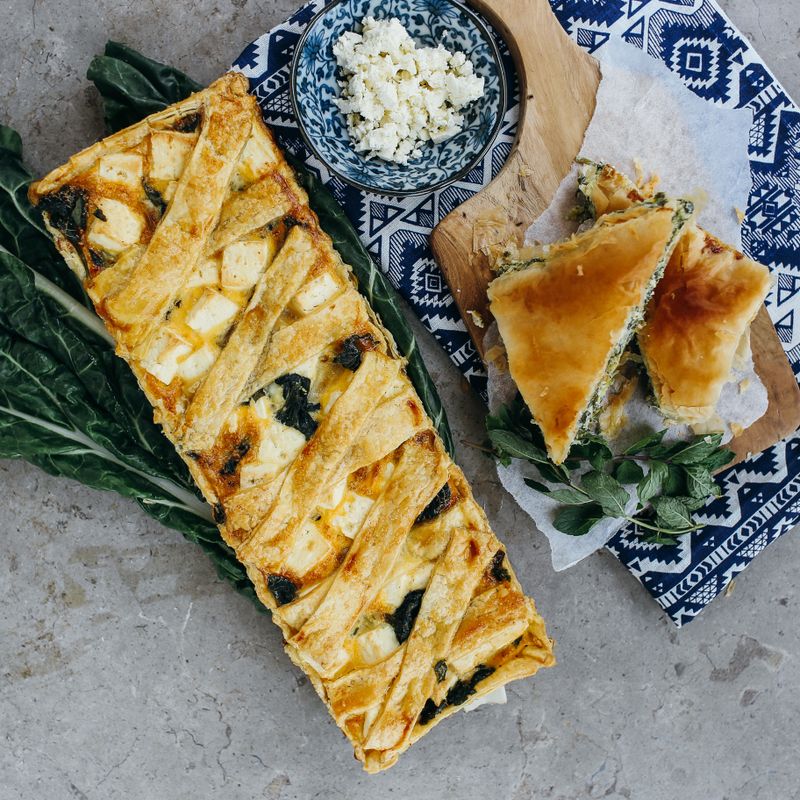
Spinach Feta Couscous Pie
A Mediterranean-inspired savory pie layered with crispy phyllo dough, tender couscous, wilted spinach, and creamy feta cheese. The filling is bound together with eggs and flavored with garlic and fresh dill for an elegant, satisfying dish that's perfect for lunch, dinner, or entertaining.
- Prep
- 28 min
- Cook
- 40 min
- Wait
- 20 min
- Total
- 1 hr 28 min
- Makes
- One 9-inch (23 cm) round pie (6–8 slices)
Steps
Before you start
- Thaw phyllo dough at room temperature for 1 hour if frozen
- Preheat oven to 375°F (190°C)
- Have all ingredients measured and prep work completed before you start layering phyllo, as it dries out quickly
Sauté the aromatics
- In a large skillet over medium heat, warm 2 tablespoons (30 ml) of the olive oil.
- Add the diced onion and cook, stirring occasionally, for 4–5 minutes until softened and translucent.
- Add the minced garlic and cook for 1 minute more, stirring frequently, until fragrant.
- Do not let the garlic brown.
+ Show details− Hide details
Ready when: Onion is soft and translucent; garlic is fragrant and light golden
Tip: Keep heat at medium to prevent the garlic from burning, which will make it bitter.
Wilt the spinach
- Add the fresh spinach to the skillet in batches, stirring until each batch is wilted before adding the next.
- This will take 2–3 minutes total.
- Once all the spinach is wilted, cook for another minute to evaporate excess moisture.
- Season lightly with ¼ teaspoon of salt and a pinch of black pepper.
+ Show details− Hide details
Ready when: All spinach is dark green and tender; any excess liquid has evaporated
Tip: If using frozen spinach, thaw it first and squeeze it dry in a clean kitchen towel to remove excess moisture before adding to the skillet.
Cook the couscous
- In a medium saucepan, bring the vegetable broth to a boil over medium-high heat.
- Stir in the couscous, 2 tablespoons (30 ml) of olive oil, and ½ teaspoon of salt.
- Remove from heat, cover with a lid, and let stand for 8–10 minutes until the couscous has absorbed all the liquid and is tender.
+ Show details− Hide details
Ready when: Couscous is fluffy and all liquid is absorbed; grains are separate when fluffed with a fork
Tip: Do not stir the couscous while it's sitting—let the steam do the work for even cooking.
Make the filling
- In a large mixing bowl, combine the cooked couscous (cooled to room temperature), wilted spinach and sautéed aromatics, crumbled feta, eggs, dill, lemon zest if using, the remaining ¼ teaspoon of salt, and the black pepper.
- Stir gently but thoroughly until everything is evenly distributed.
- The mixture should be moist but not soupy.
- Taste and adjust seasonings as needed.
+ Show details− Hide details
Ready when: All ingredients are evenly mixed; no dry pockets of couscous remain
Tip: Don't overmix, or the couscous will become mushy and the filling dense. Gently combine until just incorporated.
Prepare the baking pan
- Brush the bottom and sides of a 9-inch (23 cm) round cake pan or pie dish with olive oil.
- This will prevent sticking and help the phyllo brown evenly.
+ Show details− Hide details
Ready when: Pan is evenly and lightly coated with oil
Tip: Use a pastry brush for even, thin coverage without excess pooling at the bottom.
Layer the bottom phyllo
- Lay one sheet of phyllo dough in the bottom of the prepared pan, letting it drape slightly over the edges.
- Brush lightly with olive oil (about 1 teaspoon per sheet).
- Repeat with 4–5 more sheets of phyllo, brushing each layer with oil and letting them slightly overlap the edges.
- You should have a thick base layer that will support the filling without becoming soggy.
+ Show details− Hide details
Ready when: 5–6 layers of phyllo are in place, each brushed with oil
Tip: Phyllo dries out quickly—keep the unused sheets covered with a damp kitchen towel or plastic wrap while you work. If edges become dry, they'll shatter when you try to fold them.
Spread the filling
- Spread the couscous-spinach-feta mixture evenly over the phyllo base in the pan.
- Press gently with the back of a spoon so the filling is compact but not compressed.
- Leave about ½ inch (1 cm) of phyllo showing around the edges.
+ Show details− Hide details
Ready when: Filling is level and evenly distributed with no gaps
Tip: A moist filling can make phyllo soggy if it sits too long—assemble and bake immediately after filling.
Top with phyllo and brush with oil
- Layer 4–5 more sheets of phyllo on top of the filling, brushing each sheet with olive oil (about 1 teaspoon per sheet).
- Gently tuck the overhanging edges of the bottom layers up and around the top to seal the pie.
- Brush the top and sides generously with the remaining olive oil until the phyllo is glistening.
+ Show details− Hide details
Ready when: Top is fully covered with oiled phyllo; edges are tucked and sealed; phyllo glistens with oil
Tip: Brush the phyllo generously with oil—it will become crisp and golden as it bakes. Thin coverage on each layer ensures even browning.
Score and bakeOven 375°F / 190°C
- Using a sharp knife, lightly score the top layer of phyllo into 6–8 wedge-shaped portions (do not cut all the way through to the filling, just score the surface).
- Place the pie in the preheated 375°F (190°C) oven and bake for 35–40 minutes until the phyllo is deep golden brown and the edges are crispy.
- You may hear a gentle sizzle inside the pie as the eggs and filling set.
+ Show details− Hide details
Ready when: Phyllo is deep golden brown; the filling feels set when you gently press the top; a savory aroma fills the kitchen
Tip: If the top is browning too quickly before the filling is set, loosely tent the pie with aluminum foil for the last 10 minutes of baking.
Cool and serve
- Remove the pie from the oven and let it rest on a wire rack for 10 minutes before serving.
- This allows the filling to set fully and makes cutting and serving cleaner.
- Serve warm or at room temperature with a crisp green salad and a squeeze of fresh lemon juice.
+ Show details− Hide details
Ready when: Pie has cooled enough to handle but is still warm; filling is firm when pressed gently
Tip: Use a sharp serrated knife and a gentle sawing motion to cut through the crispy phyllo without shattering it. Wipe the knife clean between slices.
Good to know
Tips
- Phyllo dries out rapidly and becomes brittle—keep unused sheets stacked and covered with a damp kitchen towel or plastic wrap while you work. If edges become dry, they'll shatter when you try to fold them.
- Brush each phyllo layer thinly but thoroughly with olive oil. Even coverage ensures crispness and even browning. If you apply too much oil to one layer, the next layer may slide during baking.
- The couscous must cool to room temperature before mixing with the eggs, or the heat will begin to cook the eggs prematurely. If it's still warm, let it sit for 5 minutes on the counter.
- Use a sharp serrated knife and a gentle sawing motion to cut through the crispy phyllo without shattering it. Wipe the knife clean between slices for neat portions.
Make ahead
Prepare the filling (steps 1–4) up to 1 day ahead and store it covered in the refrigerator. Assemble the pie (steps 5–8) just before baking to prevent the phyllo from absorbing moisture and becoming soggy. Alternatively, assemble the pie, cover it tightly with plastic wrap, and refrigerate for up to 4 hours before baking; add 5–10 minutes to the bake time if baking from cold.
Storage & reheating
**Room temperature:** Store covered for up to 2 hours after baking. **Refrigerator:** Store covered for up to 3 days. Reheat in a 325°F (160°C) oven for 15–20 minutes until warmed through, loosely covered with foil. **Freezer:** Wrap tightly in plastic wrap and aluminum foil; freeze for up to 2 months. Thaw overnight in the refrigerator and reheat as directed for refrigerated pie.
Substitutions
- Fresh spinach → 5 oz (140 g) frozen chopped spinach, thawed. Squeeze frozen spinach dry in a clean kitchen towel to remove excess moisture before adding to the skillet in step 2.
- Feta cheese → 8 oz (225 g) ricotta cheese, goat cheese, or mild white cheddar. The flavor will be milder and less tangy. Use the same amount and follow the recipe as written.
- Fresh dill → 2 tablespoons (6 g) fresh mint, oregano, or parsley. Mediterranean herbs work well. Oregano will give a more robust flavor; mint adds brightness.
- Vegetable broth → Chicken broth or water. Use the same amount. The flavor will be slightly more neutral with broth, or plain with water.
More casseroles
See all →
Find more like this
- Meal
- Dinner
- Cuisine
- Mediterranean