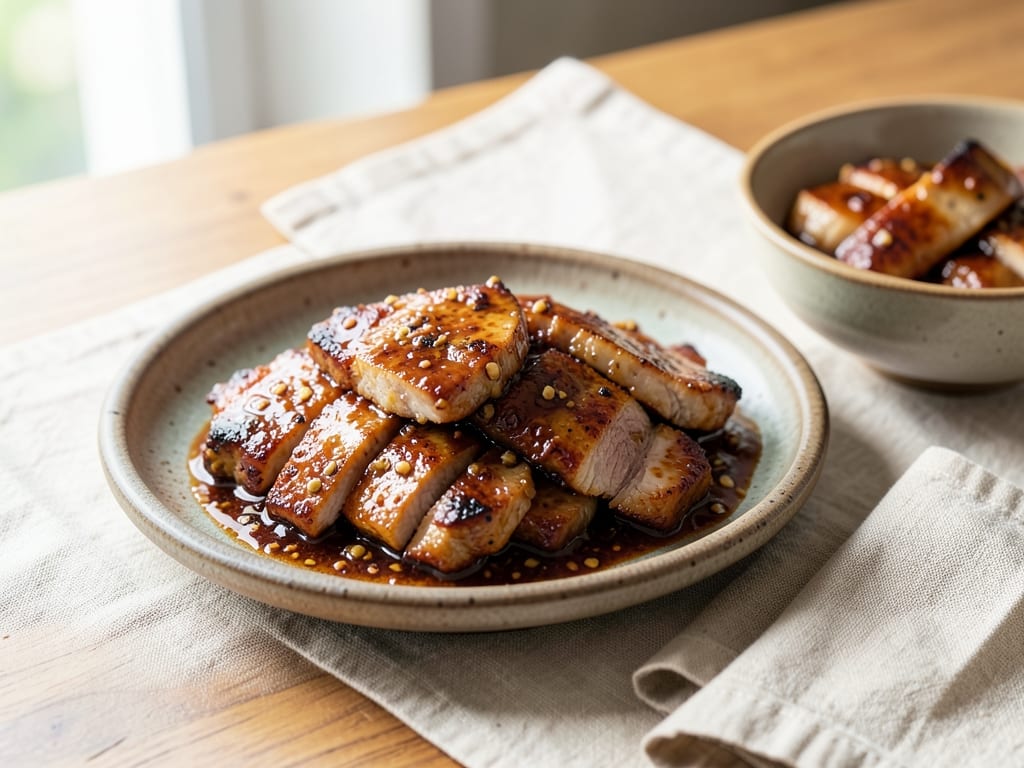
Spicy Gochujang Pork Marinade (Overnight Pork Shoulder)
A sweet, spicy, garlicky Korean-style marinade that turns thinly sliced pork shoulder into deeply flavored, caramelized, juicy pork after an overnight soak. Gochujang and honey give body and gloss, rice vinegar brightens, and a reserved portion of the marinade becomes a quick glaze at the end.
- Prep
- 30 min
- Cook
- 15 min
- Wait
- 12 hr 50 min
- Total
- 13 hr 35 min
- Makes
- About 3 lb (1.36 kg) marinated pork, serving 6
Steps
Before you start
- Plan ahead: the pork needs 8 to 24 hours in the marinade (about 12 hours is ideal), plus about 30 minutes of freezer time before slicing.
- Gochujang brands vary in heat and saltiness. This recipe is written for a medium-hot gochujang, so don't add extra salt.
- Open a window or turn on the vent fan before cooking. Sugar-rich marinades smoke a little over high heat.
- Never use marinade that touched raw pork as a sauce. This recipe sets aside a clean portion for the glaze before the pork goes in.
Chill the pork
- Trim any thick, hard pieces of fat from the pork shoulder, leaving thin streaks of marbling.
- Set the pork on a plate and put it in the freezer for 30 minutes, until the outside is very firm and the center still gives slightly when pressed.
+ Show details− Hide details
Ready when: Pork feels very firm outside but is not frozen solid in the center
Tip: Don't freeze it solid. Fully frozen pork is hard to cut and thaws unevenly in the marinade.
Mix the marinade
- In a large bowl, combine the gochujang, honey, garlic, rice vinegar, soy sauce, toasted sesame oil, gochugaru (if using), ginger, grated onion with its juice, and black pepper.
- Whisk for about 1 minute until the paste is fully loosened and no lumps of gochujang remain.
- The marinade should be thick but spoonable, like ketchup.
+ Show details− Hide details
Ready when: Smooth, evenly red marinade with no streaks of honey or lumps of paste
Tip: If the honey is stiff, warm it for 10 seconds in the microwave so it blends in easily.
Reserve glaze portion
- Spoon ¼ cup (about 65 g) of the marinade into a small container, cover, and refrigerate.
- This clean portion becomes the finishing glaze.
- Leave the rest in the large bowl for the pork.
+ Show details− Hide details
Ready when: About ¼ cup of marinade set aside and covered
Tip: Do this before the raw pork touches the bowl or spoon, so the glaze stays food safe.
Slice the pork
- Using a sharp knife, cut the chilled pork against the grain into slices about ¼ inch (6 mm) thick and 2 to 3 inches (5 to 7.5 cm) long.
- If the pork is a large block, first cut it with the grain into strips about 3 inches (7.5 cm) wide, then slice across the strips.
+ Show details− Hide details
Ready when: Slices are uniformly thin, about ¼ inch (6 mm), so they cook at the same rate
Tip: Slicing against the grain keeps the cooked pork tender rather than stringy.
Coat the pork
- Add the sliced pork to the large bowl of marinade.
- Wearing gloves or using clean hands, massage the marinade into the pork for about 1 minute, separating the slices so every piece is coated.
- Transfer the pork and all the marinade to a 1-gallon zip-top bag or lidded container, pressing out the air and spreading the pork flat.
+ Show details− Hide details
Ready when: Every slice is evenly coated in red marinade with no dry spots
Tip: Wash your hands, the bowl and the board with hot soapy water after handling the raw pork.
Marinate overnight
- Refrigerate the pork at or below 40°F (4°C) for at least 8 hours and up to 24 hours.
- About 12 hours gives the best balance of flavor and texture.
- If you can, flip or squeeze the bag once halfway through to redistribute the marinade.
+ Show details− Hide details
Ready when: Pork is deeply red and the marinade has darkened and clings to the slices
Tip: Past 24 hours the vinegar and grated onion can make the pork mushy.
Rest at room temperature
- Take the pork and the reserved glaze out of the refrigerator 20 minutes before cooking.
- Slice the scallions on a diagonal.
- Leave the marinade clinging to the pork, but shake off any large pools so the meat sears rather than steams.
+ Show details− Hide details
Ready when: Pork is cool rather than ice-cold to the touch
Tip: Don't leave raw pork out longer than 30 minutes.
Sear in batches
- Heat a 12-inch (30 cm) cast-iron or heavy skillet over medium-high heat for 2 minutes.
- Add 1½ tsp of the neutral oil and swirl.
- Add one third of the pork (about 1 lb / 450 g) in a single layer without crowding.
- Cook for 2 to 3 minutes without moving it, until the edges are browned and charred in spots, then flip and cook 2 minutes more.
- Transfer to a clean plate.
- Add another 1½ tsp oil and repeat with the remaining two batches.
+ Show details− Hide details
Ready when: Slices are deeply browned with sticky, caramelized edges and no pink in the center; an instant-read thermometer in the thickest piece reads at least 145°F (63°C)
Tip: If the sugars darken too fast or smoke heavily, drop the heat to medium. Burnt honey tastes bitter.
Glaze and finish
- Return all the pork to the skillet over medium heat.
- Add the reserved ¼ cup marinade and 2 tablespoons water, then stir and toss for about 1 minute until the sauce bubbles and coats the pork in a glossy glaze.
- Remove from the heat and transfer to a platter.
- Scatter the scallions and toasted sesame seeds over the top and serve right away with steamed rice, lettuce leaves for wraps, and kimchi.
+ Show details− Hide details
Ready when: Sauce is bubbling and coats the pork in a thick, glossy glaze
Tip: Add the water first if the pan looks dry, so the glaze loosens instead of scorching.
Good to know
Tips
- Slice the pork thin and against the grain. This matters more than anything else for tender results.
- Cook in batches. Crowding the pan steams the pork and keeps it from caramelizing.
- To grill, thread ½-inch (1.25 cm) strips on skewers and cook over medium-high direct heat for 3 to 4 minutes per side, until they reach 145°F (63°C).
- Shake excess marinade off the pork before it hits the pan. Extra marinade burns quickly because of the honey.
Make ahead
The marinade can be mixed up to 5 days ahead and kept covered in the refrigerator. You can also freeze the sliced pork in the marinade, flat in a zip-top bag, for up to 3 months. Thaw it overnight in the refrigerator before cooking.
Storage & reheating
Cooked pork keeps in an airtight container in the refrigerator for up to 4 days. Reheat in a skillet over medium heat with a splash of water for 3 to 4 minutes, until steaming hot (165°F / 74°C). Freeze cooked pork for up to 3 months and thaw overnight in the refrigerator. Don't leave cooked pork at room temperature for more than 2 hours.
Substitutions
- boneless pork shoulder (pork butt) → boneless pork belly slices or pork loin. Pork belly is richer and cooks in about the same time. Pork loin is leaner, so cook it only until it reaches 145°F (63°C) to avoid drying it out.
- honey → maple syrup or light brown sugar. Use the same amount of maple syrup. For brown sugar, use 2 tbsp (25 g).
- unseasoned rice vinegar → apple cider vinegar or fresh lime juice. Use an equal amount. The flavor will be slightly sharper.
- soy sauce → tamari or coconut aminos. Tamari makes it gluten-free if your gochujang is too. Coconut aminos is sweeter and less salty.