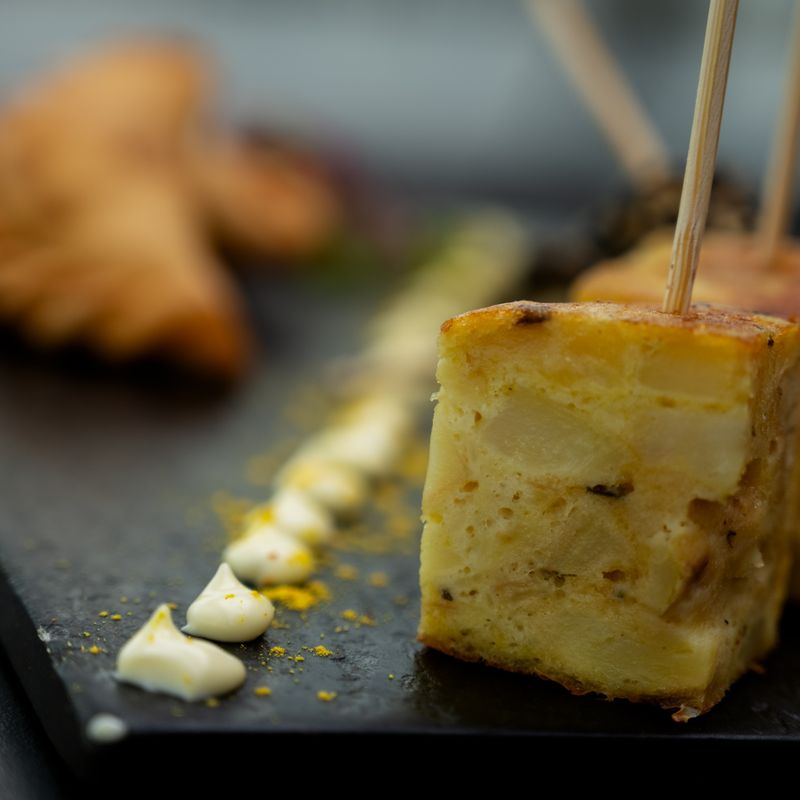
Spanish Tortilla Española (Potato and Onion Omelette)
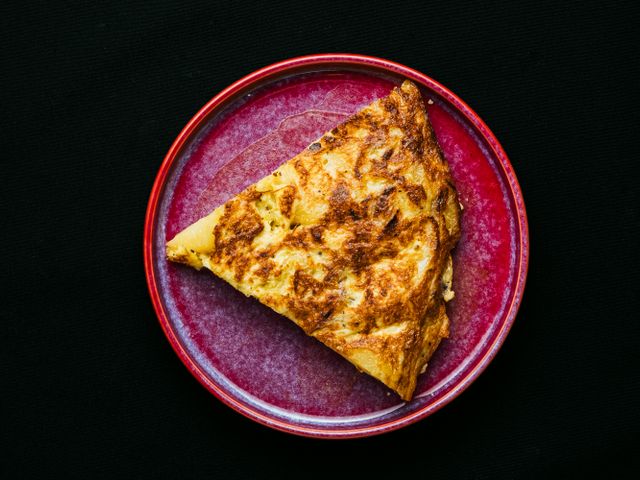
A classic Spanish potato and onion omelette with tender, olive-oil-poached potatoes set in a creamy, just-set egg center and a golden crust. Serve warm or at room temperature.
- Prep
- 20 min
- Cook
- 35 min
- Wait
- 20 min
- Total
- 1 hr 15 min
- Makes
- 1 tortilla (9-inch/23 cm), 6 wedges
Steps
Before you start
- Choose an 8- to 9-inch (20-23 cm) nonstick or well-seasoned skillet with sloped sides; this size gives a tortilla about 1½ inches (4 cm) thick.
- Find a flat plate or lid slightly larger than the skillet for flipping, and set it nearby before you start.
- Slice the potatoes thin and evenly (about ⅛ inch/3 mm) so they cook at the same rate.
- The olive oil is strained and can be reused for cooking; don't discard it.
Slice the vegetables
- Peel the potatoes, halve lengthwise, and slice into ⅛-inch (3 mm) half-moons.
- Halve and thinly slice the onion.
- Place both in a large bowl and toss with ¾ teaspoon of the salt.
+ Show details− Hide details
Ready when: Slices are even in thickness and evenly coated in salt.
Tip: Don't rinse the potatoes; their surface starch helps bind the tortilla.
Poach in olive oil
- Pour about ¾ cup (180 ml) of the olive oil into the 9-inch skillet, keeping 1 tablespoon aside.
- Heat over medium heat for about 2 minutes until a potato slice dropped in sizzles gently.
- Add the potatoes and onion, spreading them out.
- The oil should come about halfway up the layer.
+ Show details− Hide details
Ready when: Gentle bubbling around the slices, without vigorous frying.
Tip: Add the extra oil if the pan looks dry, but never let the potatoes brown hard.
Cook until tender
- Reduce the heat to medium-low.
- Cook for 18 to 22 minutes, turning the slices gently every 3 to 4 minutes with a spatula, until the potatoes are completely tender and the onions are soft and translucent.
+ Show details− Hide details
Ready when: A potato slice breaks apart easily when pressed with the spatula, with little to no browning.
Tip: Turn gently so the slices stay mostly intact; some breaking is fine.
Drain the oil
- Set a fine-mesh sieve over a heatproof bowl and tip in the potato mixture.
- Let it drain for 5 minutes, pressing lightly.
- Save the oil for another use.
- Wipe the skillet clean.
+ Show details− Hide details
Ready when: Potatoes look glistening but are not dripping.
Tip: Hot oil: use a heatproof bowl and handle carefully.
Whisk the eggs
- In a large bowl, whisk the eggs with the remaining ½ teaspoon salt for about 30 seconds until uniformly yellow with no streaks of white.
- Gently fold in the warm potato mixture, breaking up clumps without mashing.
+ Show details− Hide details
Ready when: Potatoes are evenly coated and the mixture looks loose and custardy.
Tip: Don't skip the rest; it helps the tortilla hold together.
Cook the first side
- Heat 1 teaspoon of the reserved oil in the clean skillet over medium heat for 1 minute.
- Pour in the egg mixture and spread it level.
- Cook for 3 minutes, then reduce to medium-low.
- Shake the pan and run a spatula around the edge, tucking the sides, for 5 to 6 more minutes.
+ Show details− Hide details
Ready when: The edges are set and golden, the bottom slides freely when shaken, and the center is still soft and wobbly.
Tip: If the bottom browns too fast, lower the heat.
Flip the tortilla
- Place the flat plate over the skillet.
- Holding the plate firmly, invert the skillet over a sink or work surface in one confident motion so the tortilla drops onto the plate.
- Add the remaining 2 teaspoons of reserved oil to the skillet, then slide the tortilla back in, uncooked side down.
- Tuck the edges with a spatula to round them.
+ Show details− Hide details
Ready when: The tortilla slides back in whole, with a golden top.
Tip: Wear oven mitts and flip over the sink in case of drips.
Finish the second side
- Cook over medium-low heat for 3 to 4 minutes for a juicy, slightly runny center (jugosa), or 5 to 6 minutes for a fully set center.
- Slide onto a serving plate.
+ Show details− Hide details
Ready when: The second side is golden; the center is just set and an inserted knife shows creamy, not liquid, egg for jugosa, or comes out clean for fully set.
Tip: The tortilla keeps cooking from residual heat as it rests.
Rest and serve
- Rest the tortilla on the plate for at least 5 to 10 minutes.
- Cut into 6 wedges and serve warm or at room temperature.
+ Show details− Hide details
Ready when: Slices hold their shape with a creamy center.
Good to know
Tips
- Poach, don't fry: bubbles should be gentle, otherwise the potatoes brown and turn crisp instead of silky.
- A nonstick or well-seasoned pan makes the flip much easier.
- For jugosa results, pull the tortilla while the center still jiggles slightly; it will firm up as it rests.
- Reuse the strained olive oil for sautéing; it is full of onion and potato flavor.
Make ahead
"Cook the tortilla up to 1 day ahead and refrigerate. Bring to room temperature for 30 minutes before serving; it is traditionally eaten at room temperature."
Storage & reheating
"Room temperature: up to 2 hours. Refrigerator: wrapped airtight up to 3 days. Freezer: not recommended because the potatoes turn grainy. To reheat, warm wedges in a 300°F (150°C) oven for 8 to 10 minutes, or eat cold or at room temperature."
Substitutions
- yellow onion → Spanish sweet onion or 3 shallots. Gives a slightly sweeter flavor. Omit the onion for a classic 'sin cebolla' version, and use an extra 4 oz (115 g) potato.
- extra-virgin olive oil → Light olive oil. Milder flavor and cheaper for poaching; extra-virgin is more traditional.
- waxy or all-purpose potatoes (such as Yukon Gold) → Red or white waxy potatoes. Avoid very starchy russets, which fall apart.
- fine sea salt → Kosher salt, 1½ teaspoons total (Diamond Crystal). Coarser grains are less salty by volume.
More egg dishes
See all →
Find more like this
- Meal
- Lunch
- Cuisine
- Spanish
- Method
- Stovetop
- Quick & Easy
- 5 Ingredients or Less