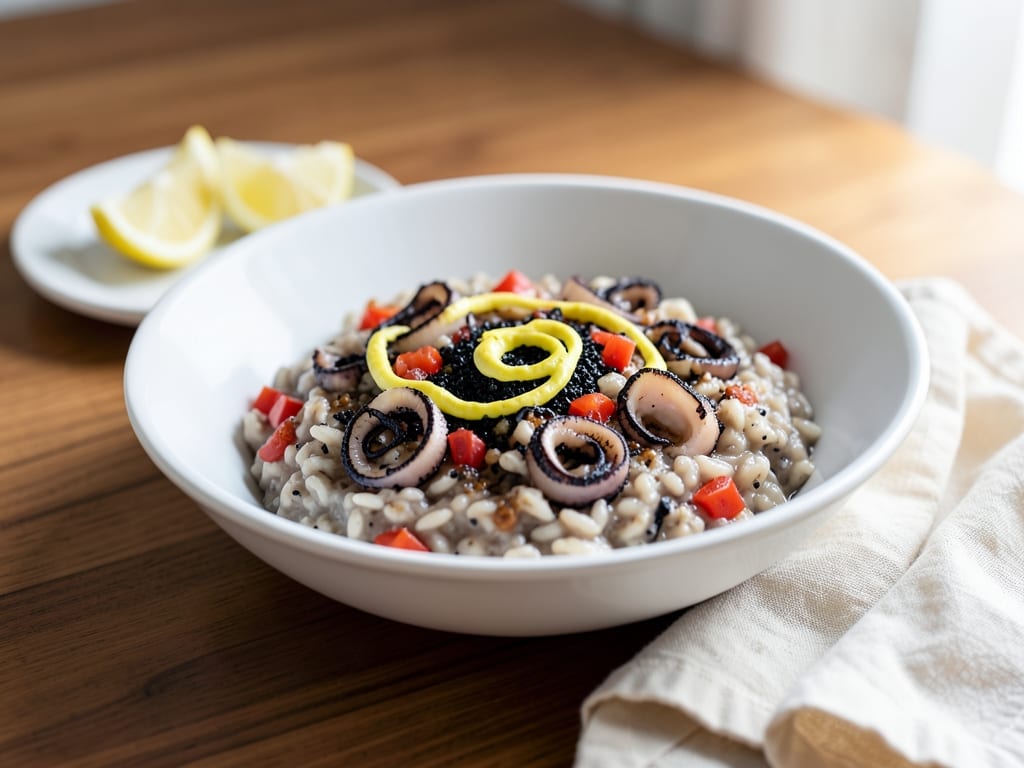
Spanish-Style Squid Ink Risotto (Arroz Negro-Style Risotto)
Creamy arborio rice stirred with a smoky pimentón sofrito, tender sautéed squid and briny black squid ink, finished with a garlicky lemon alioli swirl. It's a risotto with the soul of Spanish arroz negro.
- Prep
- 20 min
- Cook
- 35 min
- Wait
- 2 min
- Total
- 57 min
- Makes
- 4 main-course servings (about 1½ cups / 350 g each)
Steps
Before you start
- Clean the squid (or buy it already cleaned) and pat it very dry; wet squid steams and turns rubbery instead of searing.
- Keep the stock at a bare simmer in a separate pot the whole time. Cold stock stalls the rice and makes it gummy.
- Squid ink stains hands, countertops and clothing: wear an apron and rinse spills right away.
- Have everything chopped before you start; once the rice goes in you need to stir almost constantly.
Make the alioli
- In a small bowl, stir together the mayonnaise, grated garlic paste, lemon zest and 1 tablespoon (15 ml) of the lemon juice.
- Season with a pinch of salt.
- Cover and refrigerate.
- Save the remaining lemon juice for step 8.
+ Show details− Hide details
Ready when: Smooth, pale and evenly speckled with zest.
Heat the stock
- Pour the fish stock into the saucepan and bring to a bare simmer over medium heat.
- Reduce to low and keep it hot, with the ladle nearby.
+ Show details− Hide details
Ready when: Small bubbles at the edges, gently steaming.
Tip: If the stock is unsalted, taste it; the rice will concentrate its saltiness.
Sear the squid
- Heat 2 tablespoons (30 ml) of the olive oil in the large pan over high heat until it shimmers.
- Add the squid in a single layer (work in two batches if crowded).
- Cook for 1½–2 minutes, stirring once or twice, until opaque and lightly golden at the edges.
- Season with a pinch of salt and pepper, then transfer to a plate.
- Leave any juices in the pan.
+ Show details− Hide details
Ready when: Squid is opaque white with golden spots and still tender, not tight or curled into hard rings.
Tip: Squid is tender if cooked either very briefly now or for a long time. It will finish warming in the rice at the end, so don't cook it longer here.
Build the sofrito
- Lower the heat to medium and add the remaining 2 tablespoons (30 ml) olive oil.
- Add the onion and red pepper with a pinch of salt.
- Cook, stirring often, for 6–7 minutes until soft and translucent but not browned.
- Stir in the garlic and paprika for 30 seconds, then add the grated tomato.
- Cook, stirring, for 3–4 minutes until the tomato has darkened and thickened into a jammy paste.
+ Show details− Hide details
Ready when: Vegetables are soft and the mixture leaves a trail when you drag a spoon across the pan bottom.
Tip: Paprika turns bitter if scorched, so keep it moving and add the tomato right after.
Toast the rice
- Add the arborio rice and stir for 2 minutes so every grain is coated in the sofrito and the edges turn translucent with a chalky white center.
+ Show details− Hide details
Ready when: Grains look glossy with translucent rims and smell nutty.
Deglaze with wine
- Pour in the white wine and stir until it has almost completely absorbed and the sharp alcohol smell has faded, about 2 minutes.
+ Show details− Hide details
Ready when: Pan bottom is nearly dry when you drag the spoon through the rice.
Add stock and ink
- Whisk the squid ink into 1 cup (240 ml) of the hot stock in a measuring cup until fully dissolved and uniformly black.
- Pour it into the rice and stir.
- Cook at a lively simmer, stirring frequently, until the liquid is absorbed.
- Then add the remaining stock 1 ladleful (about ¾ cup / 180 ml) at a time, waiting until each addition is mostly absorbed before adding the next.
- Continue for 18–20 minutes total.
+ Show details− Hide details
Ready when: Rice is creamy and flows slowly like lava when the pan is tilted. Taste a grain: it should be tender with a slight firmness at the very center (al dente).
Tip: You may not need all the stock. If the rice is still hard, add hot water by the ladleful.
Fold in the squid
- Stir the seared squid and any plate juices into the risotto.
- Cook 1 minute to rewarm.
- Remove from the heat.
- Add the butter and the remaining 1 tablespoon (15 ml) lemon juice, then stir vigorously for 30 seconds to make it glossy.
- Taste and adjust with salt and pepper.
+ Show details− Hide details
Ready when: Risotto is glossy and loose, with squid evenly distributed.
Tip: Add a splash of hot stock if it looks tight; risotto thickens as it sits.
Rest and serve
- Cover the pan and let the risotto rest for 2 minutes.
- Spoon into warm shallow bowls, top each with a dollop of the lemon alioli and a sprinkle of parsley.
- Serve immediately with lemon wedges.
+ Show details− Hide details
Ready when: Risotto spreads gently across the bowl rather than holding a mound.
Tip: Serve right away; risotto tightens and gets stodgy as it cools.
Good to know
Tips
- Use arborio, carnaroli or Spanish bomba rice. Don't rinse it, since the surface starch makes the risotto creamy.
- Squid ink is salty; season the dish only at the end after tasting.
- Dissolving the ink in hot stock first prevents gray streaks and ensures an even jet-black color.
- Black teeth are part of the experience. Serve with plenty of napkins and a crisp white wine.
Make ahead
"The alioli can be made up to 2 days ahead and refrigerated. The sofrito (through step 4) can be made up to 2 days ahead; reheat it in the pan before adding the rice. Risotto itself is best made fresh."
Storage & reheating
"Room temperature: no more than 1 hour. Refrigerator: cool quickly and store airtight up to 2 days. Freezer: not recommended, as the rice turns grainy and the squid toughens. Reheat gently in a pan over low heat with a splash of stock or water, stirring until hot and creamy; keep the squid just warmed through."
Substitutions
- low-sodium fish or seafood stock → light chicken stock or vegetable stock. Flavor will be less briny; add an extra pinch of salt at the end.
- dry white wine → dry sherry (fino) or additional stock plus 1 teaspoon lemon juice. Fino adds a nutty Spanish note; use the same volume.
- cleaned squid (bodies and tentacles) → peeled shrimp or cuttlefish. Cook shrimp only 1 minute per side; cuttlefish needs about the same quick sear.
- mayonnaise → traditional garlic alioli. Use ⅓ cup (75 g) and skip the extra garlic if it is already garlicky.