
Spanish Ajada: Fermented Garlic and Red Pepper Mash
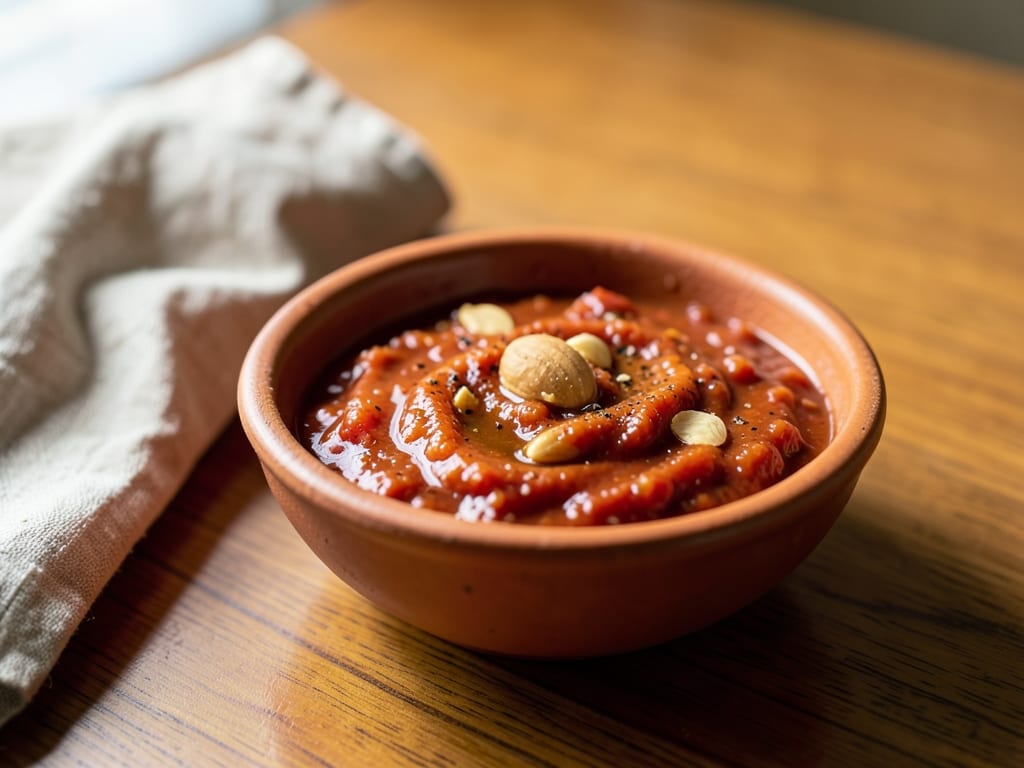
Ajada is a rustic Spanish fermented condiment of roasted red peppers and garlic pounded into a savory mash, infused with cumin and preserved in olive oil. The fermentation develops tangy, deeply savory notes that add complexity to everything from grilled meats to bread and cheese. This version uses both raw and roasted garlic for layered flavor.
- Prep
- 25 min
- Cook
- 25 min
- Wait
- 4 hr
- Total
- 4 hr 50 min
- Makes
- About 1½ cups (360 ml) ajada, enough for 8 servings as a condiment
Steps
Before you start
- Read through the fermentation timeline—this recipe calls for 4 hours minimum fermentation, though 24–48 hours develops deeper flavor
- Gather a clean glass jar (at least 16 oz / 475 ml) and a mortar and pestle or sturdy bowl and wooden spoon
- Have 1–2 parchment-lined sheet pans ready for roasting peppers
Toast cumin seeds
- Heat a small dry skillet over medium heat.
- Add the cumin seeds and toast for 1–2 minutes, stirring frequently, until fragrant and light golden brown.
- Transfer to a small plate to cool, then grind coarsely with a mortar and pestle or crush with a spoon.
+ Show details− Hide details
Ready when: Cumin is light golden and fragrant
Tip: Don't let cumin scorch—toasting for just 1–2 minutes brings out flavor without bitterness.
Roast peppers and garlicOven 450°F / 230°C
- Preheat oven to 450°F (232°C).
- Place red pepper halves skin-side up on a sheet pan, and scatter the 8 whole unpeeled garlic cloves on a separate small area of the pan or on a second pan.
- Roast for 20–25 minutes, until pepper skins are blistered and charred in spots and garlic is soft and fragrant.
- The garlic may finish earlier; remove it if it darkens too much before the peppers are ready.
+ Show details− Hide details
Ready when: Peppers have dark blistered spots on the skin; garlic cloves are very soft
Tip: Don't peel peppers hot—let them cool slightly so the skin comes away cleanly without tearing the flesh.
Cool and peel peppers
- Remove the pan from the oven and transfer the peppers to a bowl or cutting board.
- Let them cool for 5 minutes until they can be handled.
- Using your fingertips, gently peel away the blistered skin (a few dark flecks are fine).
- Tear or roughly chop the peeled peppers into 1-inch pieces, discarding any remaining stem.
- Squeeze the soft roasted garlic cloves out of their skins into a small bowl.
+ Show details− Hide details
Ready when: Pepper skin pulls away easily; roasted garlic is squeezed from its skin
Tip: Peel peppers over a bowl to catch any juices—they add flavor to the mash.
Pound peppers and garlic
- Add the cooled roasted pepper pieces and squeezed roasted garlic to a mortar and pestle (or a sturdy bowl if using a wooden spoon).
- Using steady, rhythmic motions, pound and grind the peppers and garlic together into a coarse, chunky paste.
- The mixture should not be entirely smooth; some texture is traditional.
- This should take 3–5 minutes of steady work.
+ Show details− Hide details
Ready when: Mixture is broken down into a thick, slightly chunky paste with no large pieces
Tip: Don't overwork it—ajada should have rustic texture, not be pureed smooth.
Combine with raw garlic, salt, and cumin
- Add the minced raw garlic, sea salt, and toasted ground cumin to the pepper and roasted garlic paste.
- Using the mortar and pestle (or spoon), gently fold and mix until the raw garlic and seasonings are evenly distributed throughout.
- Taste and adjust salt to preference.
+ Show details− Hide details
Ready when: Raw garlic and seasonings are evenly dispersed through the paste
Tip: The raw garlic will soften slightly during fermentation and mellow in flavor; start with less salt and add more if needed after 24 hours.
Transfer to jar and add olive oil
- Spoon the ajada mixture into a clean glass jar (at least 16 oz / 475 ml).
- Pour the extra-virgin olive oil over the top, making sure it coats the surface completely and covers the mixture by about ½ inch.
- Stir once to distribute the oil evenly and release any trapped air pockets.
+ Show details− Hide details
Ready when: Oil covers the surface and mixture is in a single jar
Tip: Keep the olive oil layer on top to protect the ajada during fermentation and storage.
Ferment at room temperature
- Cover the jar loosely with a lid or cloth (don't seal tightly) and leave it at room temperature (65–72°F / 18–22°C) for at least 4 hours, preferably 24–48 hours.
- During this time, the garlic will soften, flavors will meld, and a slight tanginess will develop from natural fermentation.
- Stir occasionally (every 12 hours if fermenting longer) to keep the surface submerged under the oil.
+ Show details− Hide details
Ready when: Flavors are mellow and integrated; raw garlic has softened; a slight tanginess may be present
Tip: Longer fermentation (48 hours) develops deeper, more savory flavor; shorter fermentation (4–6 hours) preserves bright garlic bite. Choose based on taste preference.
Good to know
Tips
- Ajada is best served at room temperature or slightly warm to fully appreciate its savory, garlicky character. Use it as a condiment for grilled meats, spread on crusty bread, stir into soups, or dollop onto cheese boards.
- For a spicier version, add ¼–½ teaspoon of cayenne pepper or a pinch of smoked paprika along with the cumin in step 5.
- If your tap water is heavily chlorinated, use filtered water to rinse your jar before filling—chlorine can inhibit fermentation.
- The fermentation time is flexible: taste after 4 hours for a brighter, more garlicky version, or wait 48 hours for a deeper, mellower condiment. Write the date on your jar so you know when you started.
Make ahead
Ajada improves with time and can be made up to 1 week in advance. Ferment and store in the refrigerator as directed below.
Storage & reheating
Room temperature (up to 2 days): Cover loosely and keep in a cool spot away from direct sunlight. Refrigerator (up to 4 weeks): Transfer to an airtight jar once fermentation is complete, ensuring the olive oil layer stays on top. The oil will solidify slightly when cold; let the jar sit at room temperature for 10 minutes before serving for easier spreading. Freezer (up to 3 months): Spoon into ice cube trays, freeze, then transfer cubes to a freezer bag. Thaw in the refrigerator overnight or at room temperature for 1 hour.
Substitutions
- cumin seeds → Smoked paprika (⅜ teaspoon) or ground coriander (⅜ teaspoon). Paprika adds smokiness; coriander brings a more citrus-like warmth. Toast paprika briefly in a dry pan if using whole seeds for deeper flavor.
- red bell peppers → Red piquante peppers or roasted red peppers from a jar (about 1 cup / 240 ml, drained). Jarred roasted peppers save time but are milder; skip the roasting step and proceed directly to pounding. Taste and increase salt slightly.
- garlic cloves, for roasting → Additional raw garlic cloves (8 cloves, minced) mixed in at step 5. The ajada will be more pungent and sharper; reduce the amount of raw garlic in step 5 to 2 cloves if using all raw garlic.
- extra-virgin olive oil → Neutral oil such as grapeseed or sunflower oil. The condiment will lack the fruity, peppery notes of olive oil but will have a longer shelf life and milder flavor—better for cooking than serving raw.
More dips
See all →


Find more like this
- Meal
- Snack
- Cuisine
- Spanish
- Quick & Easy
- 5 Ingredients or LessEasy