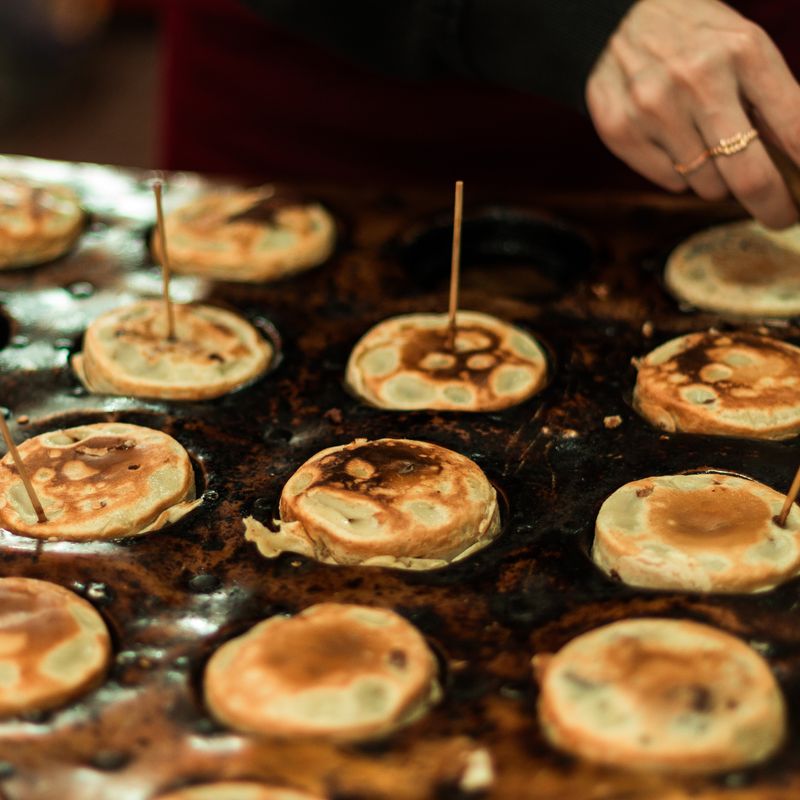
Sourdough Italian Pecorino Romano and Chestnut Griddle Cakes
Savory griddle cakes made with sourdough discard, studded with roasted chestnuts and sharp Pecorino Romano cheese, finished with crispy rosemary-infused olive oil. A rustic Italian-inspired way to use sourdough starter; light, crispy exterior with a tender, nutty interior. Perfect as an appetizer, side dish, or light lunch.
- Prep
- 15 min
- Cook
- 20 min
- Wait
- 10 min
- Total
- 45 min
- Makes
- 8 griddle cakes (2 per serving)
Steps
Before you start
- Have your sourdough discard at room temperature (fed 4–6 hours earlier or stored discard)
- Roast or purchase pre-roasted, peeled chestnuts; chop them just before mixing
- Finely grate your Pecorino Romano so it mixes evenly
- Preheat your griddle or large skillet on medium heat for 3–5 minutes before you begin cooking
Mix dry ingredients
- In a medium mixing bowl, whisk together the all-purpose flour, baking powder, salt, black pepper, and minced rosemary.
- Set aside.
+ Show details− Hide details
Ready when: Dry ingredients are evenly combined with no lumps, rosemary distributed throughout.
Tip: Sift the flour and baking powder if you have a sifter to avoid clumping in the batter.
Combine wet ingredients
- In a large mixing bowl, whisk together the sourdough discard, milk, and egg until smooth and no streaks of discard remain.
- The mixture should be homogeneous.
+ Show details− Hide details
Ready when: Wet mixture is smooth with no lumps or streaks of sourdough discard.
Tip: Use a whisk to fully incorporate the discard; sourdough can be thick and lumpy on its own.
Fold dry into wet
- Add the dry ingredient mixture to the wet ingredients and fold gently with a rubber spatula or wooden spoon until just combined.
- The batter should be slightly thick and lumpy—do not overmix.
- Fold in the grated Pecorino Romano and chopped chestnuts until evenly distributed.
+ Show details− Hide details
Ready when: Batter is combined with visible bits of chestnut and cheese; no streaks of dry flour remain.
Tip: Overmixing develops gluten and makes the cakes tough. Stop as soon as dry ingredients are no longer visible.
Let batter rest
- Set the batter aside at room temperature for 10 minutes.
- This allows the sourdough discard to activate slightly and helps the batter hold its shape on the griddle.
+ Show details− Hide details
Ready when: Batter sits quietly on the counter; small bubbles may appear on the surface.
Tip: Do not skip this rest—it improves texture and prevents the cakes from spreading excessively on the griddle.
Heat griddle and oil
- Heat a large griddle or 12-inch cast-iron skillet over medium heat for 3–5 minutes.
- Lightly oil the surface with 1 tablespoon of the olive oil, using a paper towel to spread it evenly.
- The griddle should be hot enough that a drop of water sizzles on contact but not so hot that it smokes.
+ Show details− Hide details
Ready when: Water droplet sizzles and evaporates immediately; surface is evenly hot and lightly oiled.
Tip: If the griddle is too cool, the cakes will be dense and pale; if too hot, the exterior will burn before the inside cooks.
Cook first batch of cakes
- Using a ¼-cup measure or small ice-cream scoop, drop 4 mounds of batter onto the hot griddle, spacing them 2 inches apart.
- Cook for 3–4 minutes, until the bottom is deep golden brown and the edges look set.
- Flip gently with an offset spatula, being careful not to deflate the cakes.
- Cook the second side for 2–3 minutes, until golden and the cake springs back lightly when touched.
- Transfer to a warm plate.
+ Show details− Hide details
Ready when: First side is deep golden brown with crispy edges; cakes are set and firm enough to flip without breaking.
Tip: Peek under the edge of one cake before flipping all of them. Chestnuts can brown quickly, so watch for even color.
Cook second batch
- Lightly re-oil the griddle with the remaining 1 tablespoon of olive oil.
- Drop 4 more mounds of batter and repeat the cooking process: 3–4 minutes on the first side until golden brown, then flip and cook 2–3 minutes on the second side.
- Transfer to the warm plate with the first batch.
+ Show details− Hide details
Ready when: Both sides are golden brown and cakes feel light and springy when gently pressed.
Tip: If the griddle is cooling between batches, increase the heat to medium-high for 1–2 minutes before cooking the second batch.
Finish with rosemary oil (optional)
- Warm the 1 tablespoon of extra-virgin olive oil with 2 whole rosemary sprigs in a small saucepan over low heat for 1–2 minutes, just until fragrant.
- Do not let it smoke or the rosemary will scorch.
- Drizzle the warm rosemary oil over the warm griddle cakes and serve immediately.
+ Show details− Hide details
Ready when: Oil is warm and fragrant; rosemary is bright green and aromatic.
Tip: If you don't have a second burner free, skip this step—the cakes are delicious on their own. The finishing oil adds elegance but is optional.
Good to know
Tips
- Make sure your sourdough discard is not too old or fermented (sour) before use. If it smells very vinegary, reduce it by 2 tablespoons and add 2 tablespoons milk to balance the tang. Fresh or newly-fed discard works best.
- Chestnuts brown faster than other nuts because they are lower in oil. Watch the cakes carefully after the flip to ensure the second side doesn't brown too darkly before the interior cooks through.
- For extra crispy griddle cakes, increase the oil slightly (up to 1 tablespoon per batch) and cook at medium-high heat, but watch for burning. The cheese in the batter will caramelize at the edges, which is desirable.
- Serve warm with good extra-virgin olive oil drizzled on top, a squeeze of fresh lemon, or alongside a simple arugula salad dressed with lemon vinaigrette for a complete light lunch.
Make ahead
Batter can be mixed up to 4 hours ahead, covered with plastic wrap, and refrigerated. Bring to room temperature for 15 minutes before cooking. Alternatively, cooked cakes can be cooled completely, wrapped individually, and refrigerated for up to 2 days; reheat in a 325°F (163°C) oven for 8–10 minutes until warm.
Storage & reheating
Store cooled griddle cakes in an airtight container at room temperature for up to 1 day, in the refrigerator for up to 2 days, or in the freezer (wrapped individually) for up to 1 month. Reheat in a toaster oven at 325°F (163°C) for 8–10 minutes until warm, or on a griddle over medium-low heat for 1–2 minutes per side. Do not microwave, as the texture will become rubbery.
Substitutions
- roasted, peeled chestnuts → toasted walnuts, chopped; or roasted hazelnuts. Walnuts add earthiness; hazelnuts contribute a lighter nuttiness. Adjust to taste and texture preference. Chestnuts are less oily, so walnuts may need reducing to 2/3 cup to avoid a greasy batter.
- Pecorino Romano cheese, aged → Parmigiano-Reggiano (Parmesan), finely grated; or aged Gouda. Parmesan is milder and slightly sweet; Gouda adds smokiness. Both work beautifully. Use the same quantity.
- whole milk or buttermilk → plain Greek yogurt mixed with water (1/4 cup yogurt + 1/4 cup water); or buttermilk. Greek yogurt or buttermilk add tanginess and soften the crumb. If using buttermilk, omit the baking powder and use 1/2 teaspoon baking soda instead.
- fresh rosemary leaves → fresh thyme, minced; or dried Italian herb blend. Thyme brings a lighter herbal note; dried herbs (use half the amount) are less fragrant but convenient. Adjust salt slightly if using an herb blend with added salt.