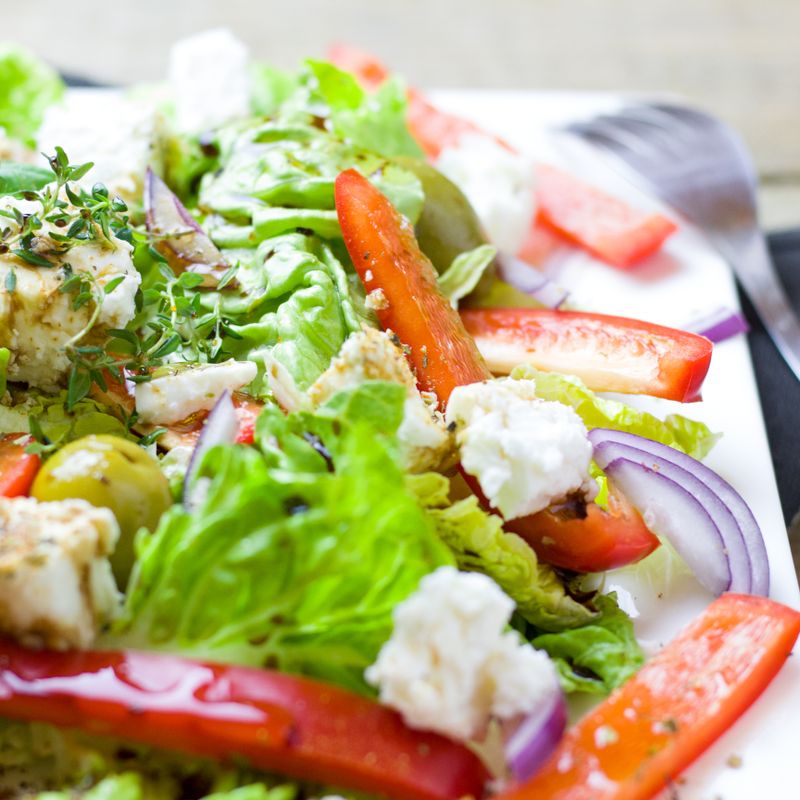
Sourdough Discard Roasted Vegetable and Feta Pockets
Crispy, golden hand pies filled with warm roasted vegetables, creamy feta cheese, and fresh herbs, made with sourdough discard for complex flavor and tender crumb. These pockets are perfect as a lunch, appetizer, or light dinner—satisfying enough to eat on their own, yet elegant enough to serve with a simple salad.
- Prep
- 35 min
- Cook
- 50 min
- Wait
- 1 hr 15 min
- Total
- 2 hr 40 min
- Makes
- 8 hand pies (2 per serving)
Steps
Before you start
- Bring sourdough discard to room temperature (about 1 hour if cold from the fridge)
- Preheat your oven to 425°F (220°C) for roasting vegetables
- Read through the filling instructions so you can have roasted vegetables ready before shaping
Roast the vegetablesOven 425°F / 220°C
- On a large rimmed baking sheet, toss the zucchini, red bell pepper, yellow squash, red onion, and minced garlic with 4 tablespoons (60 ml) olive oil, 1½ teaspoons (2 g) dried oregano, ¼ teaspoon red pepper flakes, and black pepper to taste.
- Spread in a single layer and roast at 425°F (220°C) for 25–30 minutes, stirring halfway through, until vegetables are tender and lightly caramelized at the edges.
- Remove from the oven, let cool slightly, then transfer to a bowl and set aside.
- You can do this step up to 1 day ahead.
+ Show details− Hide details
Ready when: Vegetables are soft and browned at the edges
Tip: Spread vegetables in one layer so they roast rather than steam; overcrowding will release moisture.
Make the dough
- In a large bowl, combine 1 cup (240 ml) sourdough discard, 0.75 cup (180 ml) lukewarm water, 1.5 teaspoons (9 g) kosher salt, and ½ teaspoon (2 g) sugar.
- Stir until combined.
- Add 2.5 cups (315 g) all-purpose flour and ½ cup (60 g) whole wheat flour, and mix with a wooden spoon or in a stand mixer until shaggy dough forms.
- Add 3 tablespoons (45 ml) olive oil and knead by hand for 5–7 minutes, or use the mixer on medium speed for 3–4 minutes, until the dough is smooth and elastic.
- The dough will be slightly sticky but should hold together.
+ Show details− Hide details
Ready when: Dough is smooth, elastic, and slightly sticky
Tip: Don't overwork the dough; it should be sticky enough to stick slightly to your fingers but should still form a cohesive ball.
First rise
- Place the dough in a lightly oiled bowl, turning to coat.
- Cover with a damp kitchen towel or plastic wrap and let rise at room temperature for 45 minutes to 1 hour, until the dough has increased by about 50 percent and is puffy.
+ Show details− Hide details
Ready when: Dough is noticeably puffy and soft to the touch
Tip: The dough won't double like commercial yeast dough; sourdough rises more gently. It should feel airy and increased in volume.
Prepare the filling
- If you roasted vegetables ahead, gently reheat them in the bowl or on the stovetop until warm.
- Fold in the 1¼ cups (200 g) crumbled feta cheese, ¼ cup (10 g) chopped fresh basil, and ¼ cup (12 g) chopped fresh parsley.
- Taste and adjust seasoning with black pepper if needed.
- Let cool to room temperature before assembling the pockets.
+ Show details− Hide details
Ready when: Filling is at room temperature and feta is evenly distributed
Tip: If the filling is too warm, it can cause the dough to become too soft and difficult to seal. Cool it completely before using.
Divide and shape the dough
- Lightly flour a work surface.
- Turn the risen dough out onto it and gently press into a rough rectangle.
- Divide into 8 equal pieces using a bench scraper or knife (each weighing about 3 oz / 85 g).
- Pat each piece into a flat disk about ¼ inch (6 mm) thick, gently stretching as needed without tearing the dough.
+ Show details− Hide details
Ready when: All 8 pieces are roughly even in size and thickness
Tip: Work gently to avoid developing tough pockets; handle the dough with a light touch. If it shrinks back, let it rest for a minute before stretching again.
Fill and seal the pockets
- Place about 2.5 tablespoons (40 g) of the filling on one half of each dough disk, leaving a ½-inch (1.25 cm) border.
- Fold the dough in half over the filling to form a half-moon.
- Press and seal the edges firmly with your fingers or the tines of a fork, pressing all the way around to create a tight seal.
+ Show details− Hide details
Ready when: All pockets are sealed with no gaps or openings
Tip: Don't overfill; excess filling will leak out during baking and prevent proper sealing. Press the seal firmly so the filling won't burst open.
Final proof
- Arrange the sealed pockets on a baking sheet lined with parchment paper, leaving about 1 inch (2.5 cm) between them.
- Brush the top of each pocket with beaten egg wash (1 egg beaten with 1 tablespoon water).
- If using sesame seeds, sprinkle them over the tops.
- Cover loosely with a damp kitchen towel and let rest at room temperature for 20–25 minutes, until slightly puffed.
+ Show details− Hide details
Ready when: Pockets are visibly puffy and feel light
Tip: Don't overproof; the pockets should look slightly risen but not dramatically puffy. They will continue to rise in the oven.
Bake the pocketsOven 400°F / 205°C
- Preheat the oven to 400°F (200°C).
- Bake the pockets for 20–25 minutes, until the tops are deep golden brown and crispy.
- Rotate the baking sheet halfway through for even browning.
- The internal temperature of the dough should reach about 200°F (93°C) when measured with an instant-read thermometer in the thickest part, though visual doneness (golden and crispy) is usually sufficient.
+ Show details− Hide details
Ready when: Tops are deep golden brown and crispy; dough feels firm to the touch
Tip: If the tops are browning too quickly but the inside still feels soft, tent with foil and lower the oven temperature to 375°F (190°C) for the remaining time.
Cool and serve
- Transfer the pockets to a wire rack and let cool for 5–10 minutes before serving.
- They are best enjoyed warm or at room temperature within a few hours of baking.
+ Show details− Hide details
Ready when: Pockets are cool enough to handle without burning
Tip: Pockets are hottest in the center; let them cool slightly so you don't burn your mouth on the steaming filling.
Good to know
Tips
- Room-temperature sourdough discard works best; cold discard will slow the rise. If yours is cold from the fridge, let it sit on the counter for 1 hour before making the dough.
- Don't skip the first rise; it develops flavor and creates a tender crumb. Sourdough dough rises more slowly than commercial yeast dough, so give it the full time even if it doesn't look dramatically bigger.
- For extra flavor, brush the warm pockets with a mixture of minced garlic, olive oil, and dried oregano after baking—this is optional but delicious.
- These pockets freeze beautifully unbaked. Shape and freeze them on a baking sheet, then transfer to a freezer bag and bake directly from frozen without thawing.
Make ahead
You can roast the vegetables up to 1 day ahead and store them covered in the refrigerator. The filling (with feta and herbs) can be assembled up to 4 hours ahead and kept cool. Assemble and bake the pockets the day you plan to serve them for best texture. Unbaked pockets can be frozen for up to 3 months; bake directly from frozen, adding 5–10 extra minutes to the baking time.
Storage & reheating
Room temperature: Keep in an airtight container for up to 1 day. Refrigerator: Store in an airtight container for up to 3 days; reheat gently in a 350°F (175°C) oven for 8–10 minutes. Freezer: Wrap baked pockets individually in plastic wrap and foil, or store in a freezer bag for up to 3 months. Thaw at room temperature for 1 hour or reheat from frozen in a 350°F (175°C) oven for 12–15 minutes.
Substitutions
- red bell pepper → orange or yellow bell pepper, or eggplant. Any roasted vegetable works; eggplant will need a few extra minutes of roasting to become fully tender.
- crumbled feta cheese → crumbled goat cheese or ricotta salata. Goat cheese will be slightly tangier; ricotta salata is drier and more crumbly. Both work beautifully.
- fresh basil leaves → fresh dill or mint. Dill gives an herbaceous, subtle flavor; mint adds brightness. Use the same amount by weight.
- whole wheat flour → all-purpose flour. You can use 3 cups (375 g) all-purpose flour instead of the mix. The pockets will be slightly lighter and less nutty in flavor.
More stuffed bites
See all →



Find more like this
- Meal
- Lunch
- Cuisine
- Mediterranean
- Diet
- VegetarianHalal
- Method
- Oven