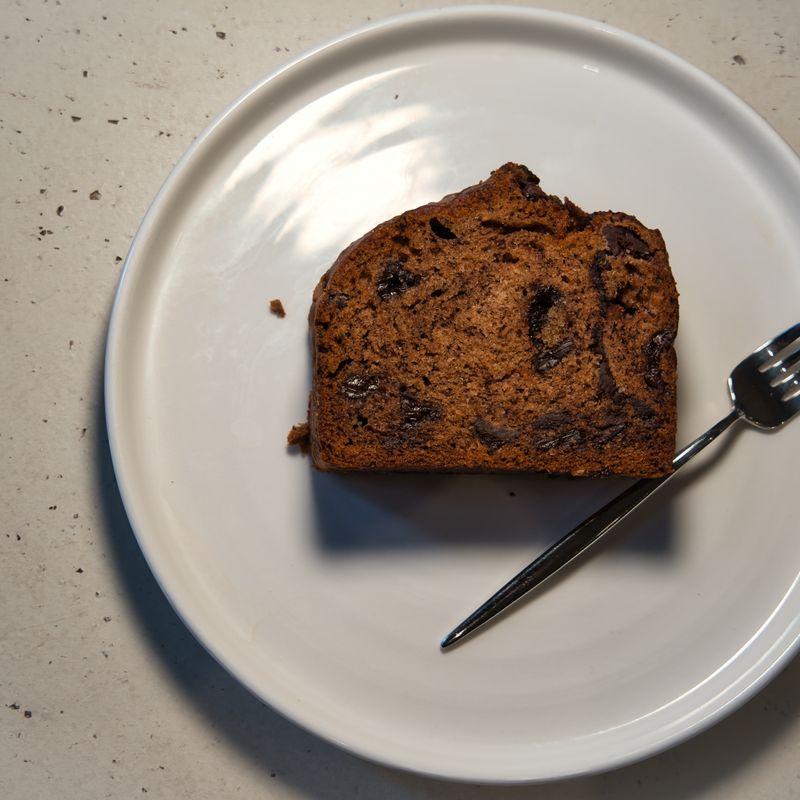
Sourdough Chocolate Chip Breakfast Loaf
A tender, slightly sweet sourdough loaf studded with chocolate chips, perfect for breakfast or brunch. The active sourdough starter creates a subtle tang that balances the chocolate and sugar, while eggs and butter produce a soft, cake-like crumb. This loaf has better keeping qualities than standard cakes and develops deeper flavor as it ages.
- Prep
- 20 min
- Cook
- 50 min
- Wait
- 2 hr
- Total
- 3 hr 10 min
- Makes
- 1 loaf (8–10 slices)
Steps
Before you start
- Feed your sourdough starter 4–6 hours before baking so it's bubbly and at peak activity
- Preheat the oven to 350°F (175°C) about 20 minutes before baking
- Have all ingredients at room temperature (68–72°F / 20–22°C) for even mixing
- Line or grease a 9×5-inch (23×13 cm) loaf pan
Combine wet ingredients
- In a large mixing bowl, whisk together the active sourdough starter (1 cup / 240 ml), eggs (2 large), and vanilla extract (1 tsp / 5 ml) until smooth and well blended.
- The mixture should be light and slightly frothy, taking about 1–2 minutes of whisking.
+ Show details− Hide details
Ready when: mixture is smooth and light
Tip: Whisking incorporates air, which helps the bread rise and creates a tender crumb.
Cream butter and sugar
- In a medium bowl, whisk together softened butter (6 tbsp / 85 g) and granulated sugar (0.5 cup / 100 g) until the mixture is pale, fluffy, and lighter in color, about 2 minutes of vigorous whisking.
- Do not use a mixer; hand-whisking gives you better control and prevents overworking the batter.
+ Show details− Hide details
Ready when: mixture is pale and fluffy, increased in volume
Tip: Proper creaming incorporates air pockets that give the loaf a light, airy texture. If butter is too cold, whisk harder; if too warm, chill it slightly.
Combine wet and dry components
- Add the butter-sugar mixture to the sourdough egg mixture and fold together gently with a rubber spatula until just combined, about 20 strokes.
- The batter will be slightly lumpy—do not overmix.
- Some streaks of butter and sugar are fine at this stage.
+ Show details− Hide details
Ready when: wet and dry elements are loosely combined with some streaks visible
Tip: Folding gently preserves the air you've incorporated and prevents gluten from overdeveloping, which would make the crumb dense.
Mix dry ingredients
- In a separate small bowl, whisk together bread flour (1.75 cups / 220 g), fine sea salt (1 tsp / 5 g), and baking soda (0.25 tsp / 1.25 g).
- Whisk for 30 seconds to evenly distribute the leavening.
+ Show details− Hide details
Ready when: dry ingredients are evenly combined with no visible streaks
Tip: Whisking the dry ingredients ensures the baking soda is evenly distributed so the loaf rises uniformly.
Fold in flour mixture
- Pour the dry ingredients over the wet mixture and fold gently with a rubber spatula until just combined.
- Stop as soon as you don't see dry flour streaks; the batter will be thick and slightly lumpy.
- Fold in semi-sweet chocolate chips (1.25 cups / 200 g) with a final 5–10 strokes until they are evenly distributed throughout.
+ Show details− Hide details
Ready when: no visible dry flour, chocolate chips distributed throughout
Tip: Overmixing develops gluten and toughens the crumb. Folding is the key to a tender, moist loaf. Mix just until you don't see flour streaks.
Transfer to loaf pan
- Pour the batter into a prepared 9×5-inch (23×13 cm) loaf pan that has been lightly oiled or lined with parchment paper.
- Use a rubber spatula to spread the batter evenly and smooth the top.
- Fill the pan about three-quarters full; this batter won't rise dramatically.
+ Show details− Hide details
Ready when: batter is level in the pan
Tip: If you fill the pan too full, the top will dome and crack. Leaving room prevents overflow in the oven.
First rise (optional but recommended)
- Let the batter rest at room temperature (68–72°F / 20–22°C) for 30 minutes.
- During this time, the sourdough starter will begin to activate the batter, adding flavor and helping it rise slightly in the oven.
- You should see the batter puff up a little and perhaps a few bubbles break through the surface.
+ Show details− Hide details
Ready when: batter has puffed slightly and shows small bubbles on the surface
Tip: Skipping this rest is fine if you're in a hurry, but 30 minutes deepens the sourdough flavor. On cool days, it may take up to 45 minutes for visible activity.
Bake the loafOven 350°F / 175°C
- Preheat the oven to 350°F (175°C) if you haven't already.
- Place the pan on the middle rack and bake for 48–52 minutes, until the top is golden brown and a toothpick or instant-read thermometer inserted into the center reads 200–205°F (93–96°C) and comes out clean or with only a few moist crumbs.
- The top should be deeply golden but not burnt; if it browns too quickly (after 35 minutes), loosely tent it with foil for the remaining time.
+ Show details− Hide details
Ready when: top is golden brown, internal temperature reads 200–205°F (93–96°C), toothpick comes out clean or with a few moist crumbs
Tip: Oven temperatures vary. If your loaf is browning too quickly, lower the rack or cover loosely with foil. If it's not browning at 45 minutes, the oven may run cool.
Cool in pan
- Remove the loaf from the oven and let it cool in the pan for 10 minutes.
- During this time, it will set enough to handle safely.
- You should hear gentle crackling sounds as it cools—this is normal and means the crust is forming.
+ Show details− Hide details
Ready when: loaf has set enough to turn out without breaking apart
Tip: Turning it out too early may cause it to crack. The 10-minute rest in the pan prevents this.
Turn out and finish cooling
- Run a thin knife around the inside edges of the pan to loosen the loaf, then invert it onto a wire cooling rack or clean kitchen towel.
- If using a towel, let the loaf cool for at least 1 hour before slicing, until it is completely cool to the touch.
- If you can't wait, allow at least 30 minutes, though the crumb will still be slightly warm and soft.
+ Show details− Hide details
Ready when: loaf is completely cool to the touch
Tip: Cooling on a rack rather than on the counter prevents the bottom from becoming soggy. Complete cooling ensures clean slices.
Good to know
Tips
- Ensure your sourdough starter is truly at peak activity—bubbly, doubled or nearly doubled in height, and with a pleasant sour smell. An inactive starter will not rise the loaf properly and may produce a dense crumb.
- Room temperature ingredients mix smoothly and incorporate air more readily than cold ones. Remove eggs and butter from the fridge 30–60 minutes ahead, or place eggs in warm water for 5 minutes.
- Do not use a stand mixer. Mixing by hand with a whisk or spatula gives you better control and prevents overworking the batter, which would toughen the loaf.
- If the top is browning too quickly, tent it loosely with foil. Every oven has hot spots, so check at 40 minutes and adjust as needed.
Make ahead
Prepare the batter up to step 6 (transfer to loaf pan) up to 12 hours ahead. Cover the unbaked loaf with plastic wrap and refrigerate overnight. In the morning, let it come to room temperature (about 1 hour) before proceeding with the rest and bake. Alternatively, skip the 30-minute rest and bake straight from the refrigerator, adding 5–8 minutes to the bake time.
Storage & reheating
Room temperature: Store in an airtight container or wrapped in plastic wrap for up to 3 days. The loaf stays moist and develops even better flavor on day 2. Refrigerator: Wrap tightly and refrigerate for up to 5 days; slice before storing to make portioning easy. Freezer: Wrap the cooled loaf tightly in plastic wrap and then foil, and freeze for up to 3 months. Thaw overnight in the refrigerator or at room temperature for 2–3 hours. To reheat, wrap in foil and warm in a 300°F (150°C) oven for 10 minutes, or toast individual slices.
Substitutions
- semi-sweet chocolate chips → chopped dark chocolate (60–70% cacao) or a mix of milk and dark chocolate. Chop chocolate into chip-sized pieces for even distribution. Dark chocolate adds depth; milk chocolate makes it sweeter. Adjust to your preference.
- bread flour → all-purpose flour. All-purpose flour produces a slightly less chewy crumb. Use the same weight (220 g) and expect a tender, more cake-like texture. Bread flour gives a bit more structure and chew.
- granulated sugar → light brown sugar. Brown sugar adds moisture and a subtle molasses flavor. Use the same amount by weight (100 g). The loaf will be slightly darker and softer.
- pure vanilla extract → almond extract or rum extract. Use 0.5–0.75 tsp of almond or rum extract (these are more potent) for a different flavor profile. Omit entirely for a more neutral taste that lets the chocolate shine.
More breakfast bakes
See all →



Find more like this
- Meal
- Breakfast
- Main ingredient
- Eggs
- Diet
- VegetarianHalal
- Method
- Oven