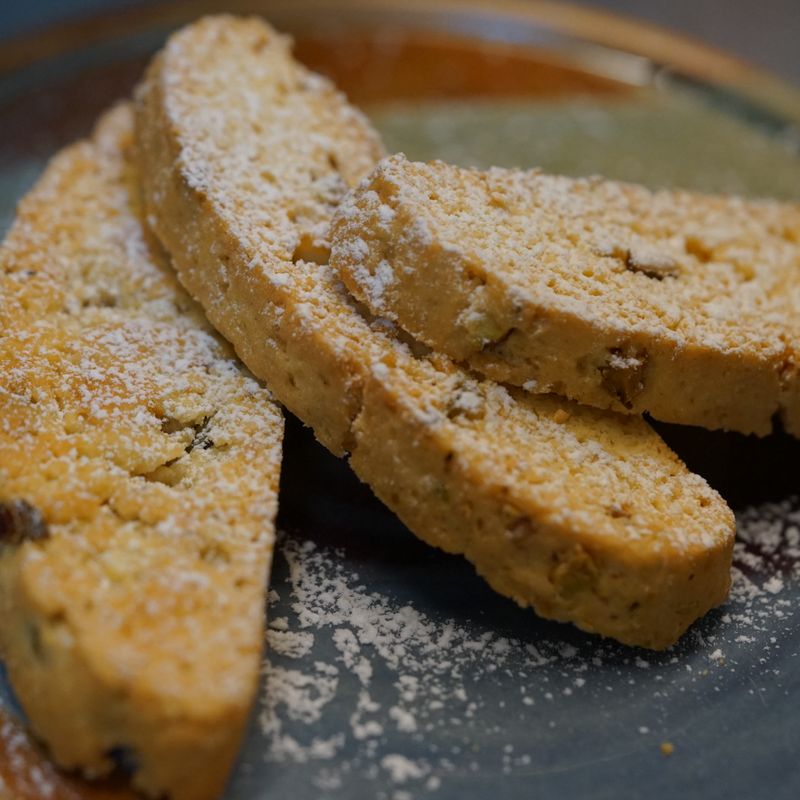
Sourdough Biscotti Twice-Baked Slices
Crispy, twice-baked Italian biscotti made with tangy sourdough starter and studded with toasted almonds. The slow double-bake creates a hard, shelf-stable cracker perfect for dunking in coffee, tea, or dessert wine. The sourdough starter adds complex flavor and a subtle sourness that balances the sweetness.
- Prep
- 25 min
- Cook
- 1 hr 5 min
- Wait
- 3 hr
- Total
- 4 hr 30 min
- Makes
- 24 biscotti slices
Steps
Before you start
- Use active, bubbly sourdough starter (fed 4–8 hours before, at room temperature)
- Preheat oven to 325°F (160°C) for the first bake
- Toast almonds first if using raw ones (350°F / 175°C for 8–10 minutes)
- Line two baking sheets with parchment paper
Mix dough
- In a stand mixer, combine the active sourdough starter (240 ml), bread flour (280 g), sugar (150 g), room-temperature eggs (100 g total), salt (4.5 g), vanilla extract (5 ml if using), and anise seeds (5 g if using).
- Using the paddle attachment, mix on low speed for 2 minutes until a shaggy dough forms.
- Switch to the dough hook and knead on medium speed for 5–6 minutes until the dough is smooth and elastic.
- If mixing by hand, combine all dry ingredients in a large bowl, make a well, add wet ingredients, and stir until shaggy; then knead on the counter for 8–10 minutes.
+ Show details− Hide details
Ready when: Dough is smooth, elastic, and comes together without being sticky.
Tip: The dough will be stiffer than sandwich bread dough; this is correct and helps hold the logs shape during baking.
Add almonds and rest
- Turn the dough onto a lightly floured surface and gently knead in the toasted almonds (180 g), working them evenly throughout.
- The dough will come together quickly once almonds are distributed.
- Place the dough in a clean bowl, cover with a damp kitchen towel, and let rest at room temperature for 30 minutes.
+ Show details− Hide details
Ready when: Dough is slightly puffed and visibly relaxed.
Tip: A 30-minute rest prevents the dough from shrinking when you shape the logs.
Shape into logs
- Divide the dough in half.
- On a parchment-lined baking sheet, gently shape each half into a log about 12 inches (30 cm) long and 2.5 inches (6 cm) wide, leaving 2 inches (5 cm) between them.
- The logs don't need to be perfectly uniform—rustic biscotti are charming with slight irregularities.
+ Show details− Hide details
Ready when: Two even logs, roughly rectangular, ready for the oven.
Tip: Dampen your hands slightly if the dough sticks; this prevents tearing and helps you shape smoothly.
First bake—cook throughOven 325°F / 165°C
- Bake the logs at 325°F (160°C) for 35–40 minutes, until they are light golden, set on the outside, and a skewer inserted in the center comes out clean.
- The logs should feel firm but not rock-hard yet.
- Remove from the oven and let cool on the baking sheet for 10 minutes so they are cool enough to handle but still warm for slicing.
+ Show details− Hide details
Ready when: Logs are light golden, firm to the touch, and a skewer comes out clean.
Tip: Rotate the baking sheet halfway through baking if your oven has hot spots; this ensures even browning on both sides.
Cool and slice logs
- Once the logs are cool enough to handle (about 10 minutes), transfer them to a cutting board.
- Using a sharp serrated bread knife and a gentle sawing motion, slice each log diagonally into ¾-inch (2 cm) thick slices.
- Work slowly and support the log with your other hand to prevent it from crumbling.
- You should yield about 24 slices total.
+ Show details− Hide details
Ready when: Slices are clean and uniform, without crumbling.
Tip: A serrated knife works best; a dull blade will crush the logs and squeeze out almonds. If the log has cooled too much and is hard to slice, warm it in a 275°F (135°C) oven for 2 minutes.
Arrange for second bake
- Stand each slice upright on two parchment-lined baking sheets, so they look like little tiles standing on their long edges.
- This exposes the maximum surface area to dry heat.
- They can touch lightly but shouldn't be crowded; ideally, they should not overlap.
+ Show details− Hide details
Ready when: All slices are standing upright and evenly spaced on the sheets.
Tip: Stand them on their cut faces so the tops are exposed; this helps them dry evenly and become crispy all over.
Second bake—dry and crispOven 300°F / 150°C
- Bake the standing slices at 300°F (150°C) for 20–25 minutes, rotating both baking sheets halfway through (at 12 minutes).
- The biscotti will continue to harden and will be completely crisp when cool.
- They should be an even, light to medium golden brown on both sides.
+ Show details− Hide details
Ready when: Slices are light to medium golden, completely hard when a cool one is snapped (not flexible).
Tip: Lower heat in the second bake prevents burning while allowing them to dry slowly and evenly. If any slices are browning faster, move them to a cooler part of the oven.
Cool completely
- Transfer the biscotti to cooling racks and let them rest at room temperature for at least 2 hours before storing.
- As they cool, they will harden further and become truly crisp.
- Do not cover them while cooling or they will soften from trapped steam.
+ Show details− Hide details
Ready when: Biscotti are completely cool, hard when snapped, and make a crisp sound.
Tip: Patience here is key: fully cooled biscotti will have a much better shelf life and superior crunch when dunked.
Good to know
Tips
- Sourdough starter varies in strength and hydration. If your dough is very sticky after mixing, add flour 1 tablespoon at a time. If it's too stiff to knead, add water 1 teaspoon at a time. The dough should be firm but not crumbly.
- Toast raw almonds before adding to the dough for better flavor. Roast at 350°F (175°C) for 8–10 minutes, stirring halfway, until fragrant and light golden.
- The double-bake method is what creates biscotti's signature hardness and shelf stability. Don't skip the second bake or lower the heat too much, or they will soften quickly.
- These are perfect for dunking in coffee, espresso, hot chocolate, or dessert wine. The sourdough tang pairs wonderfully with sweet beverages.
Make ahead
You can make the dough up to 1 day ahead: after the 30-minute rest, wrap it tightly and refrigerate. Shape, bake, slice, and finish the second bake before storing. Finished biscotti keep for 2 weeks, so you can bake them on the weekend for the week ahead.
Storage & reheating
Room temperature: Up to 3 weeks in an airtight container. They actually improve slightly as they continue to dry. Refrigerator: not necessary and will cause them to absorb moisture and soften. Freezer: Up to 3 months in a freezer bag; thaw at room temperature for 1 hour before serving. To refresh: warm in a 275°F (135°C) oven for 5 minutes if they soften slightly from humidity.
Substitutions
- raw or toasted almonds, whole or halved → Toasted hazelnuts, pistachios, or walnuts. Use the same weight and toast them the same way. Each nut brings its own flavor; hazelnuts are especially good with sourdough.
- anise seeds (optional, for traditional flavor) → Fennel seeds or omit entirely. Anise is traditional in Italian biscotti but not required. Fennel is milder. Without either, you have a plain almond version.
- bread flour → All-purpose flour. All-purpose works fine; bread flour gives slightly better structure and chew. Reduce all-purpose by 10 g (use 270 g) as it absorbs slightly less water.
- active sourdough starter, fed and bubbly → 1 cup (240 ml) buttermilk or sour cream plus ½ teaspoon instant yeast mixed into the flour. This replaces the sourdough's tang and leavening. The biscotti will be slightly less complex but still delicious.
More brownies & bars
See all →



Find more like this
- Meal
- Snack
- Method
- Oven
- Quick & Easy
- Make AheadFreezer Friendly