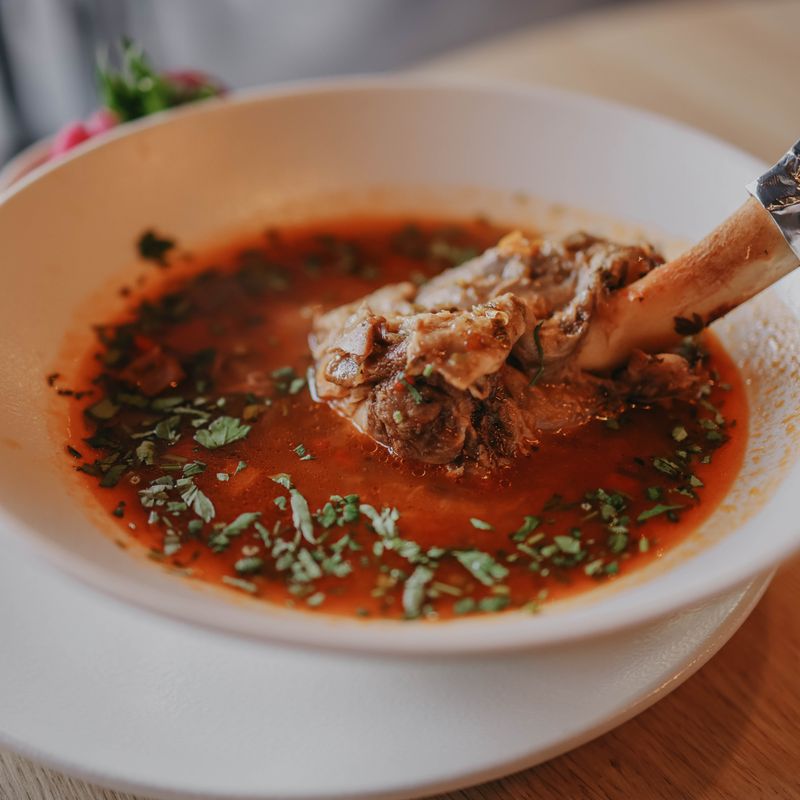
Slow Cooker Goat Bone Broth
A deeply savory and mineral-rich broth made from goat bones slow-cooked for 18 hours with Middle Eastern spices. The extended, gentle cooking extracts maximum collagen and gelatin, creating a silky, nourishing broth. Toasted coriander, cinnamon, and black pepper provide traditional warmth and depth. Sip it plain, use as a cooking base, or freeze in portions for later.
- Prep
- 15 min
- Cook
- 18 hr
- Total
- 18 hr 15 min
- Makes
- About 2 quarts (8 cups) broth
Steps
Before you start
- Source goat bones from a butcher—ask for a mix of knuckles, necks, and femurs for collagen and marrow.
- Rinse bones under cool water and remove any hair; pick off any visible meat scraps.
- Plan ahead: this broth requires 18 hours of unattended slow-cooker time (schedule it overnight or during a day off).
- Have clean storage containers or ice cube trays ready before you start.
Rinse and prepare bones
- Remove the goat bones from packaging and place them in a large colander.
- Rinse thoroughly under cool running water to remove any surface debris, particles, or hair.
- Pat dry with paper towels.
- Inspect each bone and trim away any visible meat scraps.
- Place the cleaned bones into the 6-quart slow cooker.
+ Show details− Hide details
Ready when: Bones are clean, patted dry, and arranged in the slow cooker
Tip: Rinsing removes impurities that cloud broth. If bones are frozen, thaw them first in the refrigerator overnight for easier handling.
Toast spices for depth
- Heat a small dry skillet over medium heat for 1 minute.
- Add the coriander seeds and black peppercorns together.
- Toast, shaking the pan occasionally, for 1–2 minutes until fragrant and lightly colored (not dark brown).
- Pour into a small bowl and set aside.
- Toasting brings out the essential oils in the spices and deepens their flavor.
+ Show details− Hide details
Ready when: Spices are fragrant and have turned slightly darker but are not blackened
Tip: Watch closely—spices burn quickly once they darken. Remove from heat immediately if the color becomes too deep.
Layer vegetables and seasonings
- Add the halved onions (with skin on—it adds color and minerals) and smashed garlic head to the slow cooker with the bones.
- Pour in the cold water; it should just cover the bones.
- Scatter in the toasted coriander seeds and peppercorns, the cinnamon stick, bay leaves if using, and ginger slices.
- Stir gently with a spoon to distribute the spices throughout.
+ Show details− Hide details
Ready when: All ingredients are submerged in water and spices are evenly distributed
Tip: Keep the onion skin on—it will not affect taste but will color the broth golden and add minerals.
Slow-cook the broth
- Cover the slow cooker and set to LOW heat.
- Cook for exactly 18 hours.
- The broth should reach a gentle simmer (small bubbles breaking at the surface)—never a rolling boil, which will cloud it.
- Do not stir or disturb the broth during cooking.
- After 18 hours, the broth will be deeply golden in color, aromatic, and rich.
- The bones will be very soft and beginning to fall apart.
+ Show details− Hide details
Ready when: Broth is deep golden in color, fragrant, and bones are very soft; test by inserting a fork—it should sink into bone easily
Tip: Low heat is essential for clarity and flavor extraction. Slow cookers vary slightly; if you see vigorous boiling in the last hours, reduce to the lowest setting available.
Strain through colander
- Carefully pour the contents of the slow cooker through a large colander set over a large pot, collecting the broth below.
- Let liquid drain naturally by gravity alone—do not press, squeeze, or stir the solids, as this will cloud the broth.
- Discard the bones, vegetables, and spices once fully drained.
- If you prefer extra-clear broth, line the colander with cheesecloth and strain the broth through it a second time.
- Allow the broth to cool at room temperature for about 30 minutes.
+ Show details− Hide details
Ready when: Broth is fully strained and dripping stops; liquid is clear to deep golden
Tip: Do not press the solids—impurities will cloud the broth. Let gravity do the work; rushing this step ruins clarity.
Season and prepare for storage
- Taste the cooled broth and season with sea salt to your preference—start with ½ teaspoon per cup and adjust.
- Stir well to dissolve the salt.
- The broth is now ready to use, chill, or freeze.
- If storing in the refrigerator, pour into airtight containers.
- When fully chilled (after 6–12 hours), rendered fat will solidify on the surface—you can skim and discard it for a leaner broth, or leave it as a protective layer.
+ Show details− Hide details
Ready when: Broth is seasoned to your taste
Tip: Salt at the end—if salted early, any reduction or further cooking will make the broth too salty. Taste and adjust conservatively.
Good to know
Tips
- Use a mix of marrow bones (femurs, leg) and connective-tissue bones (knuckles, necks, feet). Ask your butcher to cut large bones in half for more surface area and faster extraction. Feet and knuckles are especially high in collagen—if available, include one goat foot for a deeply gelatinous broth that gels when cold.
- Slow cookers vary in heating intensity. If the broth reaches a rolling boil or evaporates significantly by hour 12, lower the setting or reduce the initial water by ¼ cup and monitor in the second half of cooking. Gentle simmering, not boiling, is your goal.
- This broth is delicately savory and rich but milder than beef broth. Use it in soups, grain dishes, and delicate sauces, or sip it plain as a health tonic. Some cooks reduce the strained broth on the stovetop over medium heat for 30–45 minutes to concentrate flavor and yield a more intense 'demi-broth.'
- If your broth does not gel when chilled, it means the cooking time was too short or heat was too high. This broth is still delicious and nutritious—don't discard it. Gelatin content is higher with feet and knuckles, so include those for a gel-setting broth.
Make ahead
Yes, very much so. This recipe is ideal for make-ahead cooking. The broth stores beautifully in the refrigerator or freezer and can be made 2–3 days before use; flavors actually meld and improve slightly with a day of resting.
Storage & reheating
Room temperature: up to 4 hours (not recommended; refrigerate promptly for food safety). Refrigerator: 4–5 days in airtight glass or plastic containers; a fat layer will solidify on top (remove and discard, or leave for insulation and longer storage). Freezer: up to 6 months in freezer-safe containers or in ice cube trays (freeze cubes, then transfer to a labeled freezer bag). To reheat: thaw overnight in the refrigerator, then warm gently on the stovetop over medium-low heat until steaming, stirring occasionally. Alternatively, reheat in the microwave in 1-minute intervals, stirring between pulses, until hot.
Substitutions
- goat bones (necks, knuckles, and/or femurs, mixed) → Beef bones (knuckles, leg, or marrow bones). Use the same weight (3 lbs / 1360 g). Beef requires a similar 18-hour cook time and yields a richer, deeper broth.
- coriander seeds → Ground coriander (¾ teaspoon). Ground spices lack the toasting benefit and flavor slightly different when long-cooked. Add ground coriander in the final 2 hours of cooking, or stir in at the end, to preserve brightness.
- fresh ginger root → ¼ teaspoon ground ginger, or omit entirely. Fresh ginger provides brightness and slight heat. Ground ginger becomes bitter with very long cooking. If omitting ginger, add an extra bay leaf for herbaceous depth.
- cinnamon stick → ¼ teaspoon ground cinnamon added in final hour. Ground cinnamon becomes bitter if cooked for the full 18 hours, so add it late in cooking or after straining. The whole stick imparts warmth without bitterness.
More broths
See all →

Find more like this
- Meal
- Lunch
- Cuisine
- Middle Eastern
- Method
- Slow Cooker