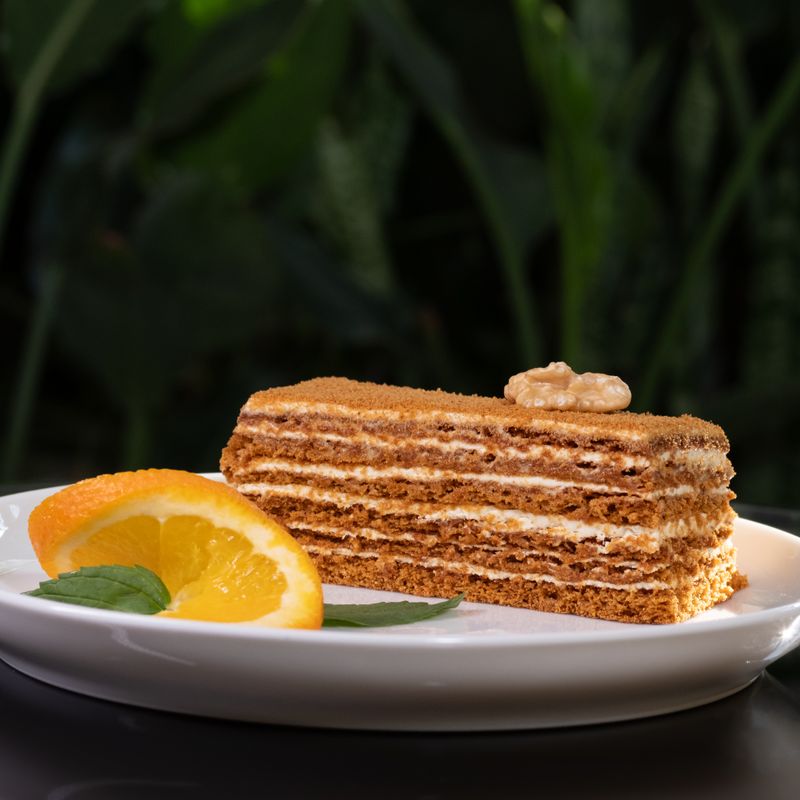
Slow Cooker Date and Walnut Cake with Burnt Orange Syrup
A moist, spiced date and walnut cake steamed in a slow cooker, finished with a caramelized burnt orange syrup that soaks into every crumb. The gentle heat of the slow cooker keeps the cake tender and deeply flavored, while the bitter-sweet orange syrup adds sophisticated contrast. A modern take on traditional Middle Eastern date cakes, designed for foolproof results.
- Prep
- 20 min
- Cook
- 3 hr
- Wait
- 30 min
- Total
- 3 hr 50 min
- Makes
- 1 cake (8 slices)
Steps
Before you start
- Line a 7-inch (18 cm) round cake pan or 6×4-inch (15×10 cm) loaf pan with parchment paper so it overhangs the sides
- Bring water to a boil (you'll need about 1 cup for the slow cooker water bath)
- Remove bitter white pith from orange halves with a small knife or vegetable peeler before charring
Plump the dates
- Place the chopped dates in a bowl and pour 0.75 cup (180 ml) of boiling water over them.
- Let sit for 10 minutes until the dates are soft and the water is absorbed or cooled.
- This step hydrates the dates and creates a naturally moist crumb.
+ Show details− Hide details
Ready when: Dates are very soft and plump, water is mostly absorbed
Tip: Don't skip this step; it keeps the cake moist without requiring extra oil.
Char the orange halves
- Heat a large dry skillet over medium-high heat.
- Place orange halves cut-side down and char for 4–5 minutes without moving them, until deeply caramelized and the flesh is blackened in spots.
- Remove and set aside.
- The char will mellow into a sophisticated bitterness in the syrup.
+ Show details− Hide details
Ready when: Flesh is blackened and caramelized, smells deeply roasted
Tip: Let the heat do the work; resist the urge to move the oranges or they won't char properly.
Mix dry ingredients
- In a medium bowl, whisk together 1.5 cups (190 g) flour, 1.5 teaspoons baking powder, 1 teaspoon cinnamon, 0.5 teaspoon cardamom, and 0.25 teaspoon salt.
- Set aside.
+ Show details− Hide details
Ready when: All ingredients are evenly distributed and no lumps remain
Cream butter and sugar
- In a large bowl, beat 0.5 cup (115 g) softened butter and 0.75 cup (165 g) brown sugar together with a whisk or electric mixer for 2–3 minutes until pale and fluffy.
- This aerates the batter, promoting a tender crumb.
+ Show details− Hide details
Ready when: Mixture is pale, fluffy, and noticeably lighter in color
Tip: Soft butter at room temperature creams faster and incorporates more air than cold butter.
Add eggs and vanilla
- Add 2 room-temperature eggs one at a time, beating well after each addition.
- Stir in 1 teaspoon vanilla extract.
- The mixture should look creamy and emulsified.
+ Show details− Hide details
Ready when: Mixture is smooth, creamy, and pale throughout
Tip: Adding eggs one at a time ensures proper emulsification; cold eggs can cause curdling.
Fold in dry ingredients and dates
- Add the dry ingredient mixture to the butter mixture in two additions, folding gently with a spatula until just combined.
- Gently fold in the softened date mixture (including any remaining liquid) and 1 cup (120 g) toasted walnuts until the batter is uniform.
- Do not overmix.
+ Show details− Hide details
Ready when: All dry ingredients are moistened and no visible streaks of flour remain
Tip: Fold, don't beat; overmixing develops gluten and makes the cake tough.
Pour batter and prepare slow cooker
- Pour the batter into your prepared 7-inch (18 cm) round or 6×4-inch (15×10 cm) loaf pan.
- Smooth the top.
- Pour 1 cup (240 ml) boiling water into the slow cooker insert.
- Carefully lower the cake pan into the water bath; the water should come halfway up the sides of the pan.
- Cover the slow cooker.
+ Show details− Hide details
Ready when: Pan is stable in the water bath and water level is correct
Tip: A water bath prevents the sides from cooking too fast and keeps the cake moist.
Steam the cake
- Cook on HIGH for 2.5 to 3 hours.
- The cake is done when a toothpick inserted in the center comes out with just a few moist crumbs (not wet batter), and the edges begin to pull slightly away from the pan.
- The slow cooker creates gentle, even heat that prevents drying.
+ Show details− Hide details
Ready when: Toothpick comes out with moist crumbs, edges pull from sides, top springs back gently
Tip: Slow cookers vary in heat; start checking at 2 hours 15 minutes, and account for elevation if you're at high altitude.
Rest the cake
- Remove the cake pan from the slow cooker and let rest on a wire rack for 10 minutes.
- This prevents structural collapse when you turn it out.
- The residual heat will continue to set the crumb.
+ Show details− Hide details
Ready when: Cake has shrunk slightly from the pan edges and feels firm
Tip: Don't rush this step; it helps the cake release cleanly from the pan.
Juice and extract orange essence
- Once the charred orange halves are cool enough to handle, squeeze them firmly over a fine-mesh strainer to extract all juice and pulp.
- Press the softened flesh with the back of a spoon.
- You should have about 0.75 cup (180 ml) of orange juice and pulp combined.
- Discard any seeds and skin.
+ Show details− Hide details
Ready when: Maximum juice and soft pulp have been extracted; only skin and seeds remain
Tip: Charred oranges are easier to squeeze after they cool. The char is essential to the syrup's depth.
Make the burnt orange syrup
- In a small saucepan, combine the orange juice and pulp with 0.5 cup (170 g) honey, 0.25 cup (60 ml) water, 2 tablespoons butter, and 3 whole cloves if using.
- Bring to a simmer over medium heat and cook uncovered for 8–10 minutes, stirring occasionally, until the mixture is syrupy and has reduced by about one-third.
- The syrup should coat the back of a spoon.
- Remove the cloves.
+ Show details− Hide details
Ready when: Syrup is thick and glossy, coats a spoon, has reduced by one-third
Tip: Don't let it boil hard or the syrup will become too thick; a gentle simmer gives better results.
Unmold and finish
- Turn the cooled cake out onto a serving platter by grasping the parchment overhang and gently releasing it.
- Peel away the parchment.
- While the cake is still warm, slowly pour or brush the burnt orange syrup over the top and sides, allowing it to soak in.
- Some syrup will pool; this is intentional.
- Let the cake cool completely before slicing.
+ Show details− Hide details
Ready when: Syrup is fully absorbed, cake has cooled, surface is glossy and moist
Tip: Applying syrup to a warm cake helps it absorb better; the parchment makes unmolding foolproof.
Good to know
Tips
- The slow cooker's gentle heat is forgiving; this cake is nearly impossible to overbake because there's no direct dry heat. That said, don't cook longer than 3.5 hours or the edges will toughen.
- For deeper burnt orange flavor, char the orange halves longer—aim for very blackened spots. The char mellows significantly once cooked and becomes a sophisticated bitter note, not an acrid one.
- If you don't have a cake pan that fits comfortably in your slow cooker, a loaf pan or even a soufflé dish works. Just check the water level so it comes halfway up the sides.
- This cake pairs beautifully with Greek yogurt, whipped cream, or crème fraîche. The tartness of dairy contrasts perfectly with the sweet, spiced cake and burnt orange syrup.
Make ahead
The cake can be baked up to 2 days ahead without the syrup. After the first day, wrap it tightly in plastic wrap or foil at room temperature. Make the syrup fresh on serving day and brush it over the cake 30 minutes before serving so it's still warm and glossy.
Storage & reheating
Room temperature (in an airtight container): 3 days. The cake actually improves on day 2–3 as the flavors meld and the crumb becomes even more moist. Refrigerator: 5 days, wrapped. The cold will firm it up slightly; warm individual slices in the microwave for 10–15 seconds before serving. Freezer: up to 3 months, unwrapped then wrapped in plastic and foil. Thaw at room temperature for 2 hours, then refresh with a light brush of fresh syrup if desired.
Substitutions
- walnuts, chopped → toasted almonds or pistachios. Use the same weight. Pistachios add a subtle green color and slightly different flavor that complements the burnt orange beautifully.
- Medjool dates, pitted → Deglet Noor dates or dried figs. Deglet Noors are less sweet and more subtle; figs create a slightly earthier cake. Chop finely and plump for the same amount of time.
- honey → maple syrup or light agave nectar. Use the same weight. Maple syrup adds woodsy notes; agave is more neutral. Both work well with the burnt orange.
- ground cardamom → ground ginger or a pinch of ground clove. Use 0.25 teaspoon ginger or 0.125 teaspoon clove. These spices add warmth and are traditional in Middle Eastern cakes, though they shift the flavor profile slightly.
More cakes
See all →



Find more like this
- Meal
- Dessert
- Cuisine
- Middle Eastern
- Main ingredient
- Dates
- Diet
- VegetarianHalal
- Method
- Slow Cooker