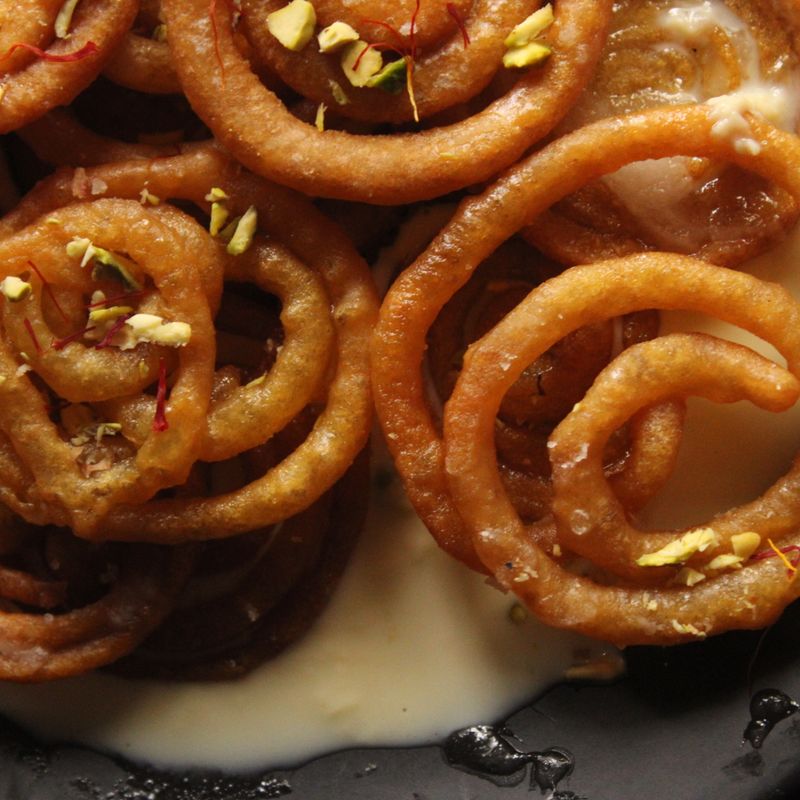
Sesame Jalebi in Saffron Rose Syrup
Crisp, lacy jalebi spirals made from a tangy yogurt-fermented batter flecked with toasted sesame, fried until pale gold and soaked briefly in a warm saffron, cardamom and rose water syrup. Crunchy at the edges, juicy in the center, and fragrant.
- Prep
- 30 min
- Cook
- 42 min
- Wait
- 8 hr 15 min
- Total
- 9 hr 27 min
- Makes
- About 24 jalebi (3-inch / 7.5 cm spirals), serving 6
Steps
Before you start
- Start the batter the evening before (or at least 8 hours ahead). It must ferment at warm room temperature, about 75-80°F (24-27°C).
- Set up a frying station before you heat the oil: a wire rack over a rimmed baking sheet, a slotted spatula, a thermometer, and the warm syrup in a shallow wide dish.
- Use a deep-fry or candy thermometer. Oil that is too cool makes greasy, limp jalebi; oil that is too hot browns them before the centers cook.
- Keep children and pets away from the stove. Hot oil and hot sugar syrup both cause serious burns.
Toast the sesame
- Place the 3 tablespoons sesame seeds in a small dry skillet over medium-low heat.
- Stir constantly for 3-4 minutes.
- Tip them onto a plate to cool completely.
+ Show details− Hide details
Ready when: Seeds smell nutty and turn light golden; a few may pop.
Tip: Move them to a plate right away. Seeds left in the hot pan keep cooking and turn bitter.
Mix the batter
- In a medium bowl whisk together the flour, cornstarch, yeast, ground cardamom, salt and 2 tablespoons of the cooled sesame seeds.
- Add the yogurt and warm water.
- Whisk vigorously for 2 minutes until completely smooth.
- Set the remaining 1 tablespoon sesame aside for garnish.
+ Show details− Hide details
Ready when: Batter is lump-free and thick, like pancake batter that falls from the whisk in a slow ribbon.
Tip: Whisking well develops just enough structure for the spirals to hold their shape in the oil.
Ferment the batter
- Cover the bowl and leave it somewhere warm, 75-80°F (24-27°C), for 8-12 hours or overnight.
+ Show details− Hide details
Ready when: Surface is dotted with small bubbles and the batter smells pleasantly sour and yeasty.
Tip: In a cool kitchen, put the covered bowl in the oven with only the light on.
Make the syrup
- In a 2-quart saucepan, combine the sugar, syrup water and crushed cardamom pods.
- Bring to a boil over medium heat, stirring until the sugar dissolves.
- Simmer without stirring for 8-10 minutes.
- Stir in the lemon juice.
- Remove from the heat and stir in the saffron and rose water.
- Let it steep 10 minutes, then remove the cardamom pods.
- Pour into a shallow dish and keep it warm.
+ Show details− Hide details
Ready when: Syrup reaches 215-220°F (102-104°C), or a drop pressed between thumb and finger forms a single sticky thread when you pull them apart.
Tip: The lemon juice stops the syrup from crystallizing. If the syrup thickens too much as it cools, warm it gently over low heat for a minute.
Fill the squeeze bottle
- Whisk the fermented batter briefly to deflate it.
- It should flow in a thick ribbon; if it holds a firm mound, whisk in 1-2 tablespoons warm water.
- Pour it into the squeeze bottle or piping bag fitted with a ⅛-inch (3 mm) opening.
+ Show details− Hide details
Ready when: Batter flows steadily from the bottle in a continuous, unbroken stream.
Tip: Too-thin batter makes flat, fragile jalebi that tear. Too-thick batter will not squeeze out smoothly.
Heat the oilOven 350°F / 175°C
- Pour the oil into the 10-inch skillet and heat over medium heat until it reaches 350°F (175°C).
- Adjust the heat to hold that temperature throughout frying.
+ Show details− Hide details
Ready when: A pea-sized drop of batter sizzles immediately and floats to the surface within 3 seconds.
Tip: Check the temperature between batches; it drops each time you add batter.
Pipe and fry first batch
- Hold the bottle close to the oil and pipe 3 or 4 spirals, each about 3 inches (7.5 cm) wide: start in the center and make 3 tight concentric circles, then finish with a quick zigzag line across to join them.
- Fry for about 1½ minutes, then flip with the slotted spatula and fry 1 minute more.
+ Show details− Hide details
Ready when: Both sides are pale golden and crisp, and the bubbling around them quiets down.
Tip: Don't fry them dark brown; they will taste bitter and turn hard after syrup soaking.
Soak in syrup
- Lift the spirals out of the oil, let excess oil drip off for 5 seconds, then place them in the warm syrup.
- Soak for 30 seconds per side, pressing gently so the syrup fills the hollows.
- Lift out onto the wire rack.
+ Show details− Hide details
Ready when: Jalebi look glossy and slightly translucent at the edges but are still crisp when tapped.
Tip: Longer soaking makes them soggy. The syrup should be warm, not boiling hot.
Fry the remaining batches
- Repeat piping, frying and soaking with the remaining batter, 3-4 spirals at a time, until you have about 24 jalebi.
- Stir the batter before refilling the bottle, and re-warm the syrup over low heat for a minute if it has thickened.
+ Show details− Hide details
Ready when: Each batch looks the same: pale gold, crisp, and glossy with syrup.
Tip: If the spirals darken fast, lower the heat and wait for the oil to fall back to 350°F (175°C) before the next batch.
Garnish and serve
- Sprinkle the jalebi with the reserved 1 tablespoon sesame seeds, plus the pistachios and rose petals if using.
- Let them rest on the rack for 5 minutes, then serve warm.
+ Show details− Hide details
Ready when: Surface is tacky but no longer drips syrup; edges are crisp.
Tip: Jalebi are best within an hour of frying, while the outside is still crisp.
Good to know
Tips
- Practice a spiral or two on a plate first so your hand is steady over the hot oil.
- Hot jalebi into warm syrup is the key: if both are cold, the syrup won't be absorbed properly; if the syrup is boiling, the jalebi go soft.
- Saffron blooms best when crumbled and steeped in warm syrup, not boiled.
- Fry one test spiral first. If it falls apart, thicken the batter with 1 tablespoon flour; if it is flat and dense, add 1 tablespoon warm water.
Make ahead
"The batter can ferment up to 12 hours at room temperature, or after 8 hours it can be refrigerated for up to 24 hours; bring it to room temperature for 30 minutes before frying. The syrup keeps covered in the fridge for up to 1 week; rewarm gently before dipping."
Storage & reheating
Best eaten the day they are made. Store cooled jalebi in a single layer in an airtight container at room temperature for up to 24 hours (they soften over time). Refrigerate for up to 3 days. Freezing is not recommended. To re-crisp, warm in a 350°F (175°C) oven for 5-7 minutes on a rack.
Substitutions
- rose water → orange blossom water. Use the same amount for a more citrusy floral flavor.
- plain whole-milk yogurt → plain unsweetened dairy-free yogurt. Fermentation works, but the batter may be slightly thinner; add a little less water.
- saffron threads → 1/8 teaspoon ground turmeric. Gives a similar golden color but not the aroma. Add it to the syrup with the rose water.
- neutral oil (such as sunflower or canola) → ghee mixed with oil (1 cup ghee + 2 cups oil). Adds a richer, traditional flavor; keep the temperature at 350°F (175°C).