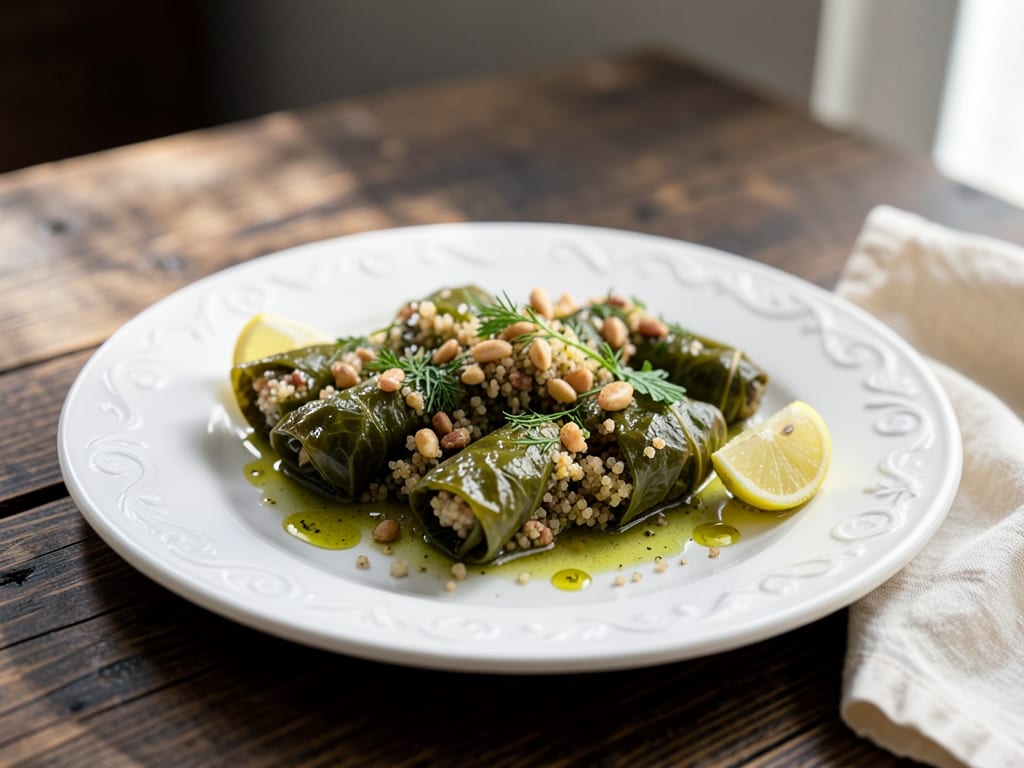
Quinoa Stuffed Grape Leaves with Dill, Lemon and Pine Nuts
A lighter, gluten-free take on Greek dolmades: tender brined grape leaves wrapped around a fragrant filling of quinoa, toasted pine nuts, dill, mint and lemon, then gently simmered in lemony olive oil broth. Serve warm or at room temperature.
- Prep
- 45 min
- Cook
- 58 min
- Wait
- 50 min
- Total
- 2 hr 33 min
- Makes
- About 32 stuffed grape leaves (8 appetizer servings of 4 each)
Steps
Before you start
- Buy a jar of brined grape leaves with at least 40 leaves. Brined leaves are salty, so the filling is seasoned lightly and the leaves are rinsed well.
- Quinoa is only partly cooked before rolling. It finishes cooking inside the leaves, which keeps the filling tender instead of mushy.
- Pick a heavy 10-inch (26 cm) pot with a lid and a heatproof plate that is slightly smaller than the pot opening to weigh the rolls down.
- Read the rolling instructions first. Roll loosely, because quinoa swells as it finishes cooking.
Soak the leaves
- Unroll the grape leaves and place them in a large heatproof bowl.
- Pour over 6 cups (1.4 L) of boiling water and let them soak for 10 minutes to remove excess brine.
- Drain, then rinse each leaf under cold water and drain again in a sieve.
- Set aside the 8 most torn or small leaves for lining the pot.
- Keep the 32 best leaves for rolling.
- Trim off any hard stem at the base of each leaf with a knife.
+ Show details− Hide details
Ready when: Leaves are pliable and bend without cracking, and taste only mildly salty
Tip: Taste a corner of one leaf. If it is still very salty, soak for another 5 minutes in fresh hot water.
Toast the pine nuts
- Heat a dry 10-inch (26 cm) skillet over medium-low heat.
- Add the pine nuts and toast, stirring often, for 3 to 4 minutes.
- Tip them onto a plate right away.
+ Show details− Hide details
Ready when: Pine nuts are golden brown and smell nutty
Tip: Pine nuts go from golden to burnt in seconds, so do not walk away.
Sauté onion and garlic
- In the same skillet, warm the 3 tablespoons (45 ml) filling olive oil over medium heat.
- Add the diced onion and ½ teaspoon of the salt.
- Cook, stirring often, for 6 to 7 minutes.
- Stir in the garlic and cook for 30 seconds.
- Remove from the heat.
+ Show details− Hide details
Ready when: Onion is soft, translucent and just starting to turn pale gold; garlic smells fragrant but is not browned
Partly cook the quinoa
- Combine the rinsed quinoa and 1 cup (240 ml) water in a 2-quart (2 L) saucepan.
- Bring to a boil over high heat, then reduce to low, cover and simmer for 8 minutes.
- Remove from the heat and keep covered for 5 minutes.
- The quinoa will be slightly firm in the center, which is intended because it finishes cooking inside the leaves.
+ Show details− Hide details
Ready when: All water is absorbed, grains are plump with a firm bite and a tiny white ring beginning to show
Tip: Do not fully cook the quinoa or the rolls will turn mushy.
Mix and cool the filling
- Fluff the quinoa with a fork and tip it into a large bowl.
- Add the onion mixture, toasted pine nuts, dill, mint, parsley, currants (if using), lemon zest, the 2 tablespoons (30 ml) lemon juice, the remaining ¼ teaspoon salt, pepper and allspice.
- Stir until evenly combined.
- Let the filling cool for 15 minutes so it is easy to handle and does not wilt the herbs.
+ Show details− Hide details
Ready when: Filling is just warm to the touch, bright green with herbs, and holds together when pressed
Tip: Taste a spoonful. It should taste bright and lemony, as the brined leaves add more salt.
Line the pot
- Spread the 8 reserved leaves in a single layer over the bottom of the heavy 10-inch (26 cm) pot, overlapping them slightly and letting a few climb up the sides.
- This keeps the rolls from scorching.
+ Show details− Hide details
Ready when: Bottom of the pot is fully covered
Roll the dolmades
- Lay one leaf shiny-side down on the board with the stem end toward you.
- Place a heaped tablespoon (about 15 g) of filling just above the stem end, near the center.
- Fold the bottom of the leaf up over the filling, fold in both sides, then roll up firmly but loosely, like a small burrito, about 2½ inches (6 cm) long.
- Roll all 32 leaves, using up the filling evenly.
- If a leaf is small, overlap two leaves.
+ Show details− Hide details
Ready when: Each roll is a neat, snug cylinder about the size of a finger with seam side down
Tip: Roll loosely. Quinoa swells as it finishes cooking, and tight rolls can burst.
Pack the pot
- Arrange the rolls seam-side down in the lined pot, packed snugly side by side in a tight circle or rows.
- Stack a second layer on top in the opposite direction.
- Pack them tightly so they cannot unroll while cooking.
+ Show details− Hide details
Ready when: Rolls are tightly packed with no gaps and the seams are all facing down
Add liquid and simmer
- Whisk the hot water or broth with the 3 tablespoons (45 ml) lemon juice and 2 tablespoons (30 ml) olive oil, and pour it evenly over the rolls.
- It should come about two-thirds of the way up the rolls.
- Set the heatproof plate upside down directly on top of the rolls to weigh them down.
- Cover with the lid and bring to a gentle simmer over medium heat, then reduce to low.
- Simmer for 40 minutes without lifting the lid.
+ Show details− Hide details
Ready when: Most of the liquid is absorbed, only a few tablespoons remain in the pot, and a leaf is tender when you cut into a roll; the quinoa is fully cooked and fluffy
Tip: Keep the heat low. A hard boil will cause the rolls to bump around and split.
Rest in the pot
- Turn off the heat and leave the pot covered, with the plate still in place, for 20 minutes.
- The rolls firm up and finish absorbing the remaining liquid.
- Lift out one roll to test it.
- If the leaf still feels tough, add ¼ cup (60 ml) hot water and simmer covered for 10 more minutes.
+ Show details− Hide details
Ready when: Rolls are plump and tender, holding their shape when lifted
Tip: Resist moving them while hot. They are delicate until they have rested.
Serve
- Using a spoon, carefully lift the rolls onto a platter, seam side down.
- Drizzle with 1 tablespoon (15 ml) olive oil and squeeze a little lemon over them.
- Serve warm or at room temperature with the lemon wedges.
+ Show details− Hide details
Tip: These taste even better after 1 hour at room temperature, when the flavors meld.
Good to know
Tips
- Rinse the quinoa well. Its natural coating, saponin, tastes bitter and soapy.
- Use a plate that fits inside the pot just above the rolls. This weight keeps them from floating and unrolling.
- Leaves vary in size. Trim very large leaves to about 6 inches (15 cm) and use less filling in small ones.
- Squeeze lemon over the finished rolls just before serving for the brightest flavor.
Make ahead
"Make the dolmades up to 2 days ahead. Cool completely in the pot, then transfer to an airtight container, drizzle with a little olive oil and refrigerate. Bring to room temperature for 30 minutes before serving, or warm gently."
Storage & reheating
Room temperature: up to 2 hours. Refrigerator: in an airtight container for up to 4 days. Freezer: freeze in a single layer, then bag, for up to 2 months; thaw overnight in the fridge. Reheat covered in a 300°F (150°C) oven or in a skillet with 2 tablespoons of water over low heat for 8 to 10 minutes, or serve chilled.
Substitutions
- pine nuts → toasted slivered almonds or chopped pistachios. Gives a similar crunch at lower cost; chop to pine-nut size.
- brined grape leaves → blanched Swiss chard or collard green leaves, stems removed. Blanch 1 minute and trim thick ribs; use for a fresher, more neutral wrapper.
- dried currants → finely chopped raisins or dried cranberries. Gives the same touch of sweetness; skip entirely for a fully savory filling.
- fresh mint leaves → additional fresh parsley. Use 2 tablespoons extra parsley; the filling will be less cooling but still fresh.